
What’s included in a custom flatware manufacturing service?
You have a unique design for a new flatware line but feel overwhelmed by the manufacturing process. You fear your vision will be lost in technical jargon and factory limitations.
A custom flatware manufacturing service includes everything from design consultation and material selection to tooling creation, mass production, polishing, and bespoke packaging. It’s a complete process to bring your unique design from a sketch to a finished product.

I’ve guided countless clients, from startup brands to established chains that buyers like Jacky represent, through this exact journey. The idea of creating your own flatware can seem complex, but a good manufacturing partner breaks it down into clear, manageable steps. It's about turning your creative idea into a physical, high-quality product that you can be proud of. Let's walk through what a truly comprehensive service looks like, answering the key questions you'll have along the way.
What does flatware include?
You're designing a set, but "flatware" and "cutlery" are used interchangeably. You're unsure what pieces are standard, making it hard to plan a complete, marketable collection.
"Flatware" typically refers to all table implements for eating and serving, including forks, spoons, and knives. A standard set is built around a 5-piece place setting but can be expanded with many specialized pieces.

In the industry, we use a few terms people can find confusing. "Silverware" is an old term, often for silver-plated items. "Cutlery" technically refers to cutting instruments like knives. "Flatware" has become the common industry term for the whole family of forks, spoons, and knives. A custom manufacturing service gives you the power to create a collection that perfectly fits your brand's vision.
The Building Blocks of a Collection
You can decide exactly what goes into your set. Do you want a simple, minimalist offering or a comprehensive collection for formal dining? It all starts with the core pieces.
| Category | Example Pieces |
|---|---|
| Core Place Setting | Dinner Fork, Salad Fork, Dinner Knife, Soup Spoon, Teaspoon |
| Formal Additions | Steak Knife, Fish Fork & Knife, Dessert Fork & Spoon, Oyster Fork |
| Serving Utensils | Serving Spoon, Slotted Spoon, Meat Fork, Gravy Ladle, Pie Server |
A custom service allows a brand to pick and choose. You might start with a 20-piece set (a service for four using the core 5 pieces). Or you could create a 77-piece luxury set that includes a full service for twelve plus a hostess set. The choice is entirely yours.
How to tell quality flatware?
You hold two forks that look similar, but one costs five times more. You can't see the difference, leaving you vulnerable to overpaying for inferior products.
Look for weight, balance, finish, and details. Quality flatware feels substantial, is balanced in the hand, has smooth edges, and features a deep, flawless polish, especially between the tines of the forks.
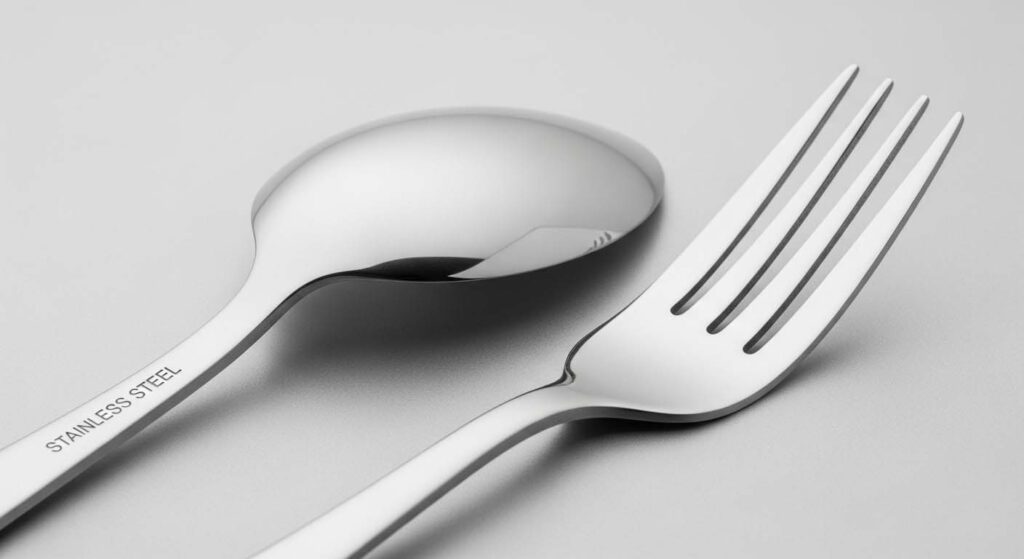
When an experienced buyer like Jacky visits my factory, he doesn't just glance at the pieces. He picks them up and he inspects them closely. He knows exactly what to look for, and these are the same details you should examine to judge quality for yourself.
1. Weight and Balance
The first sign of quality is the weight. A good piece is made from a thicker gauge of steel and feels solid and substantial in your hand. It shouldn't feel flimsy or like it would bend easily under pressure. This is the difference between stamped flatware (cut from a sheet of metal) and forged flatware1 (shaped from a heated metal billet), which is much stronger. Beyond weight, it must feel balanced. It should rest comfortably in your hand, not feel top-heavy or awkward.
2. The Finish and Edges
The finish is more than just a simple shine. Run your finger along the edges of the spoon and the handle. On a quality piece, every edge will be perfectly smooth and rounded. On a cheap piece, you might feel sharp or rough spots. The true test is the space between the fork tines. On low-quality flatware, this area is often rough and poorly polished. A premium piece will be just as smooth and flawless there as on any other surface. This level of detail requires more time and skilled labor.
What is a good grade of flatware?
You see numbers like 18/10, 18/8, and 18/0. These codes are confusing, and you don't know which one offers the best combination of durability, shine, and value for your brand.
18/10 stainless steel is the highest grade for flatware. The "18" refers to 18% chromium for rust resistance, and the "10" refers to 10% nickel for a superior shine and added durability.
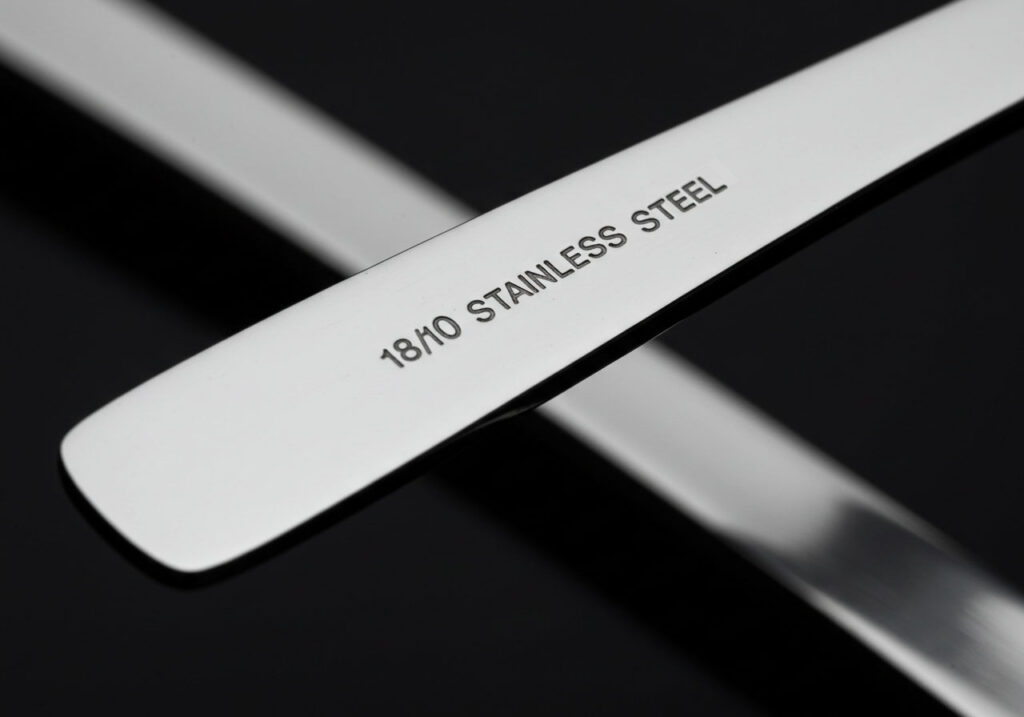
The first and most important decision in custom manufacturing is selecting your material. This choice will define the look, feel, and longevity of your product. The numbers simply represent the percentages of chromium and nickel in the stainless steel alloy, and they make a huge difference.
As a manufacturer, I work with all grades, but I guide my clients based on their goals for quality and brand positioning. For any brand that wants to be seen as premium, the choice is clear.
| Grade | Composition | Key Features | Best For |
|---|---|---|---|
| 18/10 | 18% Chromium, 10% Nickel | Best rust resistance, brightest shine, most durable. | High-end retail, luxury hotels, fine dining. |
| 18/8 | 18% Chromium, 8% Nickel | Very good quality, slightly less luster than 18/10. | Quality retail, casual dining restaurants. |
| 18/0 | 18% Chromium, 0% Nickel | Good rust resistance, lacks a silvery lustre. Magnetic. | Budget lines, cafeterias, high-volume use. |
The chromium2 provides hardness and rust resistance. The nickel3 is the magic ingredient for luxury flatware. It adds that beautiful, warm, silver-like luster and significantly boosts corrosion resistance, protecting the flatware from acidic foods. While 18/0 is very durable, it can look dull over time. For a custom brand investing in its reputation, 18/10 stainless steel is the professional standard.
Is nickel in stainless steel bad for you?
You hear that 18/10 stainless steel contains nickel. You worry that this metal could be harmful, making you hesitant to choose the best quality material for your customers.
For the vast majority of people, nickel in 18/10 stainless steel is completely safe. The nickel is tightly bonded within the steel alloy and does not leach into food in any significant amount under normal circumstances.

This is a question I get from time to time, and it's an important one to address. The safety of our products is our number one priority. The fear comes from a misunderstanding of how stainless steel is made and how it behaves.
Stainless steel is a stable alloy. That means the different metals—iron, chromium, and nickel—are melted down and locked together in a very strong, solid structure. The nickel isn't a coating that can peel or flake off into your food. It is an integral part of the steel itself. For decades, 18/10 has been the global standard for high-quality food equipment, used in millions of homes and professional kitchens without any issue.
The Topic of Nickel Allergies
It is true that a very small portion of the population has a severe contact allergy to nickel. For these highly sensitive individuals, theory suggests that prolonged contact could cause a reaction, although it is extremely rare from flatware use alone. For this specific consumer group, 18/0 (which is nickel-free) flatware is an excellent and safe alternative. However, for well over 99% of the population, the nickel in 18/10 flatware is inert and poses no health risk whatsoever.
Conclusion
A custom service transforms your vision into a quality product by managing design, material choice like 18/10 steel, skilled production, and finishing, ensuring every detail is perfect.
-
Explore this link to understand the benefits of forged flatware, including its strength and durability compared to stamped options. ↩
-
Explore this link to understand how chromium enhances durability and rust resistance in stainless steel, crucial for quality flatware. ↩
-
Explore this link to understand how nickel enhances the quality and durability of stainless steel flatware. ↩