
What You Need to Know About Etching Logos on Stainless Steel Cutlery?
Sourcing branded flatware is a challenge when standard printing methods just don't last, chipping and fading with use. This reflects poorly on your brand, whether you're a hotel, restaurant, or private label. For a truly professional and permanent solution, etching logos on stainless steel cutlery provides a premium finish that elevates your product and protects your brand's image.
Etching on stainless steel cutlery is a chemical process that permanently marks the metal's surface with a logo, text, or pattern. Unlike printing, which applies a layer of ink, etching alters the surface of the steel itself, creating a durable, high-end, and textured mark that will not peel or flake off over time.
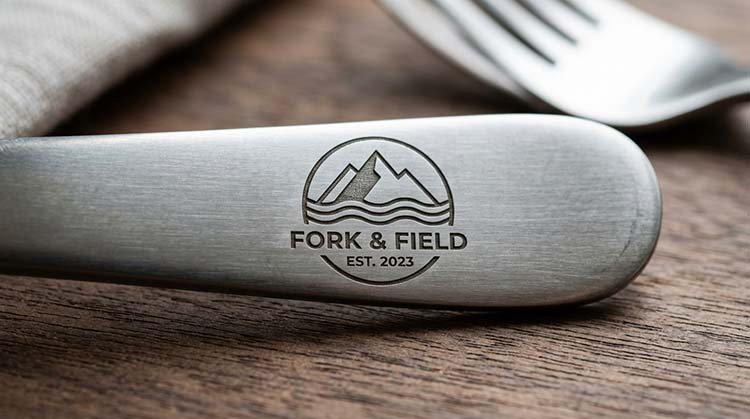
Now that you understand the basic concept, the real questions for a B2B buyer begin. How does it work? What affects the final look? And most importantly, how do you ensure consistency across an order of 50,000 pieces? Let's dive into the details you need to manage your next custom cutlery project successfully.
How Does Etching Compare to Other Branding Methods?
Choosing a branding method for your cutlery can feel overwhelming. You see terms like etching, laser engraving, and pad printing, but it's hard to know which is right for your project, budget, and desired quality.
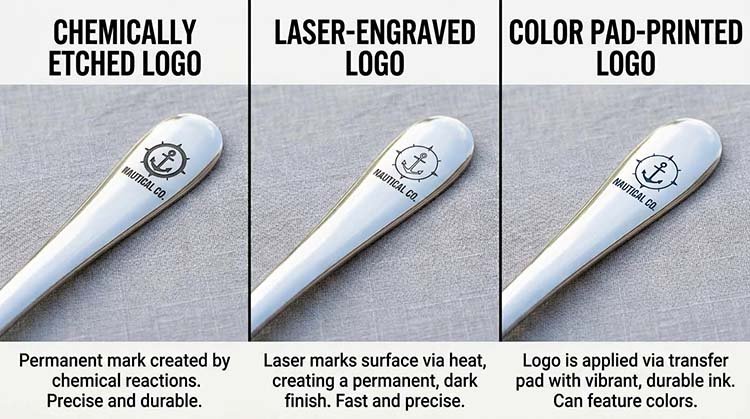
Etching is a chemical process that creates a permanent, textured mark in the metal itself. In contrast, laser engraving uses a focused beam of heat to vaporize or alter the surface, while pad printing applies a layer of ink. The best choice depends entirely on your logo's complexity, the desired finish, and your order volume.
The Etching Process Explained
Understanding the manufacturing steps helps you appreciate why certain details matter so much for quality control. While specifics can vary between factories, the core process for etching logos on stainless steel cutlery involves several key stages:
- Artwork Preparation: Your digital logo file (e.g., an AI or EPS vector file) is converted into a production-ready format.
- Surface Cleaning: The cutlery pieces are thoroughly cleaned and degreased to ensure the chemical etchant can react evenly with the steel.
- Masking: A resistant material, or "mask," is applied to the stainless steel surface, leaving only the logo area exposed.
- Chemical Etching: The cutlery is subjected to an acid or electrolytic solution. This etchant reacts with the exposed steel, removing a microscopic layer of metal to create the logo's impression.
- Neutralization and Cleaning: The pieces are rinsed and neutralized to stop the chemical reaction, then cleaned again to remove any residue from the mask and etchant.
- Post-Treatment: Depending on the desired finish, the cutlery might undergo additional polishing or finishing.
- Final Inspection: Each piece is inspected for clarity, position, and consistency.
The final result depends heavily on the stainless steel grade, the surface finish, the depth of the etch, and the precise control of these process parameters.
Etching vs. Laser Engraving
Many buyers ask me about the difference between etching and laser engraving. Both create permanent marks, but they achieve it differently and produce distinct results.
| Feature | Chemical Etching | Laser Engraving |
|---|---|---|
| Principle | Chemical reaction removes metal | Focused laser beam alters/vaporizes metal |
| Logo Effect | Subtle, textured, metallic feel | Very fine, sharp, clean lines |
| Best For | Logos, text, and simple patterns | Logos, text, and highly detailed graphics |
| Surface Adaptability | Process must be tuned to the surface finish | Highly adaptable to various finishes |
| Customization | More economical for consistent bulk runs | Flexible for small batches or variable data |
| Cost Structure | Linked to tooling (masks) and quantity | Linked to machine time and quantity |
Neither method is inherently "better." Etching is often preferred by brands seeking a classic, integrated feel where the logo becomes part of the cutlery's texture. Laser engraving is excellent for projects requiring extreme precision or the flexibility to change logos frequently between small batches.
Etching vs. Pad Printing
If your logo requires specific colors, etching is not the right choice. Pad printing is the go-to method for applying colored logos.
- Pad Printing1 uses a silicone pad to transfer ink from an etched plate onto the cutlery. It's ideal for achieving specific Pantone colors, including black, red, or even multi-color designs. The logo is a layer on top of the steel.
- Etching is purely a metallic effect. The "color" of the logo is determined by the way light reflects off the altered steel surface. It's perfect for brands that want a subtle, tone-on-tone contrast that feels integral to the product.
If your brand identity absolutely requires a colored logo, you should explore pad printing or screen printing. If you want a durable, premium mark that showcases the quality of the stainless steel itself, etching is the superior choice.
What Key Factors Affect the Appearance of an Etched Logo?
You've sent your manufacturer a perfect vector logo file, but the physical sample you receive looks... different. Why doesn't the etched logo perfectly match your digital design?
The final appearance of an etched logo is determined by a combination of physical factors, including the stainless steel grade, the product's surface finish, and the logo's placement on the cutlery piece. These variables can dramatically change the contrast, clarity, and overall aesthetic.
How Stainless Steel Grade Affects Etching
Not all "stainless steel" is the same. The specific alloy composition affects how the metal reacts to the chemical etching process. Common grades used in cutlery include:
- 18/10 (304) Stainless Steel: A high-quality standard for flatware, known for its excellent corrosion resistance. It typically produces very clean and consistent etching results.
- 18/0 (430) Stainless Steel: A ferritic stainless steel that contains nickel. It's magnetic and very durable, but its surface may react slightly differently to etchants compared to 304 steel.
- 13/0 (410/420) Stainless Steel: Often used for knives due to its hardness, which allows it to hold a sharp edge. The properties that make it good for blades mean it requires specific parameters for optimal etching.
When placing an order, simply specifying "stainless steel" is not enough. You must confirm the exact grade (e.g., 304) with your supplier. If you have your own product specifications, ensure the material is confirmed before any sampling for etching logos on stainless steel cutlery begins.
The Impact of Surface Finish
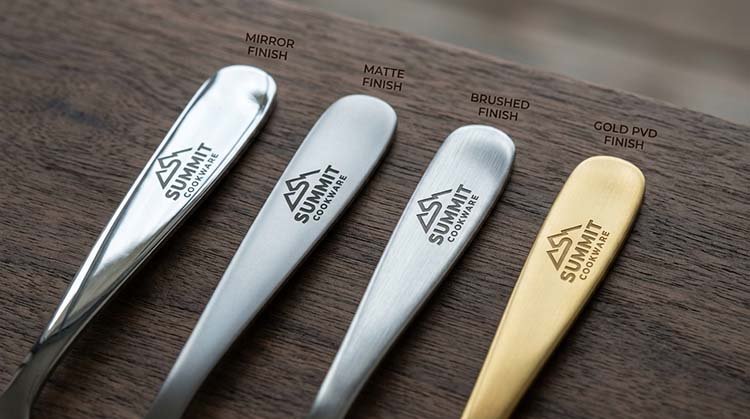
The original finish of the flatware is one of the biggest factors influencing the final look of an etched logo. The contrast and visibility of your logo will change dramatically based on the finish.
- Mirror Finish: On a highly polished, reflective surface, an etched logo often appears as a frosted or matte area. This creates a subtle, elegant contrast.
- Matte / Satin Finish: On a non-reflective matte surface, the etched logo may appear slightly darker or have a different texture, providing a tone-on-tone effect.
- Brushed Finish: A brushed finish has fine directional lines. An etched logo will interrupt this pattern, and its appearance can change depending on the viewing angle and the direction of the brushing.
- PVD Coating: Physical Vapor Deposition (PVD) applies a thin ceramic coating to the steel, creating finishes like gold, black, or rose gold. Etching is typically done before the PVD process. The PVD coating will then apply evenly over the base metal and the etched logo, creating a very subtle, textural difference.
Because of these variables, you can never approve an etched logo based on a digital mockup on a white background. You must see it on a physical sample with the correct material and finish.
Strategic Logo Placement
Where you place the logo is just as important as what it looks like.
- Common Locations: The most common and effective places are flat, or mostly flat, areas like the front or back of the handle on forks and spoons, and on the knife blade or handle.
- Curved Surfaces: Etching on a highly curved handle is possible, but it requires careful consideration. The logo might appear visually distorted if not designed and placed correctly. A smaller logo or one designed to follow the curve may be necessary.
In my experience at XR Cutlery, we often advise clients on the optimal size and position for their logo to ensure the best visual result and production consistency, especially on complex handle shapes.
How Can You Ensure Quality When Etching Logos on Stainless Steel Cutlery?
The first 100 samples look perfect, but what about piece number 10,000 or 100,000? For wholesale and private label brands, inconsistency across a large order is a costly nightmare that can lead to rejected shipments and brand damage.
To ensure quality when etching logos on stainless steel cutlery in bulk, you must proactively identify common production problems and enforce a strict, non-negotiable physical sample approval process before authorizing mass production. This is the only way to guarantee consistency at scale.
Common Problems to Watch For
For OEM/ODM orders, the real challenge isn't just creating one perfect piece; it's creating hundreds of thousands of identical pieces. Here are the most common issues that B2B buyers should look for during quality control inspections:
- Logo Position Deviation: The logo is not in the exact same spot on every piece. This is especially noticeable when cutlery is stacked or placed side-by-side in a gift box.
- Uneven Etching Depth: Some parts of the logo are deeper or lighter than others, creating an inconsistent and unprofessional look.
- Blurred or Incomplete Details: Fine lines or small text within the logo may be fuzzy, broken, or missing entirely.
- Inconsistent Appearance: Logos from the beginning of a production run look different from those at the end due to variations in chemical concentration or process timing.
- Poor Contrast: The logo is barely visible against the surface finish, defeating the purpose of branding.
- Surface Scratches or Halos: The area around the logo is inadvertently scratched or discolored during the masking or etching process.
A reliable manufacturer will have robust quality control systems in place to minimize these issues, but your own final inspection is still crucial.
The Critical Role of Sample Approval
I cannot overstate this: never approve a bulk order based on a digital file.
Imagine you've ordered 50,000 custom forks for your hotel chain, with your logo etched on the handle. Before the factory produces a single piece for the main order, you must approve a "pre-production sample" or "golden sample." This physical sample becomes the binding standard for the entire production run.
Your sample approval process should confirm:
- Product: The exact fork model, with the correct material, weight, and surface finish.
- Logo Artwork: The etched logo on the sample matches your approved artwork.
- Logo Size: The dimensions of the logo are exactly as specified.
- Logo Position: The location of the logo (e.g., 10mm from the bottom of the handle, centered) is precise.
- Etching Effect: The texture, depth, and contrast are acceptable and match your expectations.
Once you approve this sample, both you and the manufacturer have a physical reference. Your contract should state that the final production must conform to this approved sample. This simple step eliminates ambiguity and protects you from inconsistent quality in your mass order of etched stainless steel cutlery.
Frequently Asked Questions
Can you etch a colored logo on stainless steel?
No, chemical etching is a monochrome process that alters the surface of the metal itself. The "color" is simply the texture of the etched steel. For colored logos, you should consider pad printing or screen printing, which apply colored inks to the surface.
Is an etched logo permanent?
An etched logo is highly durable because it is physically part of the metal, not a coating on top. Its longevity depends on the etching depth and usage conditions. For commercial use in restaurants, a deeper etch is recommended to withstand frequent washing and polishing.
Is etching more expensive than laser engraving?
The cost depends on the project. For very large, consistent runs of the same logo, etching can be more cost-effective due to efficiencies in the masking and batch processing. For small orders or jobs with variable logos, laser engraving is often more economical as it requires no custom tooling.
Conclusion
Successfully etching logos on stainless steel cutlery for a bulk B2B order is about more than just a design file. It's a technical manufacturing process where details matter immensely. The key takeaway is that the final appearance depends on a combination of factors: the specific stainless steel grade, the surface finish of the flatware, and the logo's placement. Most importantly, for any wholesale, OEM, or private label project, a rigorous physical sample approval process is non-negotiable. This is your single best tool for ensuring the final shipment of thousands of pieces meets the exact quality standard you and your brand demand.
If you're an importer, wholesaler, or brand looking for a reliable manufacturing partner for your next custom cutlery project, we're here to help. At XR Cutlery, we have over 20 years of experience in OEM/ODM production. We can guide you through the entire process, from material selection to final quality control. Contact us to discuss your requirements.
-
Pad printing is a versatile printing process that utilizes a silicone pad to transfer ink from an engraved plate to various substrates, including metal. ↩