
How do we guarantee every single spoon fork and knife is as perfect as the first?
You order 100,000 flatware sets. The first sample is perfect, but the bulk order has inconsistencies. This hurts your brand reputation and creates logistical nightmares.
We guarantee consistency through strict production process control. This involves meticulous raw material inspection, automated machinery, multi-stage quality checks, and continuous staff training to ensure every piece meets the same high standard.

I remember when my client Jacky, a seasoned procurement manager, first visited my factory. He didn't just look at the finished spoons in the showroom. He asked to see the entire production line, from where the raw steel coils arrive to the final packaging station. He knows a secret that all experienced buyers know: true quality and consistency don't come from a final inspection. They are built into every single step of the process. Let’s walk through the factory together, just like I did with Jacky, and I’ll show you how we control every detail.
How Can You Be Sure the Steel Itself is Good Enough?
You approve a design based on 18/10 steel. A shady factory might mix in cheaper 18/0 steel to cut costs. You won't know until customers complain about rust.
We control this with a strict raw material inspection protocol. We use a spectrometer to verify the chemical composition of every steel coil before it enters our production line. Anything that fails is immediately rejected.

The entire process begins and ends with the quality of the raw material. You can have the best machines and most skilled workers in the world, but you can't turn bad steel into good flatware. That's why our process control starts before the steel even enters the main factory floor. When a new shipment of stainless steel coils arrives, we don't just take the supplier's word for its quality. We immediately quarantine it and begin our own verification.
Our Verification Protocol
- Chemical Analysis: Our first step is to use a handheld X-ray spectrometer. This device gives us an instant and precise reading of the steel's chemical makeup. We are checking the exact percentages of chromium and nickel. This confirms if we have received true 18/10 or 18/8 stainless steel, which is critical for corrosion resistance.
- Physical Inspection: We also check for any physical impurities, surface defects, or inconsistencies in thickness.
- Documentation and Traceability: Once a coil passes inspection, it is tagged with a batch number. This tag follows the material through the entire production process. If an issue is ever discovered later, we can trace it back to its exact origin. This level of accountability is non-negotiable for serious buyers like Jacky.
How Do You Prevent Small Differences in Shape and Weight?
Your flatware doesn't stack properly. Some pieces feel lighter than others. These small inconsistencies look unprofessional and cheapen the feel of your product.
We achieve uniform shape and weight through automated precision cutting and calibrated stamping or forging presses. Our machines use the exact same pressure and dimensions for every piece, eliminating the human error that creates inconsistencies.
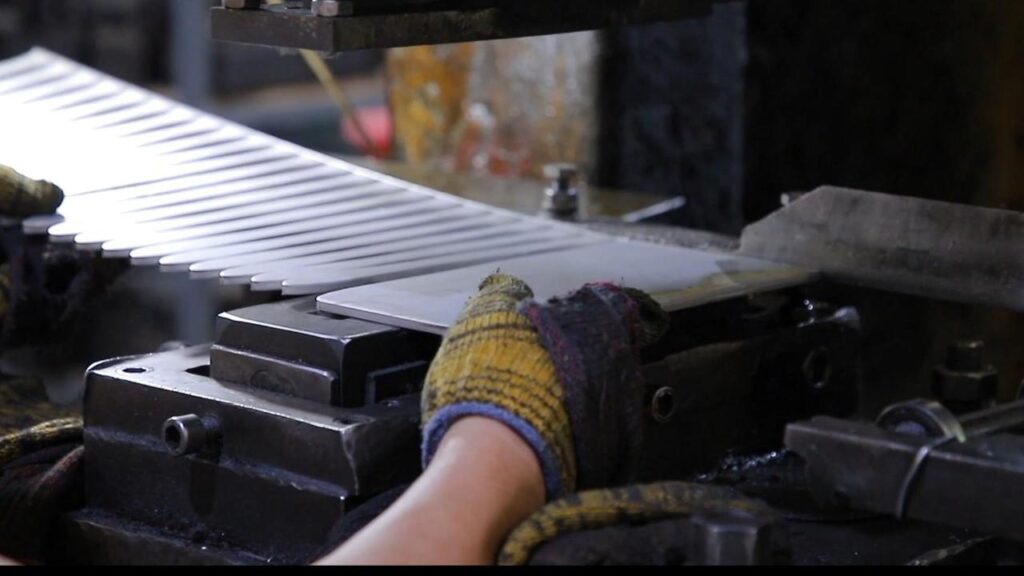
The "feel" of a piece of flatware—its weight, balance, and heft—is determined at the forming stage. This is where a flat sheet or block of steel is transformed into the recognizable shape of a fork or spoon. To ensure every piece feels identical, we rely on machine precision, not manual guesswork. The process starts with "blanking," where automated presses punch the rough outlines of the flatware from the steel coils. After that, the blanks go to powerful stamping presses. We regularly calibrate the tonnage, or force, of these presses. This guarantees that the pattern is stamped with the same depth and the piece has uniform thickness every single time. For high-end forged flatware, the process is even more controlled. The steel billets are heated in computer-controlled furnaces to a precise temperature before being struck by a forging hammer. This controlled temperature and force ensure the steel flows perfectly into the mold, creating a dense, heavy, and perfectly balanced piece, free of voids or weaknesses.
What Stops the Final Look from Being Inconsistent?
You receive an order where some spoons are mirror-polished and others look cloudy. This variation makes your entire inventory look like a jumbled, low-quality mix.
We guarantee a consistent finish through standardized, multi-stage processes. From computer-controlled heat treatment to automated polishing lines with specific compounds and timings, every step is designed to be repeatable for a perfectly uniform look.

A beautiful, uniform finish is the result of a long and carefully controlled sequence of steps. It's not just a single polish at the end. For knives, it begins with heat treatment. We use computer-controlled furnaces for hardening and tempering, which gives the blade its strength and ability to hold an edge. If this isn't controlled, blades can be too brittle or too soft.
Then comes the polishing, which is a multi-stage journey. A raw, stamped piece is rough and has sharp edges. It goes through a series of automated machines, each with a specific job. This systematic process is how we ensure every piece that leaves our factory has the exact same luster and feel as the sample you approved.
| Stage | Process | Purpose |
|---|---|---|
| 1. [Edge Grinding] | Removes sharp burrs from stamping | Creates a smooth, safe edge |
| 2. Surface Grinding | Initial smoothing with coarse belts | Erases surface imperfections |
| 3. Satin Polishing | Buffing with finer abrasive wheels | Creates a uniform base shine |
| 4. Final Mirror Polish1 | Buffing with soft cloth wheels and compound | Achieves a flawless, reflective surface |
How Do You Catch Mistakes Before They Get to Me?
A single flawed piece slips through and ends up with a customer. That one bad fork can lead to a negative review that damages your brand's reputation.
Our quality assurance is not just one final check. We have multiple inspection points throughout the process, staffed by well-trained teams. We randomly pull samples for laboratory tests, ensuring any issues are caught and corrected long before packaging.

Waiting until the end of the line to check for quality is the most expensive way to run a factory. Our philosophy is to build quality into every step and to have checkpoints all along the way. This is known as In-Process Quality Control (IPQC). Our trained inspectors are on the factory floor, visually checking products after stamping, after polishing, and before packaging. They look for tiny scratches, incomplete polishing, or any deviation from the standard.
Beyond visual checks, we conduct rigorous lab tests on random samples from each batch.
- Corrosion Test2: We place items in a salt spray chamber for hours to simulate years of dishwasher use and test their rust resistance.
- Strength Test: We use machines to apply a specific amount of force to test the bend resistance of forks and spoons.
- Hardness Test: For knives, we test the blade's hardness (HRC) to ensure it meets the specification for edge retention.
Finally, our staff are our most important asset. We have a culture of continuous improvement and regular training. This empowers every worker to be a quality inspector, ensuring that by the time an item reaches the final packaging stage, it has already been checked and approved multiple times.
Conclusion
Consistent flatware isn't an accident. It's the deliberate result of strict process control, relentless testing, and a deep commitment to quality at every single step of manufacturing.