
Why Factory-Direct Flatware Matters for Long-Term Brands?
Building a successful flatware brand requires more than a great product; it demands a reliable, consistent, and scalable supply chain. Yet, many businesses find themselves navigating a complex web of intermediaries, leading to quality fluctuations and communication gaps that erode brand trust. Sourcing factory-direct flatware provides the control and transparency necessary to build a sustainable and reputable brand for the long haul.
Sourcing factory-direct flatware matters for long-term brands because it provides direct control over product quality, consistency, customization, and cost. This direct partnership with the manufacturer enables clearer communication, more reliable reordering, and a more predictable supply chain, which are all essential for building brand equity and scaling operations over time.
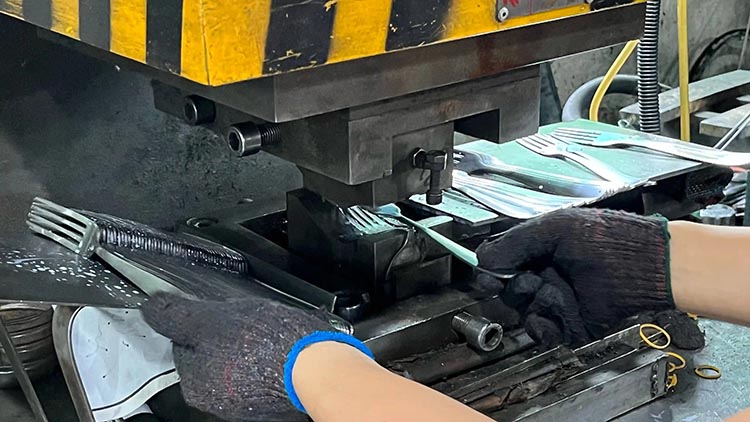
While the concept of "going direct" sounds simple, the true value emerges when you look closer at how it impacts your brand's operations, reputation, and future growth. Let's explore the strategic advantages that a direct manufacturing partnership can unlock.
What Does "Factory-Direct" Really Mean for Flatware Sourcing?
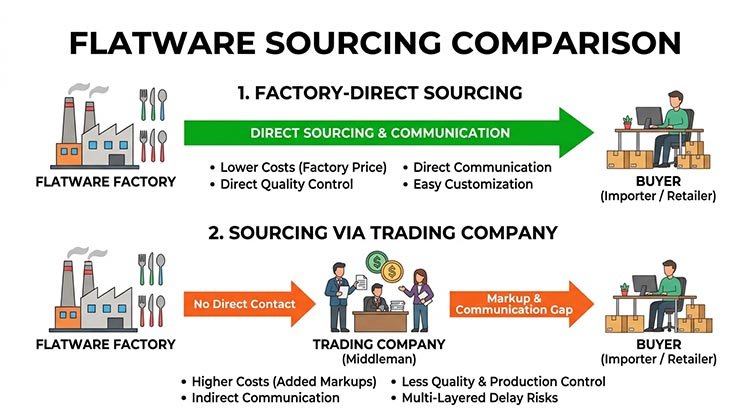
The term "factory-direct" is frequently used in global trade, but its meaning can be misinterpreted. You might think it’s just about cutting out a middleman to get a lower price. However, this view is too simplistic and misses the core strategic advantage. True factory-direct sourcing is about establishing a direct line of communication and a working partnership with the people who actually make your products.
This means your team can communicate specifications, quality standards, and design changes directly with the factory’s technical staff. A direct relationship ensures that your requirements are understood and that you receive accurate feedback on production feasibility, costs, and lead times, forming a foundation for a transparent and sustainable supply chain.
Dive Deeper
For a long-term brand, the distinction between a factory and a trading company isn't about which is "better," but which model best aligns with your strategic goals.
Direct Communication vs. Intermediary Communication
With a factory-direct model, your product development and procurement teams talk directly to the engineers and production managers. When you want to confirm the grade of stainless steel (e.g., 18/10 vs. 18/0), discuss the ideal weight and thickness for a new fork design, or approve a PVD coating color, your feedback goes straight to the source. This minimizes the risk of details being "lost in translation," which can easily happen when messages are passed through multiple parties.
A trading company, on the other hand, acts as a coordinator. This can be valuable, especially for brands sourcing a wide variety of products from different factories or for those without an in-house procurement team. However, for a specialized product like flatware, where subtle details define quality, an intermediary can sometimes complicate the process of deep customization and rapid problem-solving.
A Comparison of Sourcing Models
Here’s a practical breakdown of what to expect from each approach:
| Feature | Factory-Direct Sourcing | Working with a Trading Company |
|---|---|---|
| Communication | Direct access to the production and technical teams. | Communication flows through an account manager or agent. |
| Customization | Ideal for complex OEM/ODM projects requiring technical input. | Best for standard products or minor customizations. |
| Transparency | High visibility into production processes and QC systems. | Transparency depends on the trader's willingness to share factory info. |
| Scope | Specialized expertise in a single product category (e.g., flatware). | Often offers a consolidated catalog from multiple factories. |
| Buyer Effort | Requires more hands-on supplier vetting and project management. | Can reduce coordination workload for the buyer. |
For brands focused on building a unique, long-term identity in the flatware market, a factory-direct relationship is often the most effective path.
Why Is Consistent Quality a Benefit of Factory-Direct Flatware?
Your first order was perfect, and customers loved it. But what happens on your second, third, or tenth order? Inconsistent product quality across different production batches can silently destroy your brand's reputation and lead to negative reviews. This is where a factory-direct flatware relationship provides essential oversight and accountability, helping you protect the brand you've worked so hard to build.
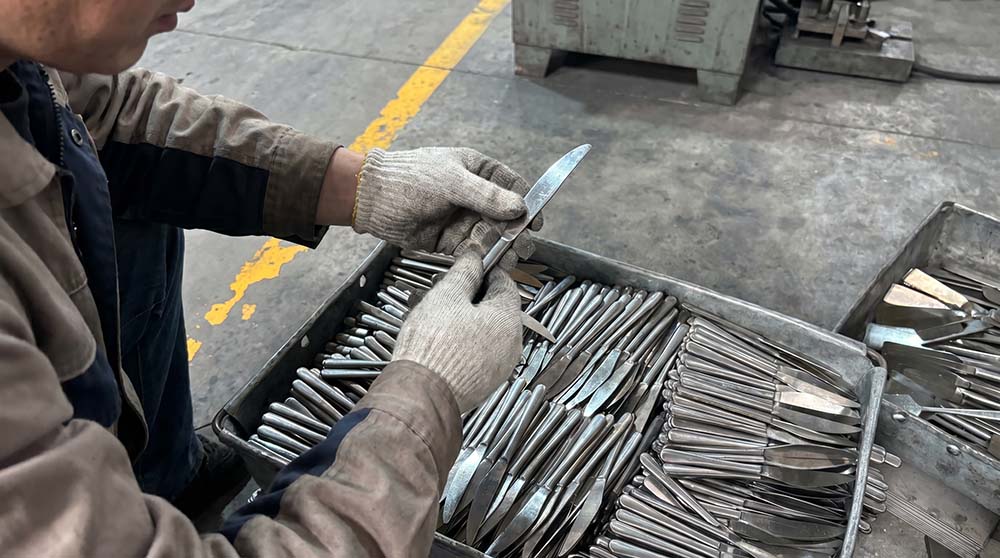
Ensuring consistent quality means that every batch of flatware adheres strictly to the approved "golden sample." This involves maintaining uniformity in every critical attribute, from the raw material grade and product weight down to the polishing finish and packaging details. Direct collaboration makes it easier to define, monitor, and enforce these standards over time.
Dive Deeper
For wholesalers, distributors, and private-label brands, product consistency is not a luxury; it's a core business requirement. Customers expect the set they buy next year to be identical to the one they bought last year.
Establishing Your Quality "Golden Sample"
A direct relationship allows you to work with the factory to create a comprehensive specification sheet and a physical "golden sample" that serves as the benchmark for all future production runs. Key parameters must be documented and agreed upon, including:
- Stainless Steel Grade: Verifying the material is 18/10, 18/8, or 18/0 as specified.
- Product Dimensions and Weight: Maintaining tight tolerances for thickness, length, and weight.
- Surface Finish: Ensuring consistency in mirror, satin, matte, or brushed finishes.
- PVD Color: Matching the exact hue, saturation, and sheen for colored flatware.
- Logo Application: Checking for consistent position, clarity, and durability of the logo.
- Edge Smoothness: Ensuring all edges are properly deburred and polished for a comfortable feel.
- Packaging Specifications: Using the correct materials, printing, and assembly for every box.
Imagine a private-label brand that sold 20,000 flatware sets in its first year and plans to order 50,000 more. If the second batch arrives with a slightly different handle shape, a lighter weight, or a different shade of gold PVD, it creates a disconnected customer experience and devalues the brand.
Accountability and Faster Problem-Solving
When a quality issue arises—and in manufacturing, they sometimes do—direct access to the factory floor is invaluable. You can quickly share photos or inspection reports with the production manager and QC team to identify the root cause. In my 20+ years of manufacturing experience, I've found that this direct loop is the fastest way to implement corrective and preventive actions (CAPA)1. Instead of a lengthy back-and-forth with a third party, you are talking directly to the people who can adjust a polishing machine or retrain an operator. This accountability is crucial for continuous improvement and maintaining a brand's promise of quality.
How Does Direct Sourcing Support Brand Growth and Customization?
A successful brand rarely stands still. To stay relevant and competitive, you need to evolve, introducing new designs, colors, and collections that resonate with your market. But developing unique products through a long chain of command can be slow, expensive, and frustrating. Working directly with your manufacturer accelerates innovation and empowers you to build a truly differentiated factory-direct flatware brand.
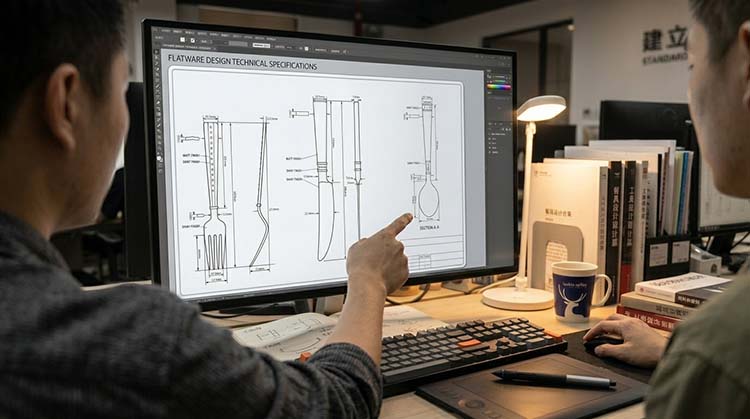
Direct sourcing enables a seamless, collaborative product development process. It allows you to move quickly from a simple idea—like a new handle texture or a unique color—to a mass-produced reality, reducing the risk of design errors and shortening your time to market. This agility is a significant competitive advantage.
Dive Deeper
From startups launching their first product to established retailers expanding their private-label lines, direct manufacturing partnerships are the engine of brand growth.
From OEM/ODM Concepts to Mass Production
Whether you're making minor modifications (ODM) or creating something from scratch (OEM), direct communication is essential. The process typically involves:
- Modifying existing designs: You might like one of our existing handle shapes but want to adjust its thickness or finish.
- Developing new dimensions: You may need a specific "dessert spoon" size for the European market or a longer "iced tea spoon" for the US.
- Creating custom finishes: Explore unique surfaces like hammered, sandblasted, or vintage finishes.
- Designing bespoke packaging: Develop gift boxes, retail sleeves, or other packaging that reflects your brand identity.
I've worked with many brands that started by simply changing the PVD color and packaging on one of our existing flatware patterns. This allowed them to launch a "new" product with minimal investment in tooling, quickly testing the market before committing to a fully custom design.
Scaling Your Brand Confidently
Your purchasing needs will change as your brand grows.
- Launch Phase: You might start with a smaller order to test the market.
- Growth Phase: As sales take off, you'll need to scale up order volumes for your bestsellers.
- Maturity Phase: You may decide to introduce new product lines at different price points.
A true factory partner works with you through each stage. We can help you plan production capacity to ensure we can meet your growing demand, especially ahead of peak seasons. This foresight prevents stockouts and ensures you can reliably supply your distribution channels, from e-commerce storefronts to national retail chains.
Can Factory-Direct Flatware Lead to More Predictable Costs and Supply?
Long-term business planning depends on a stable, predictable cost structure, not just a one-time low price. Hidden fees, unexpected cost hikes, and unreliable reordering can cripple your budget and leave you out of stock when customers are ready to buy. A factory-direct flatware partnership provides the transparency and reliability needed for effective long-term planning.
While not automatically the cheapest option on a per-unit basis, direct sourcing provides a clearer, more predictable total cost of ownership. It also establishes a more dependable supply chain for reordering, which is arguably more valuable than a small initial saving. This predictability is the foundation for sustainable profitability and growth.

Dive Deeper
For importers, wholesalers, and retail chains, predictability is paramount. You need to know your costs to set prices and plan promotions, and you need to trust that your products will be available for reorder.
Understanding Your Total Cost
Direct communication allows you to understand the cost drivers behind your flatware. Key factors include:
- Raw Material: The grade and thickness of the stainless steel.
- Manufacturing Process: The complexity of forging, stamping, and shaping.
- Finishing: The number of polishing steps required for a mirror finish vs. a matte finish.
- Customization: Costs associated with PVD coating, laser engraving, or new molds.
- Order Quantity: Economies of scale for larger bulk orders.
By discussing these levers directly with the factory, you can make informed decisions. For example, you might learn that a small change in thickness can significantly reduce cost without impacting perceived quality, allowing you to hit a key retail price point.
What to Look For in a Long-Term Factory Partner
Choosing the right partner is critical. Look for a manufacturer that demonstrates:
- Proven Experience: A long track record in stainless steel flatware manufacturing.
- Robust Capabilities: The capacity and OEM/ODM skills to match your growth ambitions.
- Documented Quality Control: A clear, verifiable QC process from raw materials to final packing.
- Transparent Communication: Openness about costs, production timelines, and potential challenges.
- A Collaborative Mindset: A willingness to work with you as a partner, not just a supplier.
At XR Cutlery, our 8,000㎡ facility and 20+ years of export experience are designed to provide this level of partnership. We focus on helping our clients build sustainable supply chains for the long run.
Frequently Asked Questions
Is factory-direct flatware always cheaper?
Not necessarily on the initial quote. The primary value comes from transparency, control over quality, and long-term supply stability. A slightly higher unit price from a reliable factory is often cheaper in the long run than a low price from an unreliable source that leads to quality issues or stockouts.
What is the difference between OEM and ODM flatware?
OEM (Original Equipment Manufacturer) is when a factory produces flatware based on your unique, custom design. ODM (Original Design Manufacturer) is when you select one of the factory's existing designs and customize it with your logo, color, finish, or packaging. Both benefit from direct communication.
Do I lose all benefits if I work with a trading company?
No. A professional trading company can add significant value, especially in consolidating shipments from multiple factories or managing logistics for clients without a dedicated procurement team. The key is to ensure your trading partner has a transparent and strong relationship with the actual manufacturer.
What is a typical MOQ for custom factory-direct flatware?
The Minimum Order Quantity (MOQ) varies greatly depending on the product and customization. Customizing an existing model with a new color or logo will have a lower MOQ than creating a brand-new design that requires new tooling. The best way to find out is to ask the factory directly.
Conclusion
For any business aiming to build a lasting brand, sourcing factory-direct flatware is a strategic decision that goes far beyond price. It's about gaining direct control over the critical elements that define your brand: consistent quality, unique product design, predictable costs, and a reliable supply chain. Removing layers of communication minimizes errors, accelerates development, and fosters a level of accountability that is difficult to achieve through intermediaries.
The real value, however, comes not from simply cutting out a middleman but from building a transparent, collaborative partnership with a capable manufacturer. The right partner is one who understands your brand's vision and has the experience, capacity, and commitment to help you deliver on your promise to customers, order after order. This is the foundation for sustainable growth.
As a manufacturer with over two decades of experience in wholesale, OEM, and private label flatware, we at XR Cutlery are built to be that long-term partner. If you are looking to establish a stable supply chain for your brand, contact us to discuss your project requirements.
-
Corrective and Preventive Actions (CAPA) are a set of processes within a quality management system designed to investigate and eliminate the root causes of non-conformities or other undesirable situations. ↩