
Why Do Stainless Steel Flatware Prices Vary So Much Between Suppliers?
Struggling to make sense of your quotes? You've likely noticed that stainless steel flatware prices can differ wildly from one supplier to another, leaving you to wonder if you're getting a fair deal. This variation makes it incredibly difficult to compare options and can create uncertainty about the true value you're receiving. The key is to understand that a price tag is a story—it tells you everything about the product's material, craftsmanship, and quality, not just the manufacturer's profit margin.
Stainless steel flatware prices vary because they reflect tangible differences in material grade (like 304 vs. 430), product weight and thickness, manufacturing complexity (forged vs. stamped), surface finish quality, packaging, and the rigor of the quality control process. A lower price often indicates compromises in these areas, not simply a better deal.
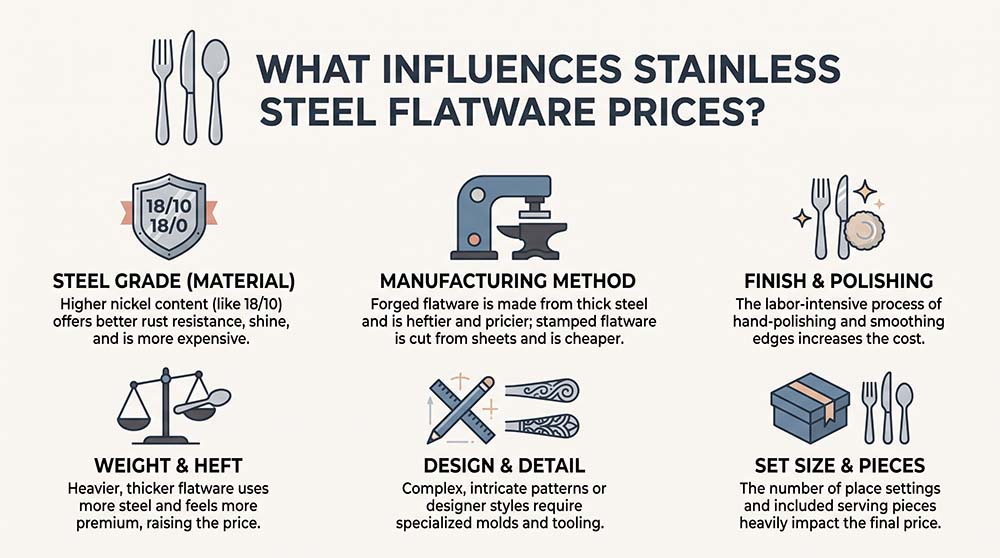
The quote you receive is the sum of many small decisions made during production. To truly evaluate your options, you need to look beyond the unit price and understand the components that build it. Let's break down exactly what drives these price differences so you can compare suppliers like an expert.
How Do Material and Construction Affect Pricing?
You might think a fork is just a fork, but the metal it's made from and how it's formed are fundamental. This can lead to frustration when two visually similar items have drastically different costs. The truth is, the raw material and physical structure are the primary drivers of the base cost.
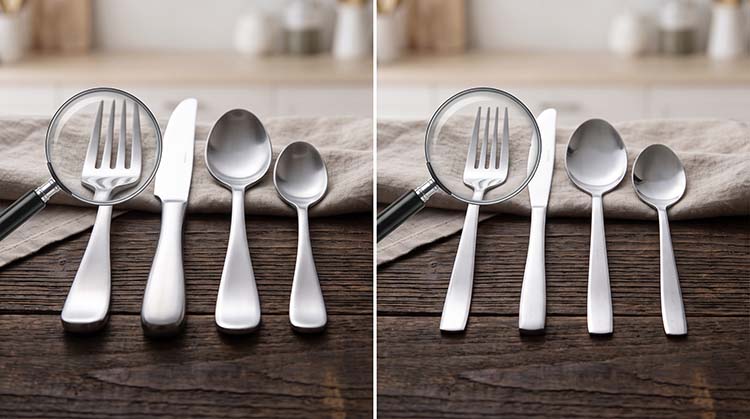
The final price is directly impacted by the grade of stainless steel used (e.g., 18/10 vs. 18/0), the thickness of the metal, and its final weight. Heavier, higher-grade materials are more expensive to purchase and require more energy to process, leading to a higher unit price from the very start.
Material Grade Matters
The type of stainless steel is one of the most significant cost factors. The three most common grades in flatware are:
- 304 Stainless Steel (18/8 or 18/10): This is the premium choice. It contains 18% chromium and 8-10% nickel. The nickel content provides superior rust and corrosion resistance, a brighter luster, and a more substantial feel. It is the standard for high-end hospitality, retail, and private label brands. Naturally, it is also the most expensive raw material.
- 430 Stainless Steel (18/0): This grade contains 18% chromium but has a negligible amount of nickel (< 0.75%). While it offers good corrosion resistance for everyday use, it is less resilient than 304 steel. It is a more budget-friendly option, common in high-volume food service and entry-level retail sets.
- 201 Stainless Steel: This is a lower-cost alternative where manganese is substituted for some of the nickel. Its corrosion resistance is significantly lower than 304 and 430, making it susceptible to rust and staining, especially in humid or salty environments. While very cheap, we generally advise our clients to avoid it for durable goods.
Thickness and Weight are Direct Cost Inputs
This is the most straightforward factor influencing stainless steel flatware prices. A thicker, heavier piece of flatware simply uses more raw material. A fork that is 2.5mm thick will cost more than an identical design that is 1.8mm thick.
When you receive quotes, don't just look at the design. Always ask for the product specifications, including thickness and weight. A supplier offering a "cheaper" fork might be quoting you on a lighter version of the same design. In my experience, a 10-15% reduction in weight can lead to a 5-8% reduction in price, but it also changes the perceived quality in the customer's hand.
Forged vs. Stamped Construction
- Stamped Flatware: This is the most common and cost-effective manufacturing method. A machine "stamps" or punches out the shape of the flatware from a large sheet of stainless steel. It's highly efficient for mass production but offers less variation in thickness and a lighter feel.
- Forged Flatware: This method involves heating a solid bar of stainless steel and hammering it into shape, often with multiple strikes. It creates a product that is denser, heavier, and allows for more intricate design features, like a thicker bolster where the handle meets the tines. Forging is more labor- and energy-intensive, making forged flatware significantly more expensive.
| Feature | Stamped Construction | Forged Construction |
|---|---|---|
| Process | Punched from a metal sheet | Hammered from a solid bar |
| Cost | Lower | Higher |
| Weight | Lighter | Heavier, more balanced |
| Design | Uniform thickness | Variable thickness, more detail |
| Best For | High-volume, budget-conscious projects | Premium, high-end product lines |
Does the Finish and Customization Significantly Change the Cost?
You've got a vision for your brand—maybe a sleek matte black set or a classic mirror finish with your logo elegantly placed. But you're worried about how these aesthetic choices will impact your budget. The reality is that surface treatments and branding are not afterthoughts; they are integral manufacturing steps with real costs attached.
Absolutely. The finish and any customization are major cost centers that can dramatically alter the final price. A multi-stage mirror polish is far more labor-intensive than a basic tumble finish. Advanced PVD coatings or custom logos often require specialized equipment, additional labor, and new tooling, all of which are factored into your quote.
The Cost of a Perfect Polish
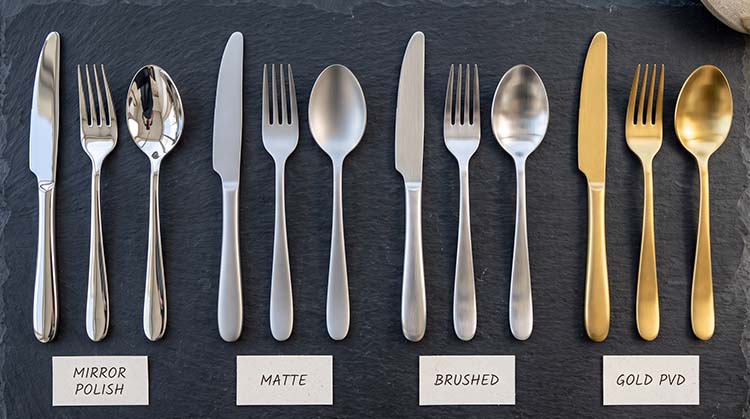
The visual and tactile feel of flatware is largely determined by its finish. Each type requires a different number of steps and level of labor:
- Tumble Finish1: The most basic and cheapest finish, where flatware is tumbled with abrasive media. It results in a dull, non-reflective surface.
- Satin/Brushed Finish: Achieved by abrading the surface with a fine-bristle brush or belt. It creates a distinctive look with fine parallel lines but is more labor-intensive than tumbling.
- Mirror Finish: The most expensive and sought-after finish. It requires multiple stages of grinding, buffing, and polishing with progressively finer compounds to create a flawless, reflective surface. A high-quality mirror polish can account for a significant portion of the labor cost.
PVD Coating and Plating
Adding color to flatware through Physical Vapor Deposition (PVD) is a popular trend. This process bonds a thin layer of metallic ceramic to the steel in a vacuum chamber. While it creates stunning and durable finishes in gold, black, rose gold, or even rainbow, it is a complex and costly step.
Not all PVD is created equal. A cheaper quote for a PVD product might mean the supplier is using a thinner coating, lower-grade base materials, or skipping crucial pre-polishing steps. This can result in inconsistent color and a finish that scratches or wears off easily. The quality control for color consistency across a large batch is also a factor that separates premium suppliers from low-cost alternatives.
Logo and Branding Customization
Placing your brand's logo on the product is essential for private label and OEM clients. The cost depends on the method:
- Laser Engraving: A precise and clean method that uses a laser to etch the logo onto the surface. It's fast and doesn't require tooling, but the cost is per-piece.
- Stamping/Embossing: This method uses a die to press the logo into the steel. It requires an upfront tooling cost for the die, but the per-piece cost is then very low, making it economical for large orders. The complexity and size of the logo will determine the tooling cost.
What Role Do Manufacturing and Order Size Play in Price?
You have your design finalized, but the quotes you're getting are heavily dependent on the order quantity. It's a common frustration for buyers to see high unit costs for smaller orders, making it hard to test a new product line. This is a direct reflection of the economics of mass production and a factory's operational structure.
Manufacturing costs are fundamentally tied to economies of scale. Larger order quantities allow fixed costs, such as machine setup, tooling, and raw material procurement, to be spread across many more units. This drastically lowers the price per piece. A supplier's internal production efficiency, automation, and supply chain management also play a key role in their base cost structure.

The Impact of Order Quantity (MOQ)
Minimum Order Quantity (MOQ) is a critical concept. Factories have significant fixed costs every time they start a new production run:
- Machine Setup: Calibrating stamping presses, polishing machines, and PVD chambers takes time and labor.
- Raw Material Sourcing: Buying steel coils in bulk is cheaper than buying small quantities.
- Tooling: For custom designs, the cost of the mold must be absorbed by the production run.
A small order of 5,000 pieces has to cover these same fixed costs as a large order of 100,000 pieces. When amortized, the cost per piece for the smaller order is naturally much higher. As a manufacturer, we can offer much better stainless steel flatware prices on larger volumes because our efficiency gains are passed on to the client.
Tooling and Mold Costs
If you are using one of our 500+ existing designs, there is no tooling cost. However, for a completely new, proprietary design (OEM/ODM), a new set of molds and dies must be created. This is a one-time Non-Recurring Engineering (NRE) cost that can range from hundreds to many thousands of dollars depending on complexity.
Some suppliers will provide a separate quote for tooling, while others will amortize the cost into the unit price over an agreed-upon volume. Be sure to clarify how tooling is being billed, as this can significantly affect price comparisons.
Factory Production Efficiency
Two factories can produce the same fork but have different costs. A factory with modern, automated equipment, a streamlined workflow, and a well-managed supply chain will have less waste, faster cycle times, and lower labor costs per unit.
For example, our 8,000㎡ facility has dedicated lines for different processes and an experienced team that minimizes errors and downtime. This efficiency allows us to offer competitive pricing for a specific, high standard of quality. A lower price from another supplier might not indicate better efficiency; it could just indicate they are skipping steps.
Why Is the Cheapest Quote Often Not the Lowest Total Cost?
You've done it. After reviewing a dozen quotes, you found one that is 15% cheaper than all the others. It feels like a huge win for your budget. But before you sign the purchase order, it's crucial to ask: what am I not seeing? A price that seems too good to be true often is.
The lowest unit price rarely equals the lowest total cost of ownership. A cheap quote often gets there by cutting corners on "invisible" but critical factors: using thinner material, skimping on polishing steps, performing minimal quality control, and using inadequate packaging. These compromises transfer risk directly to you, the buyer, in the form of higher defect rates, customer complaints, and damage to your brand.
The Hidden Costs of Poor Quality Control
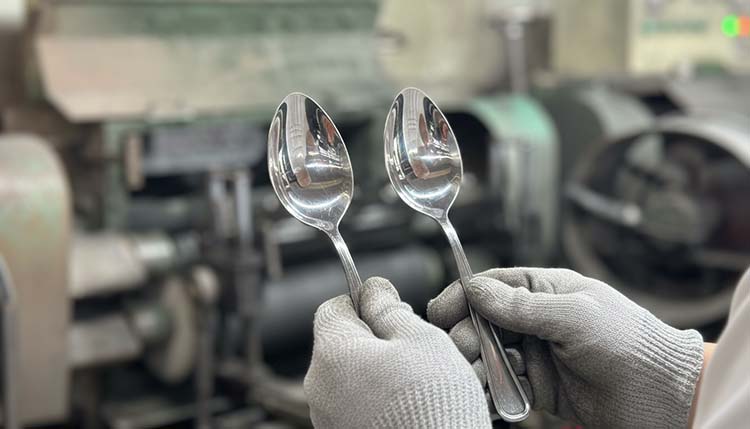
This is the single most important, yet least visible, factor in a price quote. A rigorous QC process costs money—it requires trained inspectors, testing equipment, and time. Our comprehensive QC includes:
- Incoming Material Inspection: Verifying the steel grade and thickness.
- In-Process Inspection: Checking for defects after stamping, polishing, and PVD coating.
- Final Inspection: A final check of each item for cosmetic flaws, weight, and dimensions before packing.
A supplier who skips these steps saves money on labor, but that risk is passed to you. What is the cost to your business if 5% of your shipment is unusable?
The Supplier A, B, and C Scenario
Imagine you get three quotes for a fork:
- Supplier A: $0.75
- Supplier B: $0.85
- Supplier C: $0.95
Supplier A looks like the clear winner. But what if Supplier A's product is lighter, has an inconsistent PVD finish that flakes, comes in simple bulk packaging that leads to scratches during transit, and has a 5% defect rate that you only discover once it reaches your warehouse?
The "real cost" of Supplier A is no longer $0.75. It is:
Real Cost = Unit Price + Shipping Waste + Rework/Replacement Costs + Customer Returns + Brand Reputation Damage
Suddenly, Supplier B or C, who invested in quality control and robust packaging, looks like the much smarter financial choice. The cheapest quote often leads to the most expensive problems.
Don't Compare Price, Compare Specifications
The only way to effectively evaluate stainless steel flatware prices is to conduct an apples-to-apples comparison. Create a detailed specification sheet and have every potential supplier quote against it. Your spec sheet should include:
- Material Grade (e.g., 304 18/10)
- Thickness in mm (e.g., 2.5mm)
- Weight in grams (e.g., 55g)
- Finish requirements (e.g., "high-mirror polish")
- PVD color and quality standard
- Packaging requirements (e.g., "individually poly-bagged, 24 pcs per inner box")
- Quality control and inspection standards
Only when all suppliers are quoting on the exact same product can you truly compare their pricing.
Frequently Asked Questions
What is the best grade of stainless steel for flatware?
For durability, corrosion resistance, and a premium feel, 18/10 (Grade 304) stainless steel is considered the best choice. It's ideal for hospitality, upscale restaurants, and high-quality retail brands. For more budget-conscious applications where magnetism might be needed (for sorting), 18/0 (Grade 430) is a very suitable and common alternative.
How much does a custom mold for OEM flatware cost?
The cost for a new mold varies widely based on the complexity of the design. A simple handle modification might cost a few hundred dollars, while a completely new, intricate, and forged design could cost several thousand dollars. This is a one-time investment to create your unique product.
Why is MOQ important when negotiating stainless steel flatware prices?
MOQ (Minimum Order Quantity) is crucial because manufacturing flatware involves high fixed costs for setup and tooling. A larger order allows us to spread these fixed costs over more units, significantly reducing the price per piece. Meeting or exceeding the MOQ is the most effective way to achieve a lower unit cost.
Is PVD coating on flatware durable?
High-quality PVD coating is extremely durable and resistant to chipping, scratching, and fading. The key is the process. A quality application involves meticulous surface preparation and the right parameters in the PVD chamber. A low-cost PVD job that skips these steps will not be durable, which is why price shouldn't be the only factor when choosing colored flatware.
Conclusion
Understanding the factors that influence stainless steel flatware prices is the most critical skill for any importer, wholesaler, or private label brand manager in this industry. A price quote is not just a number; it is a detailed summary of choices regarding material, weight, craftsmanship, quality, and packaging. The cheapest quote is rarely the one that provides the best long-term value. By focusing on a detailed specification and comparing the total cost of ownership rather than just the unit price, you can build a more resilient supply chain and a stronger brand.
As a flatware manufacturer with over 20 years of experience in bulk production and OEM/ODM projects, we at XR Cutlery believe in transparency. We work with our partners to define their needs and provide a clear quote that matches their quality expectations. If you're looking for a reliable partner to navigate these details for your next wholesale flatware order, contact us today to discuss your project.
-
Research indicates that Tumble Finish is recognized for its affordability and the resulting surface texture in flatware manufacturing. ↩