
Wholesale Flatware Buying Guide
Struggling to source wholesale flatware that actually sells? You're not alone. Many buyers focus on specs, but the real secret is matching the product to your specific market.
The best wholesale flatware isn't about finding the "best" material or finish; it's about making a strategic sourcing decision that aligns with your target market and business goals. This means turning technical specs into smart business trade-offs that increase profitability and reduce risk.
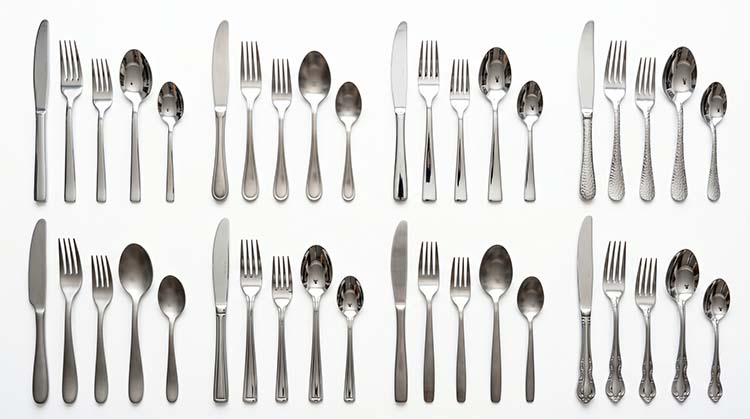
After 20 years in flatware manufacturing, I've consulted with hundreds of B2B buyers—from large importers to new Amazon sellers. I've learned that the most successful ones don't just ask about price. They ask questions that connect product details to their business strategy. They understand that the right flatware choice is a powerful tool for winning their market. This guide will walk you through the key decisions you need to make, based on my experience helping clients avoid common pitfalls and build profitable product lines. Let's reframe how you think about sourcing.
Which Stainless Steel is Best for My Target Market?
Choosing a material feels complicated. You hear terms like 18/10 and 18/01, but it's hard to know what they mean for your business and your customers.
The right stainless steel depends entirely on your end-customer's expectations and your price point. 18/10 is for premium markets demanding durability, while 18/0 is a cost-effective choice for budget-conscious segments where price is the primary driver.
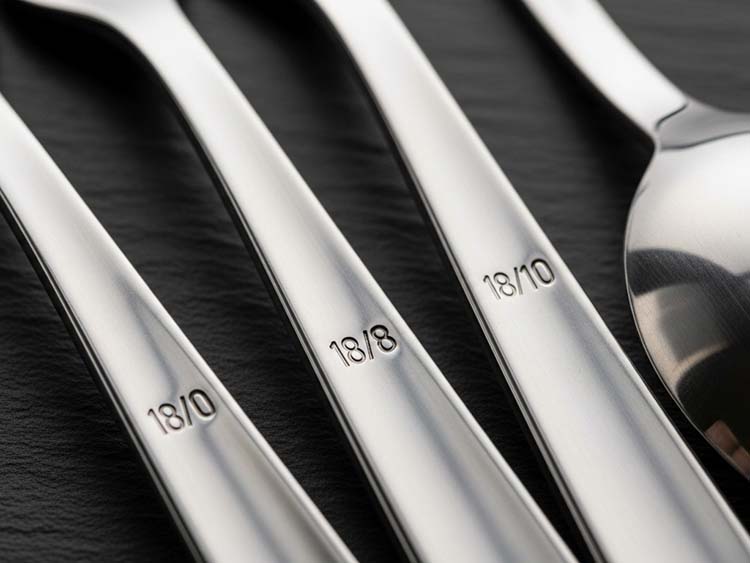
A common question I get from new buyers is, "What's the best steel?" But a better question is, "What steel does my market require?" This shifts the focus from a simple technical spec to a strategic business decision. For example, a buyer for a high-end hotel chain needs to guarantee their investment will resist rust and staining through thousands of dishwashing cycles. For them, 18/10 is non-negotiable. On the other hand, a wholesaler supplying promotional items or large-scale catering events needs to hit a specific price point. Here, 18/0 is the smart choice. Understanding this trade-off is the first step to profitable sourcing.
Matching Material to Business Model
Let's break down the common options and their ideal business applications. This isn't about "good vs. bad," but about "right for the job."
| Material Grade | Key Feature | Best For | Business Rationale |
|---|---|---|---|
| 18/10 (304) | Highest rust resistance, premium luster. | High-end retail, hotels, brand owners. | Justifies a premium price. Protects brand reputation with superior longevity and feel. Essential for markets with high humidity or frequent dishwasher use. |
| 18/8 (304) | Excellent rust resistance, industry standard. | Mid-to-high-end foodservice, quality retail. | A strong balance of performance and cost. It's a reliable workhorse that meets the quality expectations of most mainstream commercial and retail customers. |
| 18/0 (430) | Cost-effective, magnetic. | Budget retail, promotions, large catering. | The go-to for price-sensitive markets. Its magnetic property is also a plus for some industrial dishwasher systems with magnetic retrieval. |
How Do Finish and Weight Impact My Brand and Profit?
You found the right material, but now you see options for polish and thickness. It's easy to dismiss these as minor details, but they directly affect your brand's perception.
The finish and weight of your flatware are powerful branding tools. A standard mirror polish and light weight serve mass markets, while a heavier feel or unique finish like matte or stonewash justifies a higher price and builds brand identity.
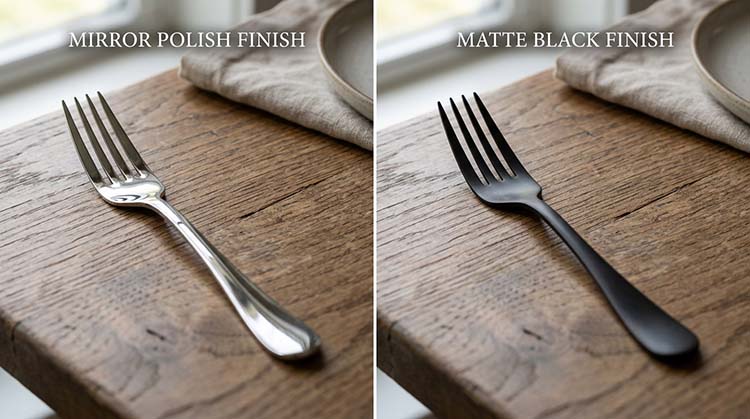
When I work with private-label e-commerce brands, we spend a lot of time on this. They aren't just selling a fork; they're selling an experience. The "in-hand feel" is one of the first things a customer notices. A heavier, well-balanced knife feels substantial and luxurious. A unique finish like PVD gold or a hammered texture makes the product stand out in a crowded market. These aren't just costs; they are investments in brand differentiation. For a wholesaler, a standard, lightweight model might be perfect for volume. For a brand, these details are your ticket to commanding a better price.
Translating Specs into Brand Value
Think of these options as levers you can pull to position your product. Each one sends a different message to your customer.
The Power of Weight and Thickness
- Heavier/Thicker Handles: Communicate luxury and durability. When a customer picks it up, it feels substantial and valuable. This is a simple way to elevate your product above generic competitors, especially in the European and American markets.
- Lighter/Standard Weight: Prioritizes cost-efficiency. This is ideal for mass-market wholesalers, large-scale food service, and any segment where volume and price are the top priorities.
The Strategic Use of Finishes
- Mirror Polish: The universal standard. It’s clean, classic, and expected in most markets. It's the safest and most common choice.
- Matte/Satin Polish: Offers a modern, sophisticated look. It's less prone to showing fingerprints, which is a practical benefit that appeals to design-conscious consumers.
- PVD Coating (Gold, Black, etc.): A major differentiator. This allows you to tap into design trends and create visually striking sets that command premium prices. It's far more durable than spray painting.
- Stonewash/Hammered: These finishes add texture and a rustic or artisanal feel. They are perfect for brands that want to tell a story of craftsmanship and uniqueness. Be aware, these processes often require a thicker base material, which affects cost, but the resulting product is highly distinct.
How Can I Verify a Supplier's True OEM/ODM Capabilities?
Nearly every supplier website says "OEM/ODM available." But these claims are often meaningless without proof, leading to failed projects and wasted time.
To verify a supplier's capabilities, you must ask specific, process-oriented questions. Instead of asking if they do ODM, ask them to show you how they've done it before. This separates true development partners from factories that just add logos.
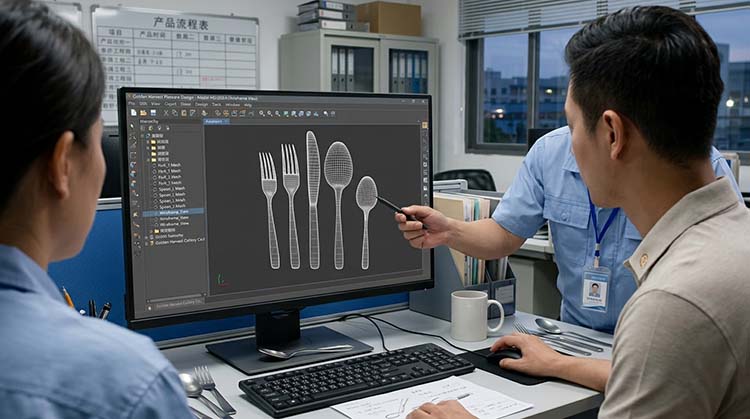
I once had a client who wanted to develop a unique handle design. Their previous supplier, who claimed "full ODM," could only offer to change the color of an existing model. They were an assembly factory, not a development partner. True ODM involves much more, from mold creation to process optimization. To avoid this situation, you need to probe deeper. A real partner can walk you through their entire process, show you case studies (while respecting confidentiality), and discuss potential manufacturing challenges with your design. Their answers will reveal their true level of expertise.
Questions That Reveal a True Partner
Don't settle for "yes." Ask questions that require a detailed, evidence-based answer. This is how you vet a factory's technical depth.
For an ODM (Original Design Manufacturing) Project:
- Weak Question: "Do you support ODM?"
- Strong Question: "Can you walk me through your process for developing a new product from a customer's sketch? What are the key milestones, from mold creation to the first sample?"
- Follow-up Question: "Could you show me an example of a new mold you've recently developed for a client? What challenges did you overcome?"
For an OEM (Original Equipment Manufacturing) Customization:
- Weak Question: "Can you do a gold finish?"
- Strong Question: "We need a PVD champagne gold finish for an order of 50,000 sets. What is your quality control process for ensuring color consistency from the first batch to the last?"
- Follow-up Question: "What specific tests do you run to check the adhesion and wear resistance of your PVD coatings?"
A factory that can confidently and specifically answer these questions is a factory you can trust with your brand. They aren't just taking an order; they are a part of your product development team.
What's the Real Cost of Wholesale Flatware Beyond the Unit Price?
Focusing only on the lowest unit price is one of the biggest risks a buyer can take. A cheap price tag can hide expensive problems that show up later.
The real cost of flatware includes the risks of poor quality, compliance failures, and supply chain disruptions. A slightly higher unit price from a reliable supplier is an insurance policy against much larger financial losses down the line.
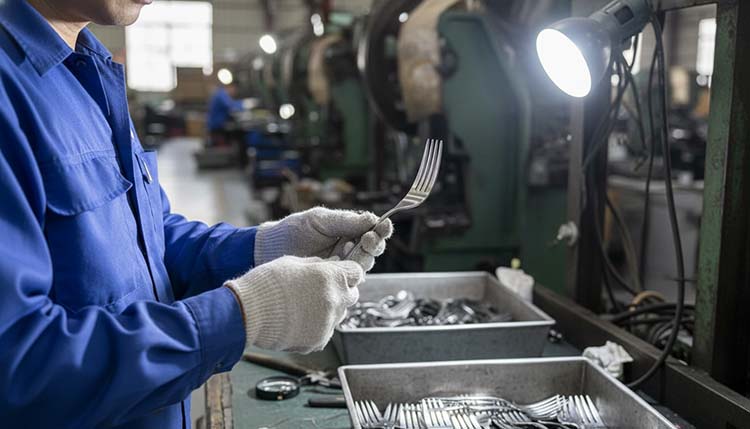
Over the years, I've seen buyers get burned by a "too good to be true" price. They receive a batch with inconsistent polishing, or their shipment gets rejected by customs for failing to meet LFGB or FDA standards. Suddenly, that low unit price becomes a massive loss. A professional factory's price includes things you don't see on the invoice: a rigorous quality control system, stable raw material sourcing, and deep experience with international certifications. These aren't costs; they are value-added services that protect your investment, your brand reputation, and your bottom line.
Calculating the Total Cost of Sourcing
A professional buyer thinks about the Total Cost of Ownership (TCO)2, not just the Free on Board (FOB) price. Here are the "hidden" values a good supplier provides:
1. Multi-Stage Quality Control (QC)
A low price often means corners were cut in QC. ; A reliable factory invests in checks at every stage:
- Raw Material Inspection: Verifying steel grade, thickness, and purity before production even starts.
- In-Process Inspection: Checking dimensions, weight, and form after stamping and during polishing.
- Final Inspection: A thorough review of the finished product for scratches, polish uniformity, and packaging accuracy.
This system catches problems early, preventing a catastrophic failure on a full order.
2. Compliance and Certification Expertise
Does your supplier truly understand your market's requirements?
- A factory with experience shipping to Europe will have LFGB testing down to a science.
- A partner for the US market will be fully versed in FDA standards.
This expertise isn't free, but it's far cheaper than having a container of goods seized at the port.
3. Supply Chain Stability
Price fluctuations often come from unstable raw material suppliers.
- A long-term factory like ours builds deep relationships with steel mills. This ensures a stable supply of high-quality raw materials, leading to more consistent product quality and predictable pricing for you over the long term.
Paying a few cents more per piece for a supplier with proven systems in these areas is the smartest financial decision you can make.
Conclusion
Choosing wholesale flatware is a strategic business decision, not just a purchase. By aligning material, finish, and supplier capabilities with your market, you build a foundation for long-term success.
-
Provides a technical definition of stainless steel grades, explaining that the numbers (e.g., 18/10, 18/0) refer to the percentage of chromium and nickel content. The presence of nickel in 18/10 (also known as Type 304) significantly increases its corrosion resistance compared to nickel-free 18/0 (Type 430). ↩
-
Business and supply chain management resources define Total Cost of Ownership (TCO) as a financial principle that calculates the full lifecycle cost of an acquisition. This includes the initial purchase price plus all direct and indirect costs, such as shipping, quality control, and potential failure costs. ↩