
Which food-grade stainless steel is right for your cutlery?
Choosing stainless steel for cutlery is confusing. The wrong grade leads to rust and complaints, forcing you to replace it all. Understanding the types saves you money and protects your brand.
For durability and rust resistance, choose 304 (18/8) stainless steel. For a balance of cost and performance in dry environments, 430 is a great option. Use 201 only for short-term or promotional items, as it is prone to rust.

I've been in the cutlery business for over 20 years, and one question comes up more than any other: "What's the real difference between 304, 430, and 201 stainless steel?" This isn't just a technical question. The answer directly impacts your budget, your brand's reputation, and how happy your customers will be in the long run. The choice you make determines whether your flatware will shine for years or develop rust spots within months. Let's break down exactly what you need to know.
What Really Makes Stainless Steel "Food-Grade"?
The term 'food-grade' is used everywhere. But not knowing what it means can lead you to buy unsafe, low-quality products. Understanding the standard protects your customers and business.
'Food-grade' means the stainless steel is non-toxic and resists corrosion from food, so it won't leach harmful materials. It's not just a type of steel; it involves the entire manufacturing process and must meet standards like FDA or LFGB.

From a factory perspective, "food-grade" is a promise of safety and quality that goes beyond a simple material number. First, the steel must be corrosion-resistant. This means it won't react with acids or salts in foods, which prevents metallic tastes and keeps the metal from breaking down. Second, it must be non-toxic and easy to clean. The surface has to be smooth and non-porous so that bacteria have nowhere to hide. But it's not just about the raw material. The smelting purity, the polishing process, and the chemical stability are all part of the equation. This is why I always tell my clients to look beyond the material grade number. A truly food-grade product will be backed by third-party testing certificates from labs like SGS or TÜV. These documents prove that the product meets international safety standards like FDA or LFGB. Without that proof, "food-grade" is just a marketing term.
304 vs. 430 vs. 201: Which Steel Should You Choose?
The numbers 304, 430, and 201 are confusing. Choosing the wrong one can lead to rusty cutlery and wasted investment. Knowing the key differences makes the decision simple.
Choose 304 (18/8) for the best corrosion resistance and premium feel. Select 430 (18/0) for a cost-effective, everyday option that still performs well. Use 201 only for budget-critical, short-term situations as it's prone to rust.
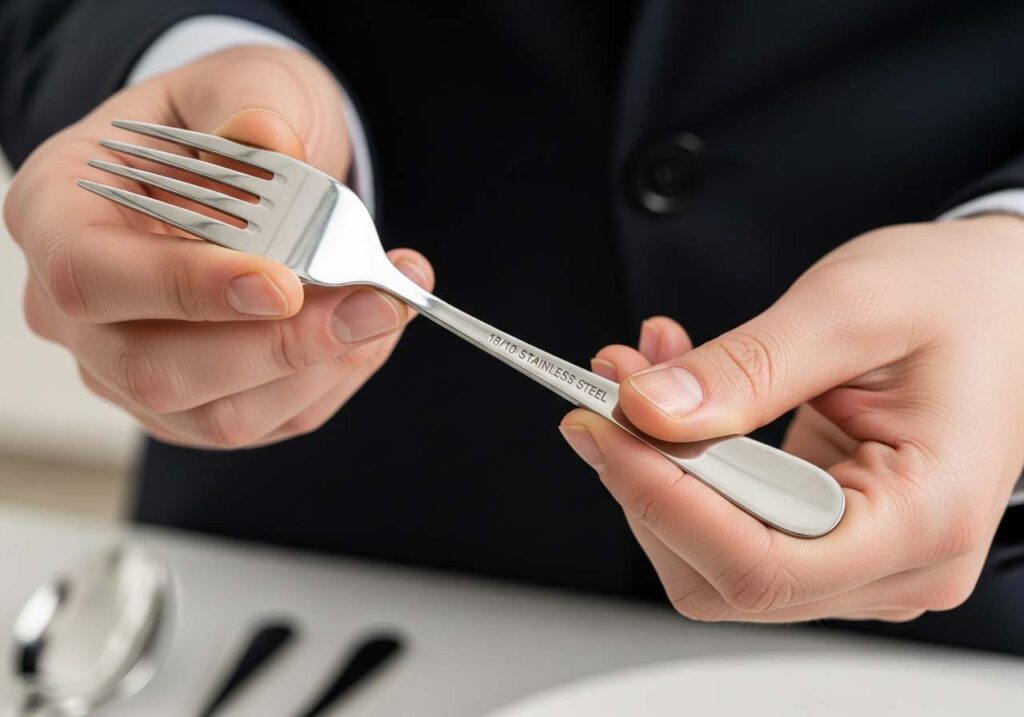
As a manufacturer, I work with these three materials every day. Here’s my breakdown based on real-world client experiences.
304 Stainless Steel: The Premium Choice
This is the gold standard for quality cutlery, often labeled as 18/8 or 18/101 because it contains 18% chromium and 8-10% nickel. The nickel content gives it superior resistance to rust and corrosion. A US restaurant chain client used to use 201 steel2 cutlery, and they saw rust spots in less than six months. After they switched to our 304 series, the problem disappeared, and guest feedback improved. If your budget allows, 304 is the most worry-free choice for long-term use.
430 Stainless Steel: The Practical Balance
This grade contains 16-18% chromium but almost no nickel, so it's sometimes called 18/0. It’s a good, durable material, but its corrosion resistance isn’t as strong as 304. We often produce 430 cutlery sets for European supermarkets. Their customers want something affordable that is good enough for daily use, and 430 hits that perfect balance. However, I always warn clients that 430 cutlery shouldn't be left in contact with salty or acidic foods for too long, as it can be prone to pitting.
201 Stainless Steel: The Budget Option
This steel grade lowers costs by replacing most of the expensive nickel with manganese. While it looks shiny and similar to 304 at first, its resistance to rust is significantly lower. I had a South American client who insisted on using 201 because of intense price competition in his market. After a year, he came back with complaints of rust, especially in humid climates. They eventually switched to 430. My advice is to only use 201 for items like promotional giveaways or single-use event cutlery.
Why Is the Right Steel Grade Critical for Restaurants and Hotels?
In a restaurant or hotel, every detail reflects on your brand. Cheap cutlery that rusts or stains can damage your reputation. Investing in the right steel grade protects your image.
It's critical for durability against constant dishwashing, preventing rust, and ensuring food safety. The right steel grade also impacts guest perception of quality and significantly lowers long-term replacement costs, making it a crucial business decision.

In a hospitality setting, cutlery goes through extreme stress. We're talking about hundreds of cycles in high-temperature commercial dishwashers with harsh detergents. This environment will quickly destroy inferior steel. A 201-grade fork might look fine out of the box, but it will quickly tarnish and rust, forcing you to replace your entire stock. A 304-grade fork, however, is built to withstand this abuse. The investment in better steel pays for itself by reducing replacement frequency. More importantly, it affects your guests' perception. The flatware is one of the few items a guest physically holds and interacts with throughout their meal. A heavy, balanced, and spotless piece of 304 cutlery feels like quality. A stained, lightweight piece of 201 feels cheap. Choosing the right steel isn't an expense; it's an investment in your brand's reputation and long-term operational efficiency.
How Can You Verify a Manufacturer's Claims About Steel Grade?
Your supplier claims their cutlery is high-grade 304 steel. But how can you be sure you're not overpaying for a cheaper material? There are simple ways to verify their claims.
Always ask for third-party testing certificates (like SGS or TUV) that show the chemical breakdown of the steel. You can also perform a magnet test: 430 is magnetic, while 304 is not.

Trust, but verify. This is my advice to all my clients. An honest manufacturer will have no problem backing up their claims. The most reliable way to check the steel grade is to ask for a copy of the third-party lab report. This document details the exact chemical composition of the steel, showing the percentages of chromium, nickel, and other elements. If a supplier refuses to provide this, it's a major red flag. For a quick and simple check, you can use a magnet. Because 430 steel has no nickel, it is magnetic. High-quality 304 steel, with its high nickel content, is non-magnetic. This test isn't foolproof (some 201 grades are also non-magnetic), but it's a great way to instantly identify 430 grade. Ultimately, the best way to guarantee quality is to work with a reputable and transparent factory that values its reputation. We welcome these questions because it shows our clients are serious about quality, just like us.
Conclusion
For premium durability, choose 304. For balanced daily use, 430 is best. 201 is for budget-only, temporary needs. Match the steel to your project for long-term success.