What Certifications Guarantee Your Stainless Steel Cutlery is Safe and High-Quality?
A product recall or a shipment rejected at customs can destroy your profits and brand reputation. But how can you be sure the stainless steel cutlery you're importing is truly safe?
Food safety and quality certifications are third-party verifications that a product meets specific international standards. For B2B buyers, they are non-negotiable proof of product safety, chemical compliance, quality management, and ethical production, essential for market access and mitigating risk.

I often talk to experienced buyers like Jacky. He doesn’t ask about price first; he asks for our certification documents. He knows that a piece of paper from a reputable lab can be the difference between a successful product launch and a legal nightmare. These aren't just logos we print on a box; they represent a deep commitment to safety and quality at every step of the manufacturing process. Let's break down which ones you absolutely need to see from any potential supplier.
Which Certifications Directly Prove Food Safety?
A product can look perfect, but you can't see the heavy metals that might be leaching into your customer's food. This hidden risk can lead to serious liability issues for your brand.
FDA, LFGB, and CE are the primary certifications for food contact safety. FDA is required for the US market, while LFGB (German) and CE (EU) are crucial for Europe. LFGB is the strictest standard, making it a global benchmark for quality.
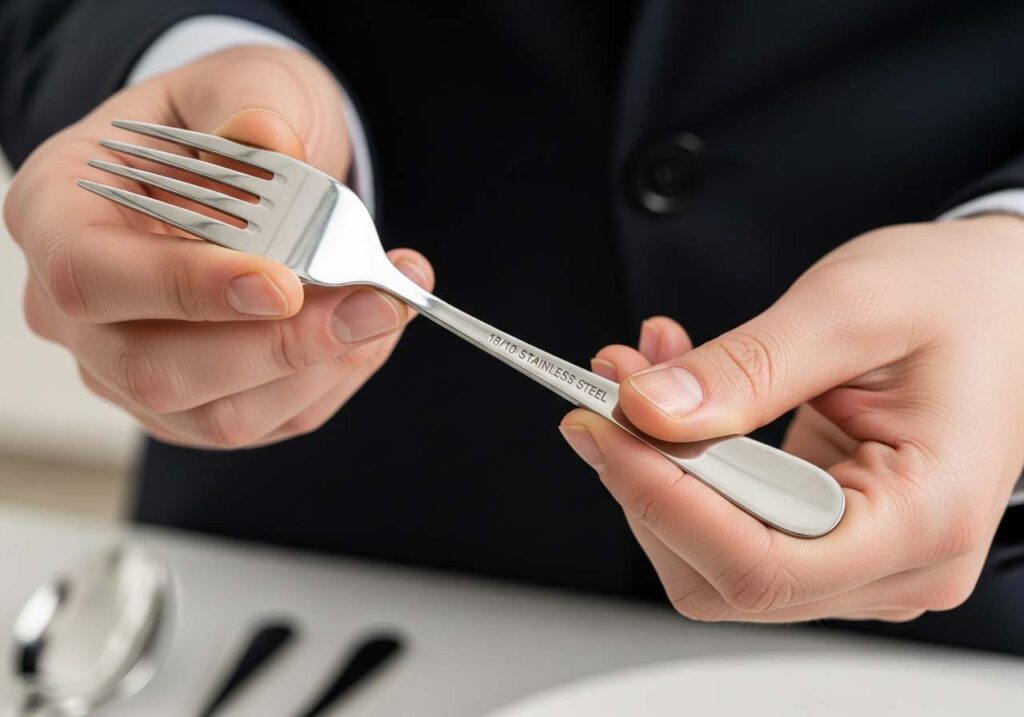
These three certifications are the absolute foundation of product safety. If a factory can't provide them, you should walk away immediately. They each test for similar things, mainly ensuring that no harmful substances, like lead, cadmium, or other heavy metals, migrate from the cutlery into the food. But they have different origins and are required for different markets. We ensure our products meet all three standards, but I always tell clients that LFGB is the one that signals the highest quality. Its testing protocols are famously rigorous, and passing them shows a true dedication to safety.
| Certification | Market | What It Means | Why It Matters for You |
|---|---|---|---|
| FDA | United States | Meets Food and Drug Administration standards for materials that are safe for direct food contact. | Essential for US Market Access. Non-compliance means your products can be seized at the border. |
| CE | European Union | The "CE Mark" indicates conformity with health, safety, and environmental protection standards for products sold within the EU. | Required for EU Market Access. It’s a broad but mandatory mark for selling in Europe. |
| LFGB | Germany / EU | Meets the very strict German Food and Feed Code. It's often called the "knife and fork" symbol. | The Gold Standard. LFGB compliance is a strong indicator of a top-tier supplier, as its standards often exceed basic EU requirements. |
Do Environmental and Chemical Certifications Matter for Cutlery?
Your customers are increasingly worried about harmful chemicals in consumer goods. A report that your beautiful new cutlery contains lead or cadmium could become a public relations disaster.
Yes, they are critical. RoHS and REACH certifications confirm your cutlery is free from hazardous substances like lead, mercury, and other chemicals. They prove your product is safe for consumers and the environment, protecting your brand from reputation damage and legal issues.

These certifications are about what's not in your product. They were originally developed for electronics and other industries but are now applied to all consumer goods to ensure safety.
RoHS: Restriction of Hazardous Substances
This directive restricts the use of specific hazardous materials1 found in electrical and electronic products. For cutlery, it is a voluntary but important declaration that your product is free from substances like lead, cadmium, and mercury. Having a RoHS-compliant supplier shows they have a clean and controlled material supply chain.
REACH: Registration, Evaluation, Authorisation and Restriction of Chemicals
This is a broad EU regulation that deals with thousands of different chemicals. It requires companies to identify and manage the risks linked to the substances they manufacture and market in the EU. For a cutlery buyer, a REACH-compliant factory gives you confidence that your products do not contain any "Substances of Very High Concern2" (SVHCs) that could harm human health or the environment. It is a powerful form of due diligence that protects your brand and your customers.
How Do You Verify a Factory's Quality and Ethics?
Your product sample is perfect, but can the factory produce 100,000 identical, flawless pieces? And are they treating their workers fairly, or are you risking a supply chain scandal?
You verify this through management and social compliance certifications. ISO 9001 guarantees the factory has a robust quality management system for consistent production. BSCI ensures the factory adheres to ethical labor practices, protecting your brand's reputation.
These certifications look beyond the product itself to evaluate the factory's entire operation. They are essential for any buyer looking for a reliable, long-term partner.
ISO 9001: Quality Management System
This is perhaps the most famous quality certification in the world. It doesn't relate to the product itself, but to the factory's processes. An ISO 9001 certified factory has proven systems for everything: tracking raw materials, controlling production steps, training workers, and handling customer feedback. For you as a buyer, this means consistency, traceability, and a much lower risk of defects in your final order. It’s evidence of a professional and well-run operation.
BSCI: Business Social Compliance Initiative
In today's market, ethics matter. Consumers care about where their products come from. A BSCI audit ensures that a factory complies with local and international labor laws, including rules on working hours, fair wages, workplace safety, and the prohibition of child labor. Partnering with a BSCI-compliant supplier protects your brand's reputation and shows your commitment to ethical sourcing.
Finally, for specific markets, a Kosher certification can be vital, proving the products and manufacturing processes comply with Jewish dietary law.
Conclusion
Choosing suppliers with these key certifications protects your business, builds customer trust, and ensures your products are safe, high-quality, and ethically made for any market in the world.