
What Are the Key Stages of Quality Control Inside a Flatware Factory?
Ever wondered what happens between a raw coil of steel and the perfectly polished fork in a retail box? It's a journey defined by rigorous, stage-by-stage quality control.
Inside a flatware factory, quality control is a continuous process. It begins with inspecting raw materials and continues through every major stage: forming, polishing, safety checks, and final packaging, ensuring defects are caught and corrected long before shipment.
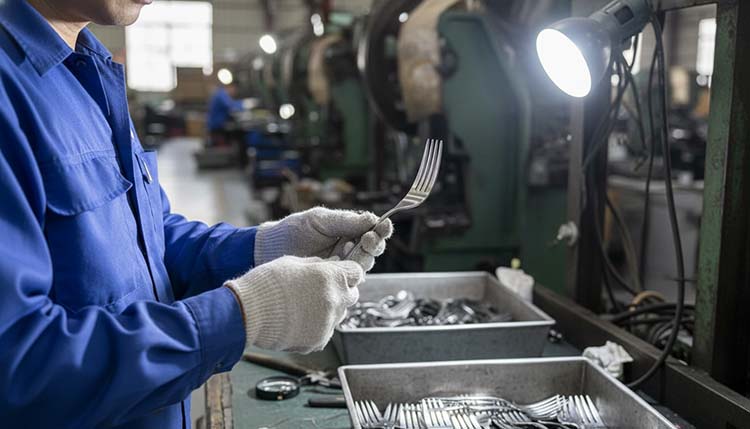
As someone who manages a factory floor, I can tell you that quality isn't just a final check; it's built into our DNA. We don't wait until the end to see if we made a good product. We ensure it's being made correctly at every step. Think of it like building a house. You wouldn't wait until the roof is on to check if the foundation is solid. The same principle applies here. At XR Cutlery, our QC team isn't just a separate department; they are integrated into the entire production flow, from the moment the steel arrives to the moment the container is sealed. This inside look will show you the critical checkpoints that turn raw metal into reliable, high-quality flatware.
What is the First and Most Critical Quality Checkpoint?
Before a single machine is turned on, the most important quality decision has already been made. If you start with bad ingredients, you'll end up with a bad meal, no matter how skilled the chef.
The first critical stage is the incoming material inspection. This checkpoint verifies the steel's grade, thickness, and surface condition. Using the wrong or flawed material makes every subsequent step a waste of time and money.
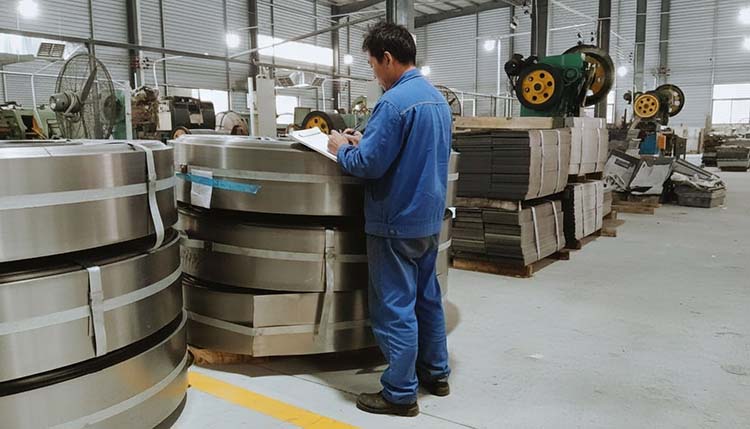
This is the great dividing line in quality manufacturing. Unstable steel composition or incorrect thickness can't be fixed later in the process. When a shipment of steel coils arrives, our QC team immediately gets to work.
- Verify the Paperwork: We check the mill certificate from the steel supplier to confirm the grade (e.g., 18/10, 18/0) and chemical composition.
- Conduct Physical Tests: We don't just trust the documents. We use a spectrometer1 to verify the chemical makeup and a simple magnet test (18/10 is non-magnetic, 18/0 is magnetic).
- Inspect for Flaws: We visually inspect the coils for any rust, deep scratches, or other surface defects.
Any material that fails these checks is rejected and never enters our production line. This single step prevents 80% of potential material-related defects down the road.
How Do We Ensure Every Piece is Shaped Correctly?
Once the steel is approved, it heads to massive presses for stamping or forging. How do we ensure that the first fork and the 100,000th fork are structurally identical and free from defects?
During the forming and shaping stage, quality control focuses on structural stability. In-process inspections catch issues like warping, bending, and tool misalignment in real-time, preventing the mass production of defective pieces.
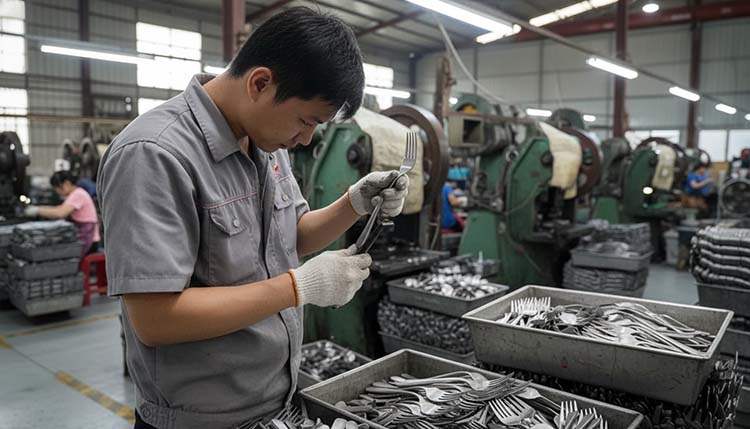
This is where the flatware gets its fundamental shape and strength. A tiny error here, repeated thousands of times, results in a huge amount of scrap. That's why we don't just "spot check." Operators are trained to visually inspect pieces as they come off the line, and our roving QC inspectors perform regular dimensional checks. More importantly, before any mass production starts, we conduct a "first-article inspection." We produce a small number of pieces, and they must be signed off by the QC department for weight, thickness, and overall form before the full run is authorized. This "first piece confirmation" is more critical than random sampling because it ensures the setup is perfect from the very beginning.
What’s the Difference Between a “Shiny” and a “Quality” Polish?
Polishing seems straightforward—just make it shiny, right? But for B2B clients, the consistency of that shine across an entire order is what separates a top-tier product from a problematic one.
Quality control in polishing focuses on uniformity, not just brightness. Inspectors check for an even gloss across every surface, including edges and lines, to ensure every piece in a batch has an identical finish.
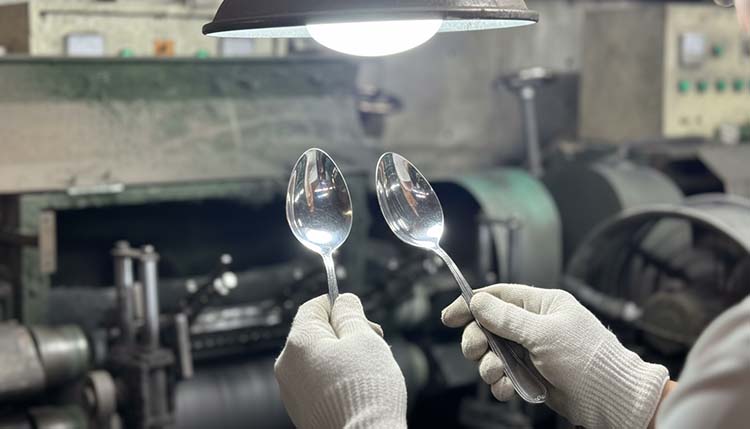
The complaint rate from wholesale customers is directly tied to polishing consistency. A batch with mixed finishes—some pieces slightly duller, others with visible polishing lines—looks cheap and unprofessional. Our inspectors look for specific defects under specialized lighting:
- Pitting or "Orange Peel": Tiny dimples on the surface.
- Scratches or "Drag Lines": Visible lines left by the polishing process.
- Shadows: Dull areas, often near the edges or in detailed patterns.
Any piece with these defects is sent back for re-polishing or is scrapped. This ensures that the aesthetic quality—the first thing the end-user notices—is flawless and consistent across every single item.
How Do We Guarantee the Final Product is Safe and Consistent?
The flatware is shaped and polished, but is it ready for the dinner table? The final stages of QC are about function, safety, and ensuring every piece in a set is a perfect match.
The final internal quality stages involve functional and consistency checks. We inspect for sharp edges, verify weight and dimensions to ensure a consistent "feel," and check that all pieces within a set match perfectly before they are packaged.
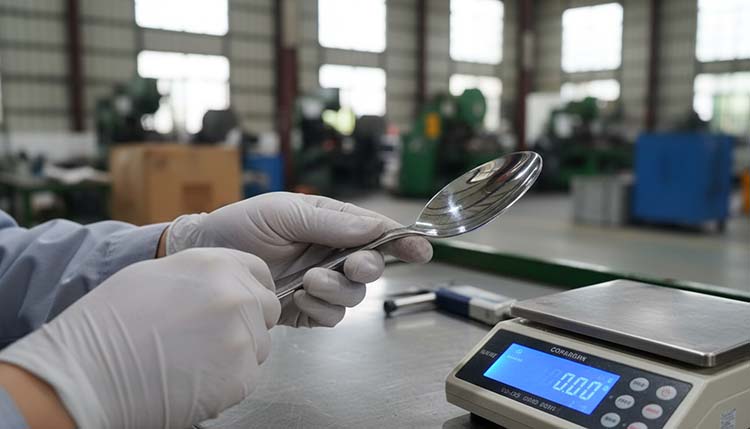
This is where we confirm the user experience. A beautiful fork is useless if it has a sharp burr that can cut someone. A knife needs a sharp cutting edge but smooth, safe edges everywhere else.
- Functional & Safety Tests2: We check that knife blades are sharp, fork tines are aligned, and spoon bowls are smooth. Crucially, we ensure there are no sharp edges or burrs anywhere else on the product.
- Dimensional & Weight Control: We measure pieces to ensure they meet the specified dimensions and weight. This is vital for distributors because batch-to-batch variations in "hand feel" are one of the most common complaints from end-users.
- Set Consistency: Before packaging, we do a final visual check to ensure all items in a set—forks, knives, spoons—match in color, tone, and finish. This prevents mismatched items from ending up in a retail box.
This final line of defense before packaging is crucial for preventing customer complaints and costly returns.
Conclusion
At XR Cutlery, quality control isn't a single department; it's a philosophy that runs through our entire factory. By locking in key parameters for material, weight, and finish, and by inspecting at every critical stage, we move quality control from a final check to a continuous process.