
How XR Cutlery Ensures Fast Turnaround Times for Bulk Orders Without Sacrificing Quality?
Struggling to find a supplier who delivers bulk orders fast without compromising on quality? A delayed or poor-quality shipment can wreck your timeline and budget, damaging your brand's reputation.
We achieve fast turnarounds and high quality by focusing on a systematic process, not just speed. This involves securing a stable raw material supply, running an efficient pre-production phase, blending automation with manual craftsmanship, and implementing a strict, multi-stage quality control system from start to finish.
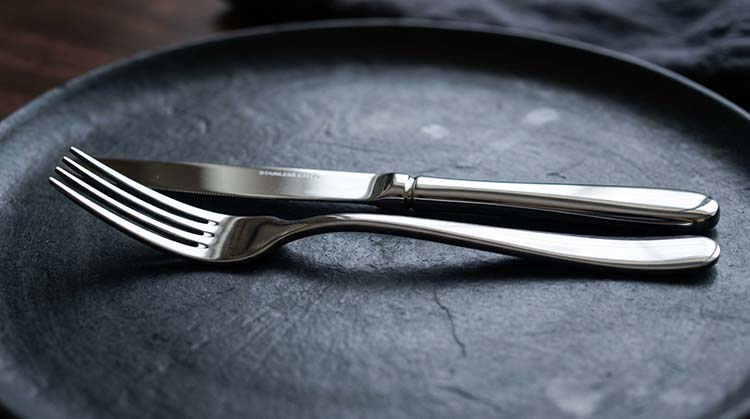
Over my 20+ years in this industry, I've seen countless B2B buyers make the same mistake. They focus only on the final delivery date and the unit price. They ask, "Can you deliver 100,000 pieces by this date?" A better approach is to understand the supplier's entire process. A factory that can't clearly explain how they manage speed and quality is a major red flag. In this article, I'll walk you through the framework we use at XR Cutlery, which you can use to evaluate any potential manufacturing partner. This will help you look past promises and assess a factory's true capabilities to mitigate your risks.
Is Pre-Production the Real Secret to Faster Delivery?
Worried that unforeseen issues will delay your order before production even starts? These hidden problems in pre-production can silently derail your entire project, causing costly setbacks and missed deadlines.
Yes, the pre-production phase is the most critical and often overlooked factor in ensuring fast delivery. Efficient communication, rapid mold development, and swift material verification can save more time than any adjustment made on the factory floor. This is where experience truly matters.
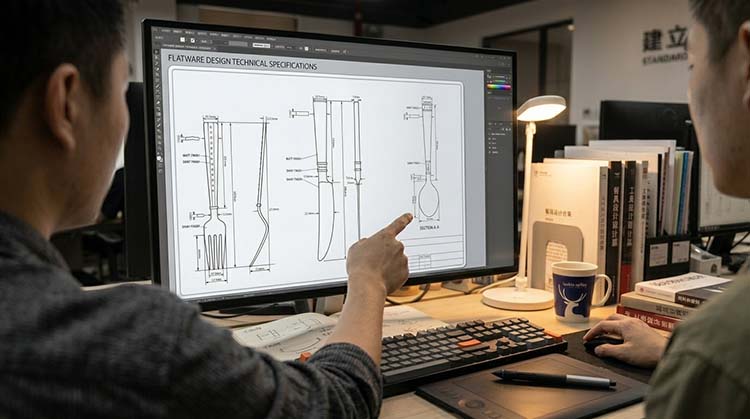
The factory floor is where the action happens, but the real speed is gained before a single piece of steel is stamped. A common question I get from buyers is about our factory's daily output. A more effective question would be, "How do you manage the OEM/ODM development process?" The biggest time-sinks in any bulk order are almost always poor communication, slow mold development, or raw material issues. At XR Cutlery, we've built our system to attack these problems head-on. Our location in Jieyang, the heart of China's cutlery industry, gives us a huge advantage. We can develop and refine new molds quickly because the expertise and facilities are right here. This is crucial for brands wanting a unique design. Instead of waiting weeks for a mold, we can often turn it around in days, allowing us to get your project moving faster than competitors.
Key Stages in Our Pre-Production Process
| Stage | Our Action | Benefit to You |
|---|---|---|
| 1. Design & Communication | Dedicated OEM/ODM team clarifies specs upfront. | Reduces back-and-forth; ensures your vision is captured correctly from day one. |
| 2. Mold Development | Leverage local industry ecosystem for rapid prototyping. | Faster samples and quicker start to mass production. |
| 3. Raw Material Verification | In-house testing for steel composition, thickness, and hardness. | Prevents defects and production halts; ensures product consistency. |
This systematic pre-production process is how we de-risk your project from the very beginning.
How Does Our Process Management Prevent Delays and Defects?
Concerned that rushing a large order will lead to inconsistent products? When a factory simply speeds up, defects multiply, and the quality you were promised disappears, leaving you with unsellable inventory.
We combine the best of both worlds: automation for consistency and manual craftsmanship for detail. Automated machines handle stamping and forming for uniformity, while our skilled artisans perform fine polishing and inspection to ensure every piece meets high-end standards.
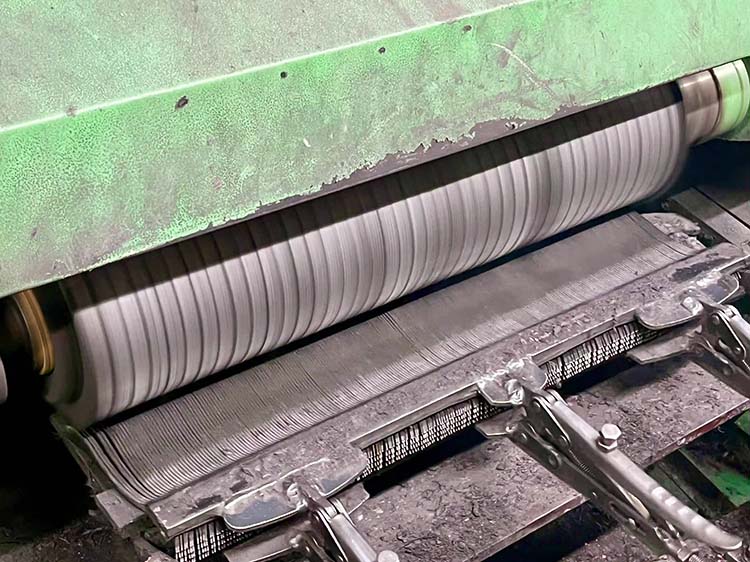
Many buyers believe they have to choose between the perfect consistency of a fully automated factory and the fine details of a manual workshop. That's a false choice. The reality is that both have weaknesses when it comes to bulk orders. Pure automation can miss subtle defects, while pure manual work struggles with uniformity at scale. Our solution is a hybrid model. We use automated presses to ensure every single fork, knife, and spoon has the exact same dimensions, weight, and shape. This is the foundation of quality at scale. However, when it comes to the final finish—the part your customer touches and feels—we rely on our experienced team. They perform semi-automated polishing and manual finishing touches, ensuring edges are smooth, surfaces are flawless, and the final product has that premium feel that machines alone can't replicate. This approach gives us the efficiency to handle orders of 5 million pieces a month while maintaining the quality you'd expect from a smaller, more specialized workshop.
Why Should You Ask 'How' Instead of 'If' for Quality Control?
Have you ever been promised high quality, only to receive a shipment full of defects? Asking "Do you have QC?" isn't enough, as a simple "yes" can hide a flawed and ineffective process.
Instead of asking if a factory has quality control, ask how their QC system works. A reliable partner will detail a multi-stage process that starts with raw materials and ends only after the final pre-shipment check. This transparency is your best guarantee of quality.
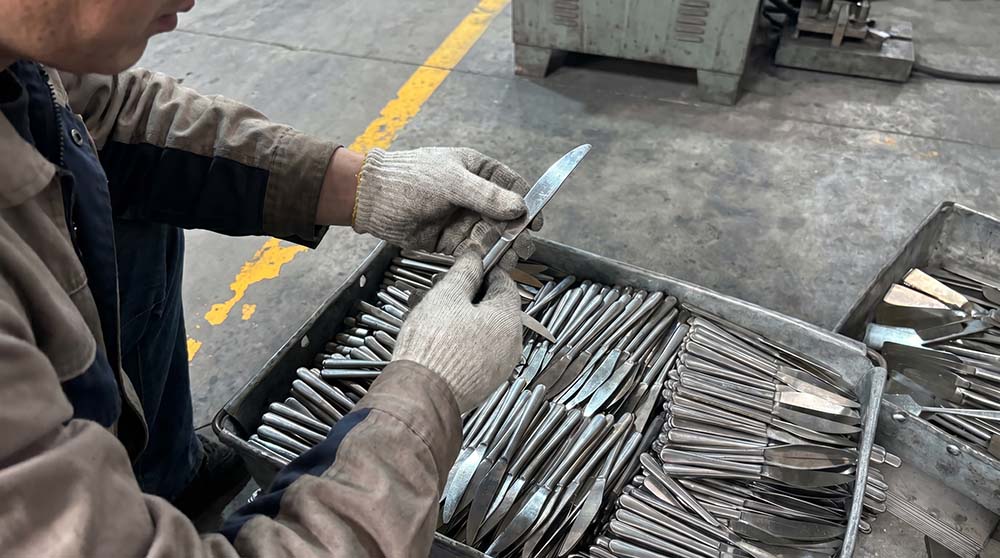
Based on my experience delivering to large importers and Amazon sellers, the most significant risk isn't a factory having zero QC; it's a factory having a single, ineffective QC step at the very end. Finding defects right before shipment is too late. It causes massive delays and arguments. That's why you need to dig deeper. At XR Cutlery, quality isn't a single event; it's a continuous process woven into our production line. We don't just inspect the final product; we inspect at every critical stage. This multi-stage system allows us to catch and correct potential issues early, preventing them from multiplying and affecting your entire order. This is how we ensure that the 500,000th piece is just as perfect as the first. When evaluating a supplier, ask them to walk you through their QC checkpoints. If they can't give you a clear, detailed answer, that's a serious warning sign.
Our Multi-Stage QC Checkpoints
- Raw Material Inspection: We test all incoming steel for composition, thickness, and surface flaws.
- Semi-Finished Product Check: After stamping, we verify dimensions, weight, and shape.
- Polishing Inspection: We check for surface uniformity, smoothness, and scratches.
- PVD Coating & Finishing Check: We test for color consistency and adhesion.
- Final Pre-Shipment Inspection: We conduct a final review of the product, packaging, and labeling before it leaves our factory.
How Is Quality Integrated From Start to Finish?
Do you worry that quality is just an afterthought for most factories? A final inspection can't fix fundamental flaws baked into the product from poor materials or imprecise manufacturing processes.
True quality isn't applied at the end; it's built in from the beginning. It's an integrated system where every step—from selecting the right 18/10 stainless steel to the final polishing technique—is designed to contribute to the final product's excellence.
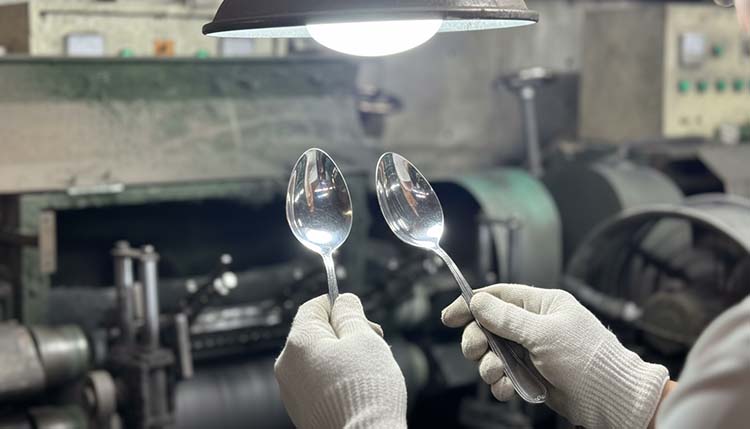
A common mistake buyers make is viewing quality as a feature that can be added or checked for at the end. In reality, quality is the sum of a thousand small decisions made throughout the manufacturing process1. The ability to deliver consistent quality on a massive scale depends entirely on this integrated system. For example, the final feel and balance of a knife aren't just checked at the end; they are determined by the thickness and weight specifications decided in the OEM design phase, executed by our high-precision stamping molds, and preserved through careful handling. The mirror finish on a spoon isn't just about the final buffing; it starts with sourcing high-grade stainless steel with minimal surface defects. By controlling each variable—material, stamping, polishing, and PVD coating—we ensure the final product meets your specifications without fail. This systematic approach is how we move from simply making cutlery to crafting a reliable, high-quality product for our brand partners.
Conclusion
Fast, high-quality bulk orders come from a supplier's systematic process, not from rushing. Ask the right questions to find a partner who has de-risked production from start to finish.
-
This concept is a central tenet of Total Quality Management (TQM), a management philosophy which posits that quality is derived from the collective and continuous improvement of all processes and systems within an organization, not from a single inspection point. ↩