
How Is OEM Stainless Steel Flatware Manufactured in China?
Struggling to find a way to create a unique flatware line for your brand? The process of OEM stainless steel flatware manufacturing can seem like a black box, leaving you worried about quality, consistency, and whether the final product will match your vision. Without a clear understanding of the steps involved, you risk costly errors and delays. This guide demystifies the entire journey, showing you exactly how a reliable partner turns your idea into a market-ready product.
Original Equipment Manufacturing (OEM) for stainless steel flatware is a process where a factory like ours, XR Cutlery, produces flatware sets based entirely on a client's specifications. This includes their unique design, chosen material grade, desired thickness and weight, specific surface finish, custom logo, and branded packaging. It allows brands, importers, and wholesalers to launch proprietary product lines without investing in their own manufacturing infrastructure.
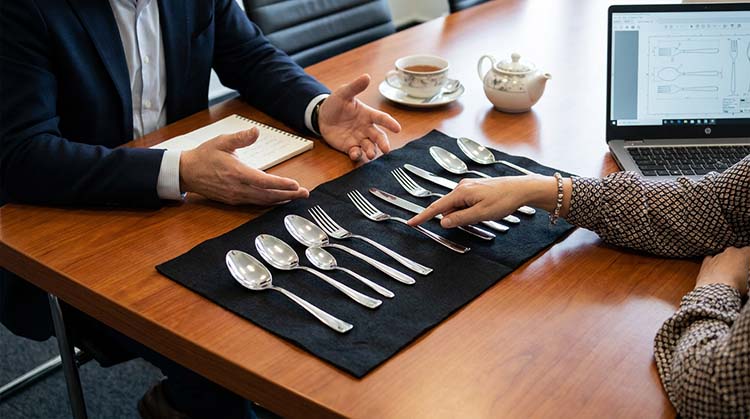
Now that you have a high-level overview, you're probably curious about the details. This isn't just about bending metal; it's a precise combination of engineering, craftsmanship, and quality control. Let's walk through each stage of the process, from a simple design concept to a beautifully finished product ready for your customers.
What Is OEM Stainless Steel Flatware Manufacturing and Why Is Design the First Step?
You have a vision for a new flatware collection, but how do you translate that idea into a physical product made thousands of miles away? The design and engineering stage is where this happens, but any miscommunication here can lead to samples that miss the mark and production that fails to meet your standards.
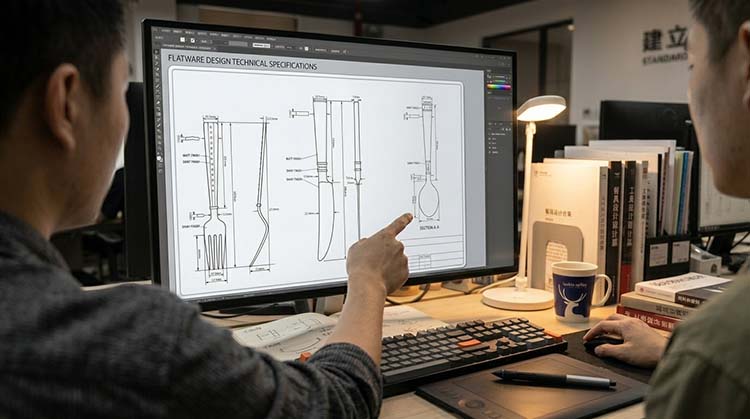
The design phase is the cornerstone of any successful OEM project. It is a collaborative process where we work with you to lock in every critical detail of the product, including its style, dimensions, material, weight, finish, and packaging, ensuring the final flatware perfectly aligns with your brand and target market.
Dive Deeper
OEM manufacturing is fundamentally a partnership. It empowers our clients—importers, private label brands, and large distributors—to leverage our 20+ years of production expertise, our 8,000㎡ facility, and our skilled team to create products that are uniquely theirs. This collaboration begins with a detailed product development plan.
From Concept to Blueprint
Every great product starts with a clear plan. In the initial phase, we work closely with you to define the core attributes of your flatware. This involves answering key questions:
- Target Market: Is this for a high-end hotel, a mass-market retail chain, or a trendy e-commerce brand? The answer influences every other decision.
- Flatware Style: Are you aiming for a classic, modern, minimalist, or ornate design?
- Material Grade: Will this be a premium 18/10 stainless steel set or a more cost-effective 18/0 collection for commercial use?
- Physical Specifications: We finalize the exact length, thickness, and weight of each piece—the fork, knife, and spoon—to ensure the desired hand-feel and balance.
- Surface Finish: Will it be a brilliant mirror polish, a subtle matte finish, or a unique hammered texture?
Prototyping and Mold Development
Once the blueprint is set, we move from paper to physical form. For a completely new design, our engineering team uses CAD/CAM technology1 to create detailed 2D drawings and 3D models. This allows you to visualize the product and make adjustments before any steel is cut.
From there, we can produce prototype samples. Holding a physical sample is the best way to approve the design, weight, and ergonomics. Upon your approval, we proceed with creating the production molds. These hardened steel molds are the tools that will stamp and form tens of thousands of identical pieces, so their precision is paramount. At XR Cutlery, our experience ensures these molds are optimized not just for aesthetics but also for manufacturing efficiency and long-term production stability.
How Are Raw Steel Sheets Transformed in OEM Stainless Steel Flatware Manufacturing?
The quality of your finished flatware is determined long before it's polished. Choosing the wrong stainless steel can lead to rust and corrosion, while an imprecise forming process can result in weak handles or poorly shaped spoon bowls. This is where true manufacturing expertise becomes critical.
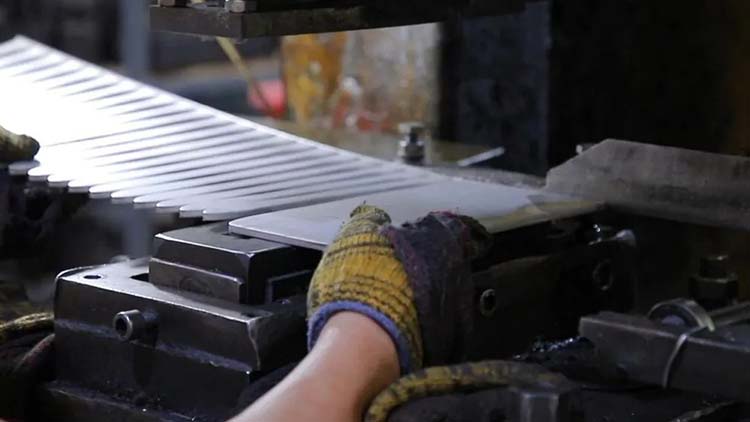
The physical production begins with selecting the correct grade of stainless steel coils or sheets. A high-tonnage stamping machine then cuts, or "blanks," the basic flat outline of each fork, spoon, and knife. These flat pieces then undergo a series of stretching and press-forming operations to create their three-dimensional shape, followed by trimming to refine the edges.
Dive Deeper
Transforming a flat sheet of industrial steel into an elegant fork or spoon is a multi-stage process that requires both powerful machinery and precise control. It all starts with the material itself.
Selecting the Right Stainless Steel
As a professional manufacturer, we guide our clients to the best material for their market and budget—not just the most expensive option. The choice of stainless steel grade has a direct impact on durability, corrosion resistance, appearance, and cost.
| Stainless Steel Grade | Composition | Best For |
|---|---|---|
| 304 (18/10 or 18/8) | 18% Chromium, 8-10% Nickel | Premium residential, private label brands, high-end hotels. |
| 430 (18/0) | 18% Chromium, 0% Nickel | Commercial use, wholesale programs, cost-effective collections. |
| 420 / 410 | 13% Chromium, 0% Nickel | Knife blades, where hardness for a sharp edge is essential. |
| 201 | Lower Nickel Content | Economy-focused products for specific price-sensitive markets. |
The Stamping and Forming Journey
Once the material is selected, production begins.
- Blanking: A powerful stamping press uses a custom mold to punch out the flat, two-dimensional shape of the item from a large stainless steel sheet. At this point, it looks like a cookie-cutter version of a spoon or fork.
- Horizontal Elongation (横延): The blank is passed through rollers that carefully stretch and distribute the metal. This is especially important for the handle, giving it structural integrity and a balanced feel.
- Press Forming (压型): The piece is placed in another mold, where immense pressure forms its final three-dimensional features. This is where a spoon gets its deep bowl and a fork's head is shaped. For patterned handles, this step also includes embossing the design.
- Trimming (修边): Any excess material, known as "flash," is trimmed from the edges to create a clean, precise outline.
The Special Case of Knives: Heat Treatment
Spoons and forks rely on their shape for function, but a knife's value is in its edge. To achieve the necessary hardness for cutting, knife blades (often made from 420 stainless steel) undergo a separate heat treatment process. This involves heating the blades to a high temperature, rapidly cooling (hardening) them, and then tempering them to achieve the perfect balance of hardness and durability. This is why a knife in a set feels much more rigid than its fork and spoon counterparts.
How Do Polishing and Branding Finalize Your OEM Stainless Steel Flatware?
A well-formed piece of flatware is still just a piece of metal. It's the finishing touches—the polish that makes it shine and the logo that makes it yours—that create a premium feel and establish your brand identity. A sloppy polish or a poorly placed logo can instantly cheapen an otherwise well-made product.
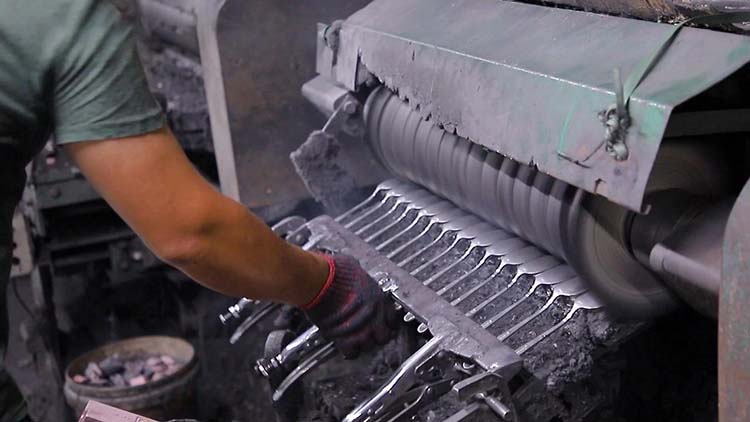
The final aesthetic is achieved through a meticulous, multi-step polishing process to create the desired surface, whether it's a brilliant mirror shine or a modern satin finish. Afterward, we apply your brand's logo using precise methods like laser engraving or stamping, transforming the item from a piece of cutlery into your product.
Dive Deeper
At XR Cutlery, we consider polishing one of our core competencies. It's a craft that combines automated processes with the skilled touch of experienced workers to achieve a flawless result. This attention to detail is what separates high-end flatware from the rest.
The Art and Science of Polishing
The polishing process is far more than just a quick buff. It involves several stages using progressively finer abrasive materials to remove any microscopic imperfections left over from the forming process.
- Flat Polishing (平抛): This is used for the flat surfaces of the handles, creating a smooth, even base.
- Curved Polishing (弯抛): A more intricate process done by hand or with specialized machinery, this focuses on the spoon bowl, the neck of the fork, and the edges to ensure a uniform luster with no rough spots.
After the primary polishing, we can apply a variety of final surface finishes to meet your design goals:
- Mirror Polish: The classic, highly reflective finish.
- Satin/Matte Finish: A modern, non-reflective look that resists fingerprints.
- Stone Wash Finish: An artificially distressed, vintage look that is very popular in trendy restaurants and retail brands.
- Hammered Finish: A textured, artisanal pattern applied to the handles for a unique, handcrafted feel.
- PVD Coating: Physical Vapor Deposition allows us to apply a durable, food-safe coating in colors like gold, black, rose gold, and champagne.
Making It Your Own: Logo Customization
Branding is the final step in creating your OEM product. We offer several methods to apply your logo:
- Laser Engraving: Uses a high-precision laser to etch the logo onto the surface. This is perfect for intricate designs and offers a clean, modern look.
- Stamping: Uses a custom die to press the logo into the metal before the final polishing. This creates a permanent, debossed mark with a classic feel.
I remember working with a European private label client who wanted a very minimalist logo on a new matte black collection. During sampling, we tested several engraving positions and depths. The initial placement looked fine on the 3D model, but on the physical sample, it felt unbalanced. We adjusted it by just 2 millimeters, and it made all the difference, creating a much more elegant and professional final product. This is the kind of detail that defines high-quality OEM stainless steel flatware manufacturing.
How Do Quality Control and Packaging Complete the OEM Stainless Steel Flatware Manufacturing Process?
Your beautifully designed and polished flatware is almost ready. But how can you be certain that every piece in your 10,000-unit order meets your standards? And how do you ensure it arrives at your warehouse safely and ready for immediate sale? Overlooking these final stages can turn a successful production run into a logistical nightmare.
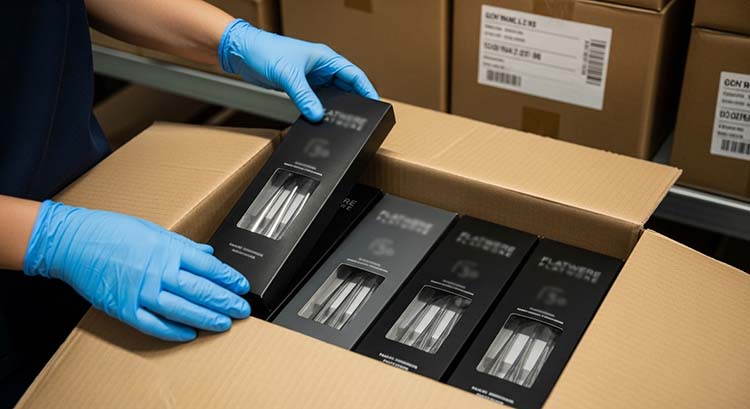
A comprehensive quality control system is essential, with inspections at every stage of production, from raw material to finished product. This is followed by strategic, customized packaging that not only protects the flatware during transit but is also designed specifically for your retail, e-commerce, or wholesale distribution channel.
Dive Deeper
Finishing production is only part of our job. Ensuring that what we produced is what you ordered—and that it gets to you in perfect condition—is just as important. This is where our systems for quality assurance and logistics come into play.
Our Multi-Point Quality Control System
We don't just inspect the final product; we build quality into every step of the OEM stainless steel flatware manufacturing process. Our QC team conducts checks at multiple key stages:
- Raw Material Inspection: We verify the stainless steel grade, thickness, and surface quality before it ever enters production.
- In-Production Inspection: During stamping and forming, we constantly check dimensions, weight, and shape consistency against the approved specifications.
- Polishing Inspection: Each piece is examined for scratches, polishing marks ("chatter"), and finish uniformity. The edges must be smooth to the touch.
- PVD/Logo Inspection: For coated or branded items, we check for color consistency, coating adhesion, and logo clarity and placement.
- Final Pre-Shipment Inspection: Before packaging, a final inspection is done to check overall appearance, quantity, and sorting. This can be a statistical sample (AQL standard) or a 100% check for very high-end orders.
More Than Just a Box: Strategic Packaging
Packaging is the final handshake with your customer. It needs to protect the product, represent your brand, and work for your sales channel. We offer a wide range of solutions:
- Retail Packaging: Custom-printed color boxes, gift boxes with inserts, or PVC window boxes.
- E-commerce Packaging: Sturdy mailer boxes designed to withstand shipping, with support for FBA labels, barcodes, and other Amazon requirements.
- Wholesale Packaging: Bulk cartons, smaller inner packs, or simple poly-bagging for cost efficiency.
We design the packaging not only for aesthetics but also for container-loading efficiency, helping you save on shipping costs.
Why Partner with a Chinese Manufacturer Like XR Cutlery?
For decades, China has been the world's workshop for stainless steel flatware for good reason. The industrial ecosystem in our city, Jieyang, is incredibly complete. We have immediate access to raw steel suppliers, mold developers, polishing experts, and packaging producers. This integrated supply chain, combined with our 20+ years of export experience and cost-efficient large-scale production, allows us to offer a level of value that is hard to match. We manage the entire process for you, from a sketch to a container shipped to your port.
Frequently Asked Questions
What is the minimum order quantity (MOQ) for OEM flatware?
The MOQ can vary depending on the complexity of the design and whether we are using an existing mold or creating a new one. Generally, for a new OEM project, a typical MOQ starts around 6,000 to 12,000 pieces per item (e.g., per fork or spoon). We are flexible and can discuss options for trial orders.
How long does it take to develop a new OEM flatware design?
The development timeline depends on the project. If it's a new design requiring new molds, the process from drawing confirmation to finished prototype samples typically takes 30-45 days. This includes mold fabrication, testing, and refinement to ensure the product is perfect before mass production begins.
Can I get a sample before placing a large order?
Absolutely. We always recommend and provide pre-production samples for approval before moving forward with a bulk order. For OEM projects, this ensures that the final product's design, weight, finish, and branding meet your exact expectations.
What stainless steel grade is best for my brand?
The best grade depends on your target market and price point. For premium, high-end brands, 18/10 (304) stainless steel offers the best corrosion resistance and luster. For food service, commercial, or more budget-conscious lines, 18/0 (430) is an excellent, durable, and cost-effective choice. We can help you decide based on your specific needs.
Conclusion
The journey of OEM stainless steel flatware manufacturing is a detailed and collaborative process that transforms a simple idea into a tangible, high-quality product. It begins with a meticulous design and engineering phase, moves through the precise transformation of raw steel into elegant shapes, and is perfected with artisanal polishing and custom branding. Finally, rigorous quality control and strategic packaging ensure that the product that arrives at your door is exactly what you envisioned, ready to build your brand's reputation. This partnership between client and factory is the key to success in the global market.
If you are looking for a reliable manufacturing partner to bring your flatware collection to life, we are here to help. With over 20 years of experience, a monthly capacity of over 5 million pieces, and a deep commitment to quality, XR Cutlery has the expertise to manage your project from concept to final delivery. Contact us today to discuss your OEM project.
-
Research indicates that CAD/CAM technology significantly enhances the efficiency and accuracy of engineering design processes. ↩