
How Is a Flatware Knife Properly Heat Treated?
Ever had a batch of knives that were too soft and bent easily, or so brittle they chipped on a dinner plate? This inconsistency from suppliers can ruin your brand's reputation and lead to costly customer returns.
Proper heat treatment is a precise 7-step process that balances hardness and durability. It involves material selection, shaping, heating to a critical temperature, quenching to harden, tempering to add toughness, straightening, and final hardness testing to ensure consistent quality.
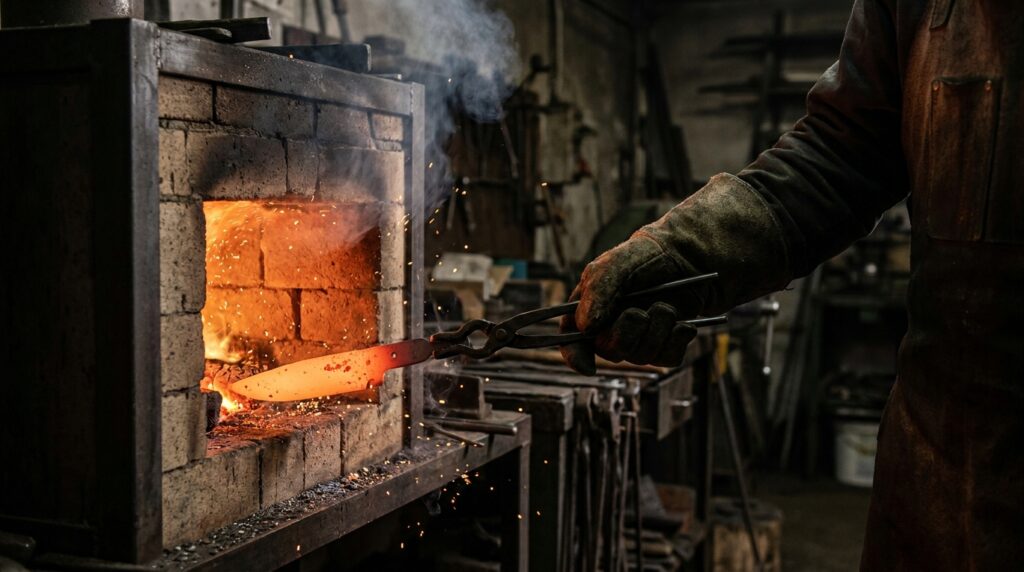
From my factory's perspective, heat treatment is the most critical stage in making a quality knife. It's not just about making the steel harder; it's about achieving the perfect balance between hardness (to hold an edge) and toughness (to resist breaking). Many factories get this wrong by taking shortcuts or focusing only on the final inspection. To truly understand it, we need to look at the key stages that give a knife its strength and durability.
What is normalizing?
You worry that hidden defects in the raw steel will cause problems later in production. Without a stable starting material, any process that follows is built on a weak foundation, leading to unpredictable results.
Normalizing is a heat treatment process that refines the steel's internal grain structure. By heating the steel and then air-cooling it, we create a more uniform and consistent material, reducing the risk of warping or cracking during later manufacturing stages.
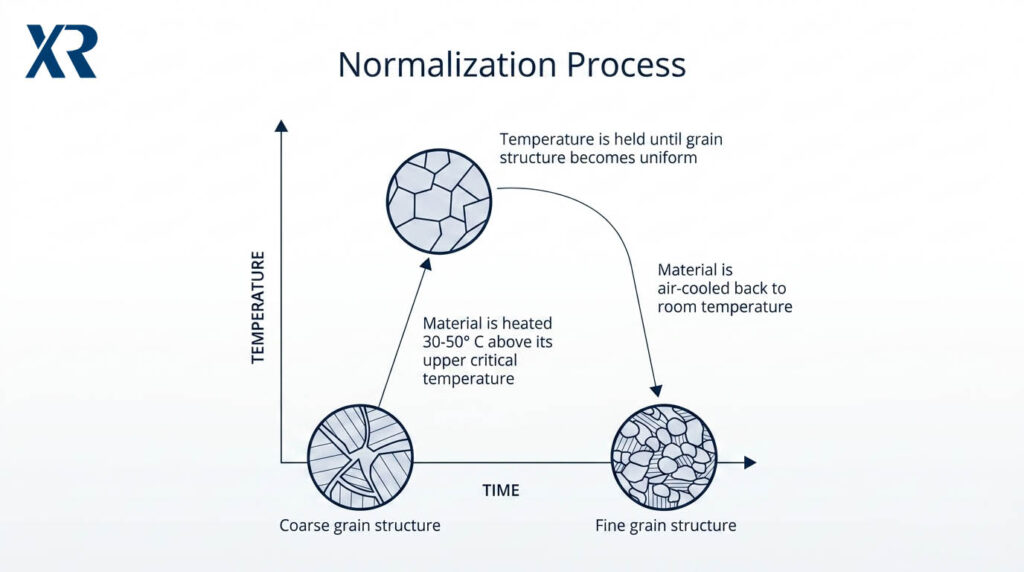
Think of normalizing as "resetting" the steel to its ideal, stress-free state. Before a knife is even shaped, the raw stainless steel sheets can have an uneven internal structure from the milling process1. If we ignore this, it can cause major issues. For example, inconsistent grain structure can lead to spots that are harder or softer than others. When this material is stamped into a knife blank, it can deform unpredictably.
In our factory, we ensure our raw materials, like 420 or 410 stainless steel2, have a normalized structure. This preliminary step is crucial for process stability. It ensures that when we move to the next stage, like blanking and shaping, every single knife blank behaves in the same predictable way. It’s a foundational step for achieving the batch-to-batch consistency that distributors rely on.
What is annealing?
You need to shape steel into a knife, but the material is too hard and resists forming. Trying to stamp or bend hard steel can break expensive molds and cause the product itself to crack.
Annealing is a process that makes steel softer and easier to work with. We heat the steel to a specific temperature and then cool it down very slowly. This reduces hardness and increases ductility, making it ideal for stamping, shaping, and forming without defects.
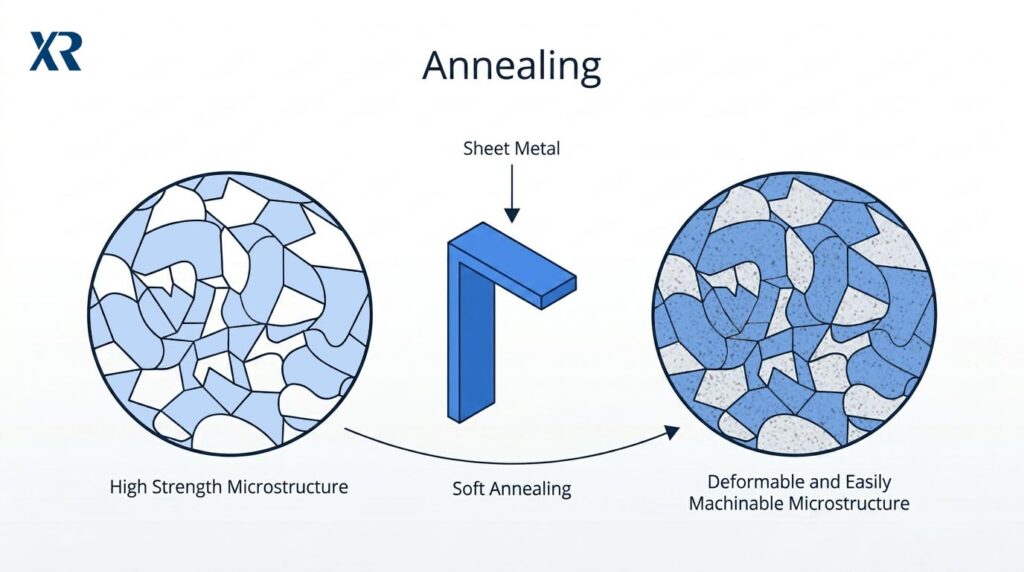
Before a knife gets its shape, it starts as a flat piece of steel. The "Blanking & Shaping" step involves using powerful presses to stamp out the knife's silhouette from a sheet. If the steel is too hard, this process becomes incredibly difficult. The pressure required can wear out or even break the stamping molds, leading to production downtime and increased costs. More importantly, the steel itself can fracture or develop micro-cracks.
This is why annealing is so vital. By making the steel softer and more pliable, we ensure a clean, precise cut every time. The material flows smoothly into the mold, capturing every detail of the design without resistance. For nearly all high-volume flatware production, the steel is in an annealed state before it ever touches a stamping press. It's a critical step that enables efficient, high-quality mass production.
What is quenching?
You need a knife that is sharp and holds its edge, but the soft, annealed steel won't do the job. Without a way to make it hard, the knife would be useless for its primary function: cutting.
Quenching is the rapid cooling of heated steel to lock in a hard, crystalline structure. After heating the knife blank to its critical temperature (around 950–1050°C), we quickly submerge it in oil or cool it with gas to dramatically increase its hardness.
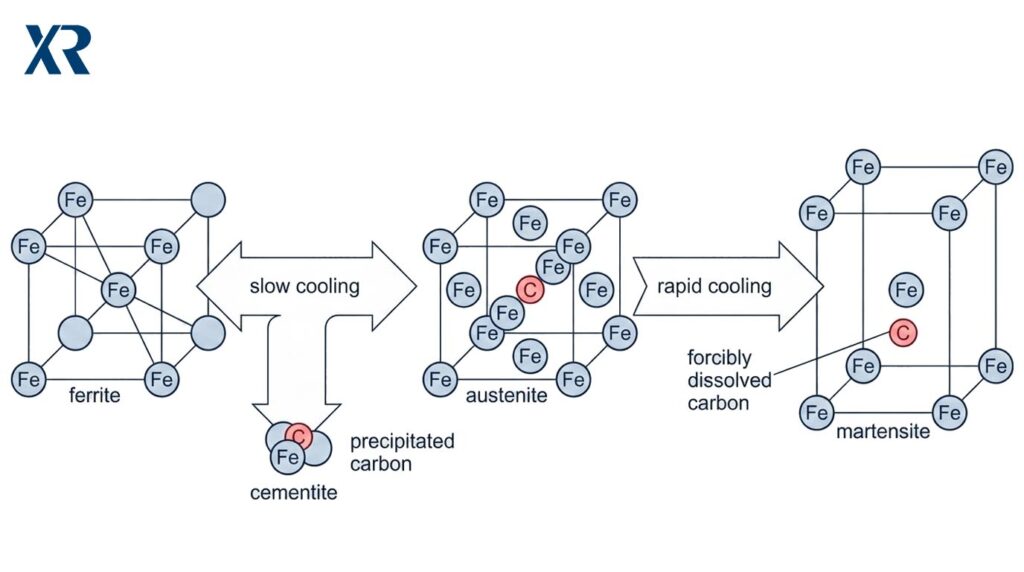
This is the step where the knife truly gains its strength. Once the knife is shaped, we heat it in a furnace until it reaches the precise temperature where its internal crystal structure transforms. The moment it hits that point, we have to cool it down instantly. This speed is what traps the molecules in a hard, rigid state known as martensite. If the cooling is too slow, the steel will just become soft again.
This is also a stage where many low-cost factories cut corners. Poor temperature control in the furnace can lead to uneven heating, and inconsistent cooling can result in a blade that has hard and soft spots. I’ve seen competitors’ products where one part of the blade is durable while another part dulls quickly. At XR Cutlery, we use controlled atmosphere furnaces and calibrated quenching baths to ensure every single knife is heated evenly and cooled at the exact right speed for uniform hardness.
What is tempering?
The knife is now very hard from quenching, but it's also extremely brittle. A hard knife that shatters or chips when dropped is just as bad as a soft one that bends. This fragility makes the product unreliable.
Tempering is a secondary heating process that reduces brittleness and adds toughness to a hardened knife. After quenching, we reheat the blade to a much lower temperature (around 150–300°C) to relieve internal stresses, creating a blade that is both hard and durable.
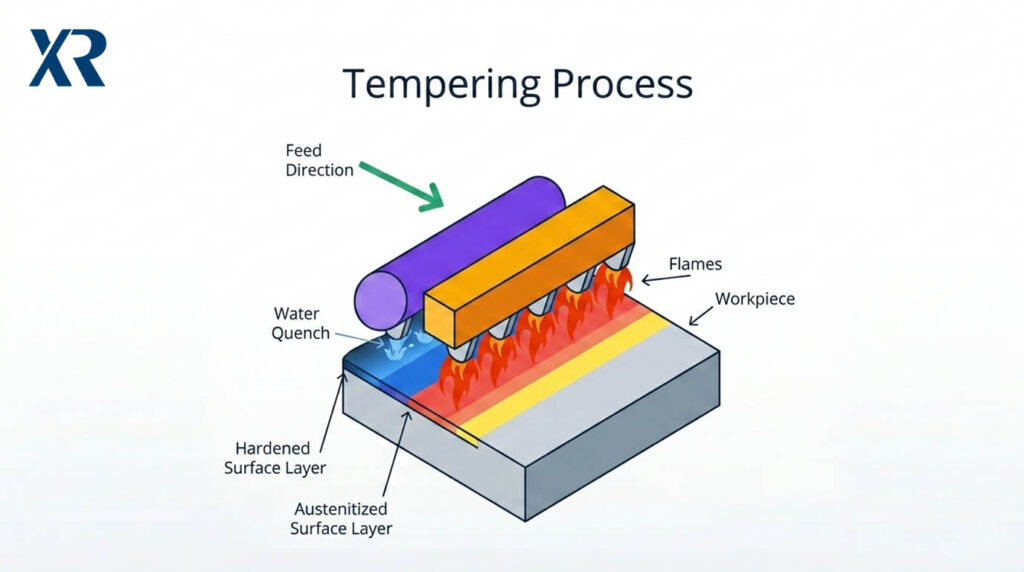
A common misconception is that harder is always better. In reality, a knife that is too hard is like glass—strong but brittle. The tempering process is the crucial final step to find the perfect balance. By gently reheating the quenched blade, we allow the rigid molecular structure to relax just enough to absorb impact without breaking. This trade-off—sacrificing a little bit of maximum hardness for a huge gain in toughness—is what makes a knife practical for everyday use.
After tempering, we perform straightening and grinding to correct any minor warping and sharpen the edge. We are careful to control the grinding temperature to avoid ruining the temper we just achieved. Finally, every batch undergoes hardness testing with a Rockwell (HRC) tester3. We test multiple knives from each batch to ensure the hardness falls within our strict, predefined range. This final check guarantees that the product you receive is not just hard, but reliably tough.
Conclusion
Heat treatment is not a single action but a precise sequence of controlled processes. It's how we transform a simple piece of steel into a durable, reliable, and perfectly balanced knife.