
How Does Screen Printing for Stainless Steel Cutlery Work?
Struggling to get your brand’s vibrant, colored logo onto stainless steel cutlery? You know laser engraving won’t preserve your brand colors, and you’re worried that any printed logo will just scratch off. The solution is understanding the professional process of screen printing for stainless steel cutlery, a method that allows for colored branding when executed with precision.
Screen printing for stainless steel cutlery, also known as silk screening, is a customization technique where ink is transferred onto the flatware's surface through a mesh screen. A squeegee pushes the ink through a stencil on the screen, creating a colored logo, text, or graphic directly on a relatively flat area, such as the handle.
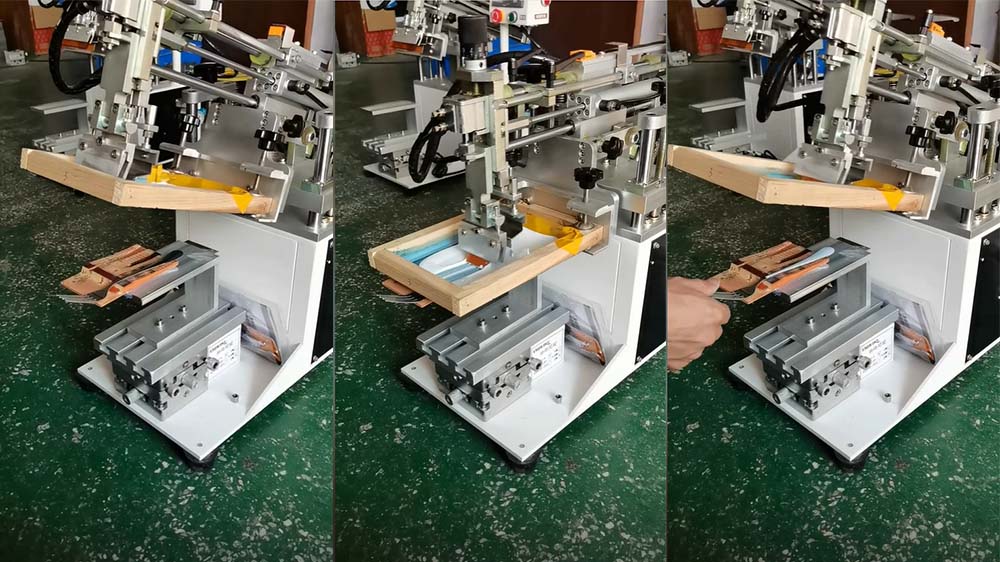
This method is more than just applying ink; it’s a controlled industrial process. Let's explore how it works, what makes it durable, and how it compares to other customization options so you can make an informed decision for your next wholesale or OEM order.
What Are the Key Applications of Screen Printing for Stainless Steel Cutlery?
Are you wondering where screen printing fits into the world of custom flatware? You might have a specific branding need but aren't sure if this method is the right tool for the job. Choosing the wrong technique can lead to a final product that doesn't match your brand's aesthetic or durability requirements.
Screen printing is ideal for adding colored branding to cutlery with relatively flat surfaces. It’s particularly effective for hotel, restaurant, and private-label flatware where a specific brand color—like a white, black, red, or blue logo—is essential for brand identity.
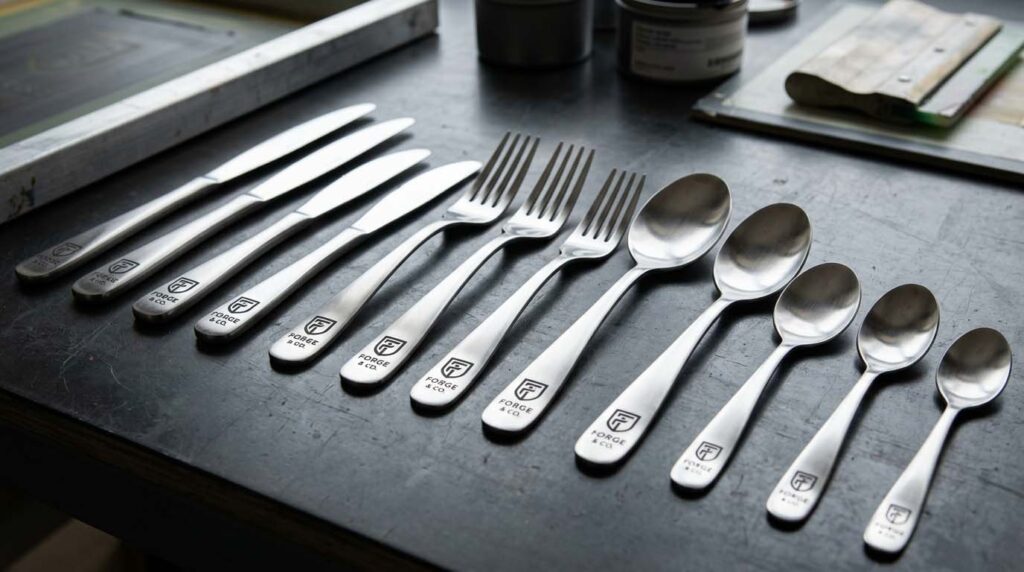
Where Screen Printing Shines
The primary advantage of screen printing for stainless steel cutlery is its ability to apply specific, opaque colors. This is something that methods like laser engraving, which only alters the metal's surface, cannot achieve.
If a client comes to me and says, “I want our actual brand color on the handle,” screen printing immediately becomes a top contender.
Common applications we handle at our factory include:
- Brand & Company Logos: The most common use, especially for private label brands and e-commerce sellers who want their logo prominently displayed.
- Hotel & Restaurant Branding: Many hospitality chains require consistent branding across all their properties. Screen printing allows for the hotel's logo to be printed on thousands of forks, spoons, and knives.
- Promotional Cutlery: For corporate gifts or marketing campaigns, a colorful and eye-catching design can be more effective than a subtle engraving.
- Decorative Graphics & Text: Beyond logos, simple patterns or text can be applied to handles to create a unique product line.
This technique is most suitable for projects where the design is relatively large and the printing surface is flat or has a very gentle curve. Think of classic, flat-handled flatware patterns—they are perfect candidates. For a large restaurant group that wants to brand their standard flatware sets, screen printing offers a cost-effective way to add that crucial touch of customization without altering the cutlery's physical form.
How Does the Screen Printing Process for Cutlery Actually Work?
It’s easy to think of printing as a simple one-step action, but in manufacturing, it’s a multi-stage process where every detail matters. If you don't understand the steps, you can't anticipate potential quality issues. A lack of process control can lead to inconsistent logo placement, poor color matching, and weak durability across a large order.
The screen printing process involves preparing the artwork and screen, mixing the correct ink, precisely positioning the cutlery in a fixture, applying the ink with a squeegee, and finally, curing the ink to ensure it bonds properly to the steel surface.
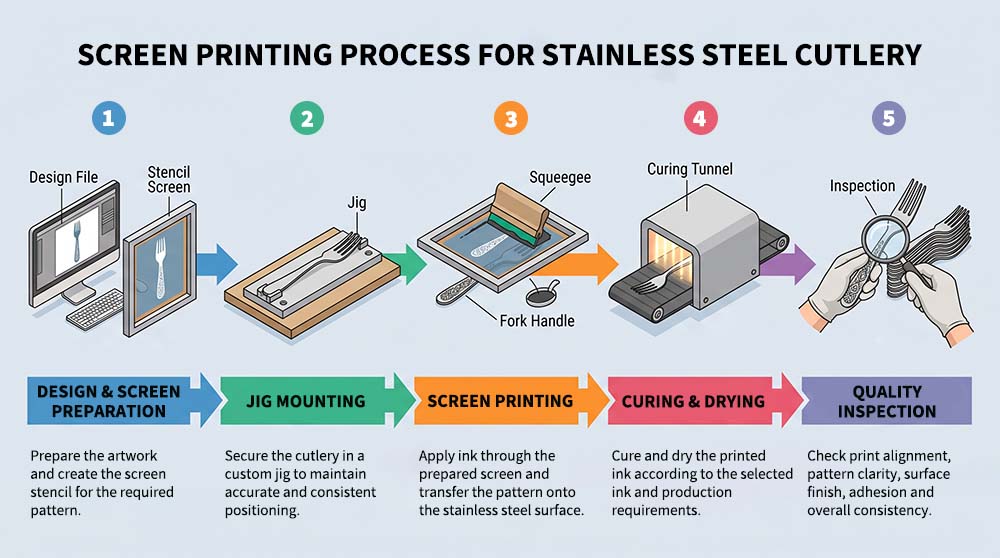
A Step-by-Step Breakdown
From a manufacturer's perspective, consistency across tens of thousands of pieces is the ultimate goal. Here’s a look at how we achieve that with screen printing for stainless steel cutlery.
- Artwork and Screen Preparation: It all starts with your design. We require a high-resolution vector file (like an .AI or .EPS) of your logo. This file is used to create a "screen"—a fine mesh stretched over a frame. The logo design is transferred to the screen using a photo-emulsion process1, which blocks off the mesh everywhere except for the shape of your logo. This open area is where the ink will pass through.
-
Ink Preparation: This is part science, part art. We select and mix an ink system based on the stainless steel's surface finish (e.g., mirror or matte), the required color, and the end-use durability requirements. The ink's viscosity and composition are critical for achieving sharp edges and proper adhesion.
-
Product Positioning (Fixturing): To print the same logo in the exact same spot on 50,000 forks, each fork must be held perfectly still in a custom-made holder called a fixture or jig. This step is non-negotiable for mass production. Without a precise fixture, logos will drift in position and angle, creating a major quality control failure.
-
The Printing Stroke: The fixtured cutlery is placed under the screen. A line of prepared ink is applied to the screen, and a flexible blade called a squeegee is pulled across it at a specific pressure, angle, and speed. This action pushes the ink through the open mesh of the logo stencil and onto the cutlery handle.
-
Drying and Curing: The printed piece is carefully removed and transferred to a drying rack or conveyor oven. The ink must be properly cured—either by air drying or, more commonly, by heat. Curing creates a chemical reaction that hardens the ink and bonds it permanently to the stainless steel surface. Simply looking at a freshly printed logo tells you nothing about its durability; the real quality is locked in during the curing stage.
Each of these steps contains variables that we must control to ensure the first piece looks identical to the last.
What Factors Affect the Quality of Screen Printing on Cutlery?
Ever received a batch of custom products where the logo looks great on some items but is blurred, misplaced, or faded on others? This inconsistency stems from a lack of control over key production variables. For a B2B buyer, these defects can render an entire shipment unacceptable, leading to delays and financial losses.
The final quality of screen printing for stainless steel cutlery is determined by the interplay of the cutlery's surface, the ink system, strict process controls, and proper curing. A failure in any one of these areas can lead to defects like blurred edges, poor adhesion, or color variations.
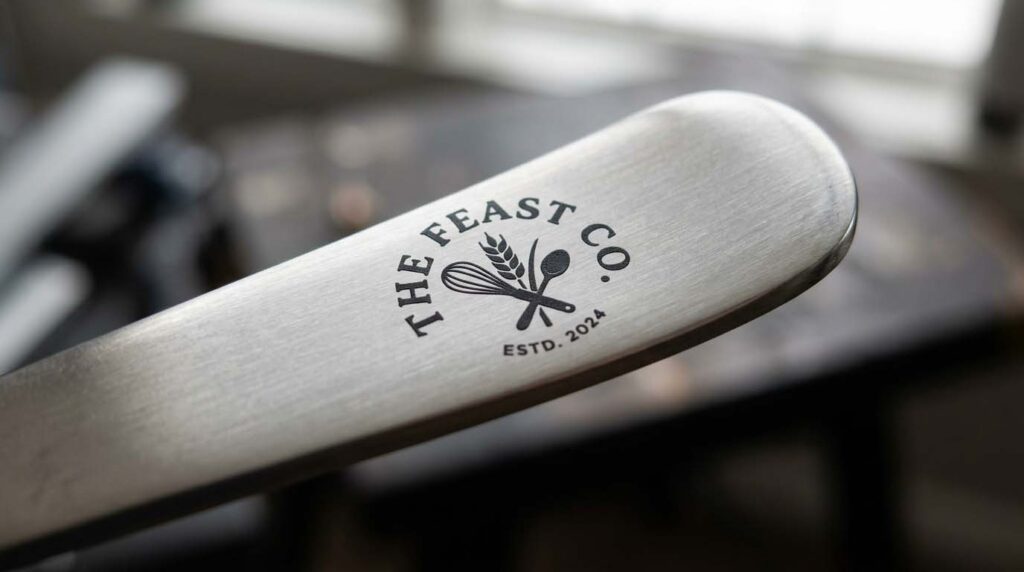
The Details That Define Quality
When a client sends us a logo and a product picture, our job is to think about all the factors that will impact the final result. A beautiful design on a computer screen can fail spectacularly on the factory floor if these elements aren't managed.
The Stainless Steel Surface Itself
The substrate is everything. A logo's appearance and adhesion will change based on the finish:
- Mirror Finish: Provides a high-contrast, sharp look but is unforgiving of any surface contaminants like oil or fingerprints.
- Matte (Satin) Finish: Offers a more subdued, softer look. The micro-texture can improve ink adhesion but may slightly soften the logo's edges.
- Brushed Finish: The directional lines of a brushed finish can interact with the printed logo, which needs to be considered during the design phase.
- PVD Coated Finish: Printing on a PVD (Physical Vapor Deposition) surface like gold, black, or rose gold is possible but requires specialized inks and testing. The PVD coating has different surface properties than raw steel, and adhesion must be rigorously verified.
Critical Process and Material Factors
Beyond the surface, a host of process variables must be dialed in:
- Surface Cleanliness: The cutlery must be perfectly clean before printing. Any residual polishing compound, dust, or oil will cause the ink to fail.
- Ink & Screen: The ink's viscosity and the screen's mesh count must be matched to the logo's detail. A fine logo requires a high mesh count screen, which in turn requires a specific ink consistency.
- Squeegee Control: The squeegee's pressure, angle, and speed determine how much ink is deposited. Inconsistent pressure leads to uneven color.
- Fixture Stability: As mentioned, the jig holding the cutlery must be robust. Any movement during the print stroke will cause blurring or smearing.
- Curing: Under-curing is a primary cause of poor adhesion. The ink may look dry but will easily scratch or peel off if it hasn't fully bonded to the steel. We perform adhesion tests (like the cross-hatch test) on samples to validate our curing process.
I remember a project for a hotel client who needed their logo on 100,000 forks. The handle had a slight curve. Our initial samples showed minor logo distortion at the edges. We had to redesign the fixture and adjust the squeegee's flexibility to accommodate the curve perfectly. Finding this in the sample stage saved the entire project from failure. This is why insisting on an approved pre-production sample is the most important step a buyer can take.
How Does Screen Printing Compare to Other Customization Methods?
With so many ways to put a logo on flatware, how do you know which is best? Choosing based on price alone can lead to disappointment if the result doesn't match your aesthetic or durability needs. You might select laser engraving for a colorful brand, only to end up with a monotone mark.
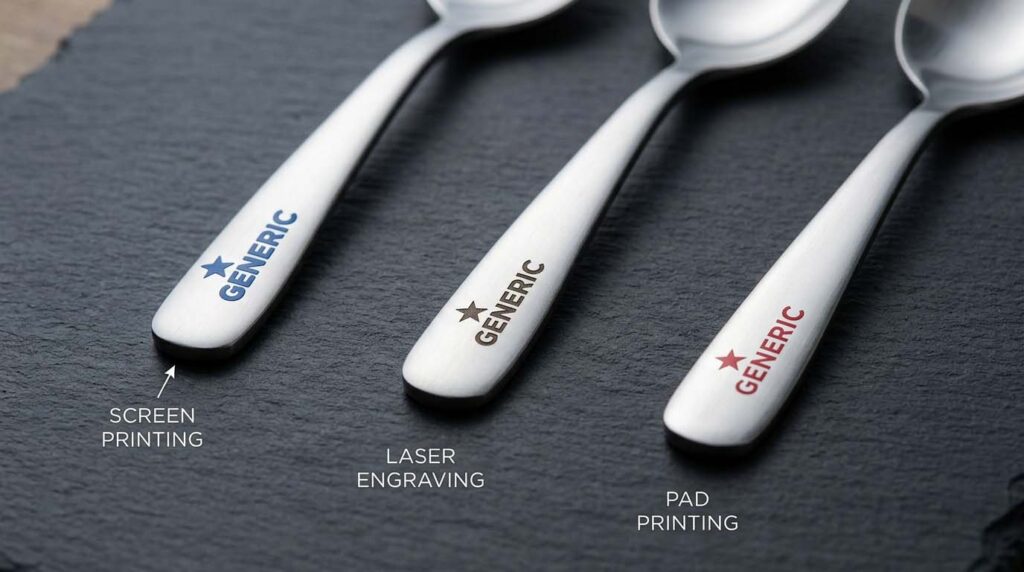
The best method depends on your desired look, the product's shape, and your application. Screen printing offers color, laser engraving offers permanence and subtlety, and pad printing is better for curved surfaces.
Choosing the Right Tool for the Job
As a manufacturer, we help clients navigate these options daily. The right choice is always a balance of design intent, product suitability, and performance requirements.
Screen Printing vs. Pad Printing
This is a frequent point of confusion. Both are ink-based printing methods.
- Screen Printing excels on flat or gently curved surfaces and is great for larger graphics and text. It pushes ink through a flat screen.
- Pad Printing uses a soft silicone pad to pick up ink from an etched plate and transfer it to the product. This flexibility makes it ideal for small logos on irregular or highly curved surfaces where a flat screen can't make proper contact.
The choice isn't about the logo itself, but about the combination of the logo and the surface it's being printed on.
Screen Printing vs. Other Methods
Here is a quick comparison table to help guide your decision:
| Method | Best For | Key Characteristic | Main Advantage | Main Limitation |
|---|---|---|---|---|
| Screen Printing | Colored logos on flat areas | Ink layer applied to the surface | Vibrant, specific brand colors | Limited to flat/gentle curves |
| Laser Engraving | Subtle, permanent logos | Removes or alters the metal surface | Extremely durable; no inks to wear off | Monochromatic (usually dark grey/black) |
| Pad Printing | Small logos on curved surfaces | Ink transferred via a flexible pad | Versatile for irregular shapes | Limited print size; less efficient for large graphics |
| Stamping/Embossing | Recessed or raised logos | Metal is physically deformed by a die | Extremely permanent; textural effect | High initial tooling cost; affects metal structure |
If a customer's brief is, “I want a red logo,” my mind immediately goes to screen or pad printing. If they say, “I want the logo pressed into the metal without color,” I know we need to discuss stamping. Understanding these fundamental differences is key to achieving your desired product outcome.
Frequently Asked Questions
Can you screen print on any stainless steel cutlery?
No, it's not suitable for all designs. Screen printing works best on cutlery with relatively flat or gently curved handles. Highly curved, ornate, or irregular surfaces can cause logo distortion or incomplete printing and are better suited for pad printing or laser engraving.
How durable is a screen-printed logo on flatware?
Durability depends heavily on the ink system, surface preparation, and curing process. For commercial use in hotels and restaurants, we use highly resistant two-part epoxy inks and optimized curing to maximize durability against frequent washing. However, it is an ink layer and can abrade over time with heavy use and harsh detergents.
What file format do you need for my logo?
For the best results, we always require a vector file of the logo. Common vector formats include Adobe Illustrator (.AI), .EPS, or scalable .PDF files. These files allow us to scale your logo to any size without losing sharpness or quality, which is crucial for creating a clean printing screen.
Is it possible to print a logo with multiple colors?
Yes, but each color requires a separate screen, a separate printing run, and a precise registration process to align them. This adds significant complexity and cost to the project. For most cutlery applications, a single-color logo is the most practical and cost-effective choice.
Conclusion
Ultimately, screen printing for stainless steel cutlery is a powerful customization method for adding vibrant, colored branding to your products. It excels where laser engraving cannot—by delivering logos in specific brand colors like white, red, or blue. However, its success is not guaranteed. It is a technical process where quality hinges on controlling every variable, from surface cleanliness and ink chemistry to fixture design and proper curing. For B2B buyers, the key isn't just finding a factory that can print a logo, but one that can do it consistently across a production run of thousands or even hundreds of thousands of pieces.
As a manufacturer with over 20 years of experience, we’ve perfected this process. If you’re considering custom-branded flatware for your hotel, restaurant, or private-label brand, let's talk. We can evaluate your design and product to determine if screen printing is the right fit and ensure your final product is something you can be proud of.
-
The photo-emulsion process is a critical technique in screen printing that allows for precise design transfer. ↩