
How Does Flatware Quality Control Work in Mass Production?
You've placed a huge order, but how can you be sure every one of the 100,000 pieces meets your standards? Without a solid QC process, you risk receiving defective products that can ruin your brand's reputation.
Flatware quality control in mass production is a multi-stage process. It relies on strict inspections at every step—from raw material checks to in-process monitoring and final pre-shipment sampling—to catch defects before they reach you.

As a factory owner, I can tell you that mass production isn't about luck; it's about systems. A reliable factory doesn't just check the final product; we build quality into every step of the manufacturing process. I remember a time we were producing a 120,000-piece order for a North American wholesaler. During our final inspection, we found a minor issue: about 2% of the forks had a very slight warp in the handle. It didn't affect function, but it wasn't perfect. We made the decision to rework the entire batch, which delayed shipment by three days. I nervously informed the client, and his response surprised me. He said, "You're the first factory that chose to delay a shipment instead of shipping it and hoping for the best." That client worked exclusively with us for the next five years. That's the power of a transparent and rigorous QC process.
What Happens Before a Single Fork is Stamped?
You're worried about the final product, but the biggest risks are often hidden in the raw materials. Using the wrong or defective steel can lead to a catastrophic failure of the entire production run.
Quality control starts with the raw materials. Before production begins, we verify the steel's chemical composition, check its thickness and hardness, and inspect for any visual defects. Substandard materials are immediately rejected.
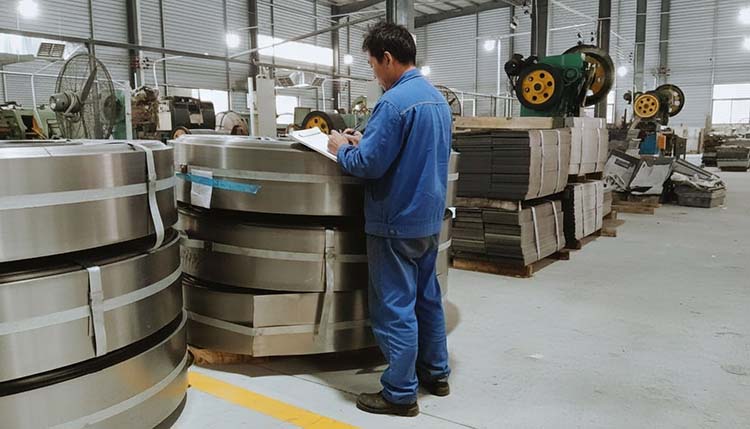
The old factory rule is simple: if the material is wrong, everything that follows will be wrong. You can't turn bad steel into good flatware. That's why the first QC gate is the most important one. When a new batch of steel coils arrives at our factory, our quality team gets to work immediately.
Key Incoming Material Checks
- Verify Documentation: We start by checking the mill test certificate provided by the steel supplier. This document confirms the exact grade (e.g., 304, 430) and chemical composition.
- Conduct Independent Tests: We don't just trust the paperwork. We take samples from the coil and use our own equipment, like a spectrometer, to verify the chemical makeup. This ensures the 18/10 steel you ordered is actually 18/10.
- Physical Inspection: We check the material's thickness and hardness to ensure it matches the product specifications. We also visually inspect the coils for any rust, dents, or surface imperfections.
Any material that fails these checks is quarantined and sent back to the supplier. This strict upfront control prevents costly problems from ever entering the production line.
How Do We Catch Defects During Production?
With thousands of pieces moving down the line every hour, how can you be sure each one is perfect? A single mistake in stamping or polishing can be replicated thousands of time before anyone notices.
We use in-process quality control (IPQC). At every critical manufacturing stage—stamping, forging, polishing, and assembly—trained operators and QC staff conduct checks to catch defects in real time and prevent them from multiplying.
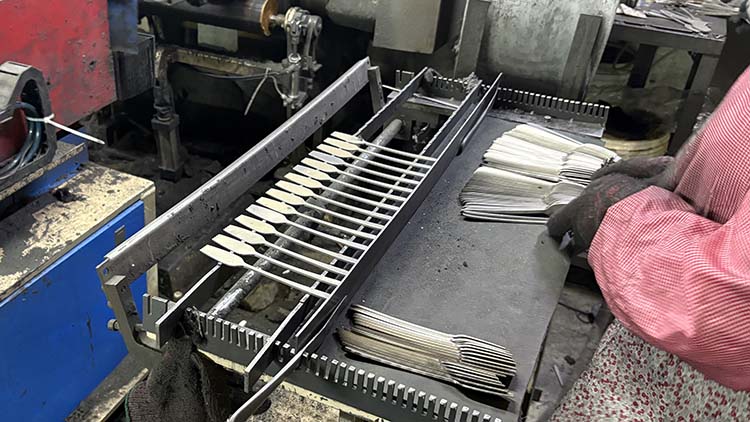
Waiting until the end to check for quality is a recipe for disaster. In mass production, we build quality checks directly into the workflow. Our operators are trained to be the first line of defense, and dedicated IPQC teams roam the factory floor to perform audits and spot-checks.
| Production Stage | Key QC Check | Purpose |
|---|---|---|
| Stamping/Forging1 | Check for sharp burrs, cracks, and correct shape. | Ensures the basic form is accurate and safe before moving to the next stage. |
| Grinding/Deburring | Inspect for smooth edges and removal of all burrs. | Prevents sharp edges that could be dangerous for the end-user. |
| Polishing | Look for scratches, dull spots ("orange peel"), or uneven finish. | This is critical for the product's final appearance. Defects here are highly visible. |
| Welding/Assembly | Test the strength of joints (e.g., between a knife blade and handle). | Guarantees the structural integrity of the flatware so it doesn't break during use. |
We use a combination of human eyes and technology. For example, our automated polishing robots ensure a consistent finish across thousands of pieces, while experienced inspectors under specialized lighting check for subtle imperfections that machines might miss.
What is the Final Hurdle Before Your Order Ships?
The products are made and packed. Is it finally time to ship? Not yet. This is the last and most critical chance to catch any issues before the order leaves the factory.
The final stage is the Pre-Shipment Inspection (PSI). Here, a random sample of the fully packed order is inspected based on internationally recognized standards (like ISO 2859-1) to verify overall quality, packaging, and quantity.
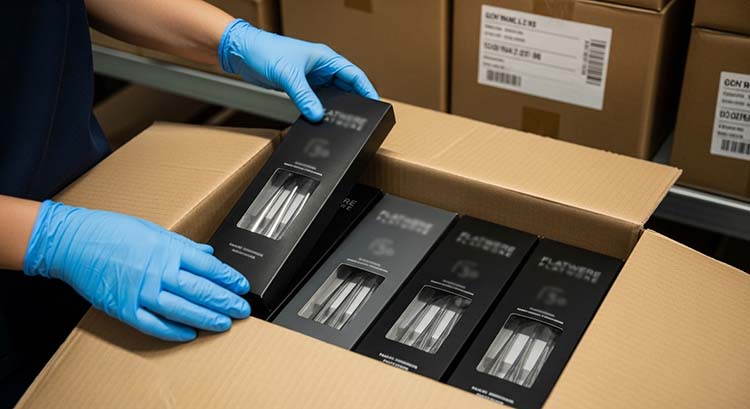
The PSI is your ultimate safeguard. Once 80-100% of your order is packed and ready to go, our independent final inspection team steps in. They don't know which boxes have which products; they pull cartons at random from the finished pallets. This process is statistical and objective. Using a sampling plan (often called AQL, or Acceptable Quality Limit2), they determine how many units to inspect. For an order of 120,000 pieces, this could mean inspecting several hundred individual items.
During this final check, they look for everything:
- Visual Defects: Scratches, rust spots, dents, polishing marks.
- Functional Defects: Bent tines, dull knives, poorly balanced pieces.
- Packaging and Labeling: Correct barcodes, accurate piece counts, and proper carton markings.
- Consistency: Do all the forks in a set match? Are the logos printed correctly?
If the number of defects found exceeds the pre-agreed limit, the entire lot is rejected. It must then be reworked and re-inspected. This final, rigorous check ensures that what you ordered is exactly what you get.
How Do We Ensure Consistency for Your Future Orders?
You love the first shipment, but how can you be sure your reorder next year will be identical? Maintaining consistency across multiple production runs is one of the biggest challenges in manufacturing.
We achieve consistency through traceability and meticulous record-keeping. Every batch is tracked, "golden samples" are preserved, and all specifications are documented, allowing us to perfectly replicate an order years later.
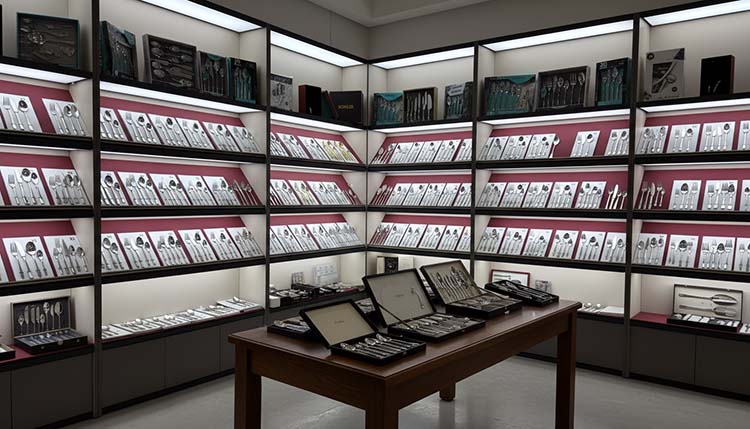
For a wholesaler, predictability is profit. You need to know that the flatware you reorder in two years will match the stock you have on your shelves. This is where a factory's internal systems become your greatest asset.
Here's how we ensure you can perfectly replicate an order:
- Batch Tracking: Every batch of production is assigned a lot number that traces back to the specific coil of raw steel used, the production date, and even the shift that made it. If a problem is ever reported, we can isolate the issue to a specific batch instead of recalling everything.
- Golden Samples: The pre-production sample you approved isn't just a memory. We preserve it in a controlled environment. This "golden sample" becomes the physical benchmark for all future runs.
- Digital Records: All technical specifications—weight, thickness, polishing sequence, packaging design—are stored digitally. When you place a reorder, we pull up the exact "recipe" to ensure a perfect match.
This disciplined approach means that when you find a product that works for your market, you can confidently sell it for years, knowing that every shipment will meet the same high standard as the first.
Conclusion
Effective flatware quality control is not a single event but a continuous system woven into every stage of mass production. It is a factory's commitment to stopping, checking, and correcting at every step.