
How Do You Develop a New Flatware Collection for Your Market?
You have a great idea for a new flatware collection, but launching it feels like a gamble. A failed launch means wasted investment, dead inventory, and a major setback for your brand.
To develop a successful flatware collection, start with market positioning, not design. Define your target customer, price point, and quality level early. Then, create designs that are not only beautiful but also optimized for consistent mass production and long-term replenishment.
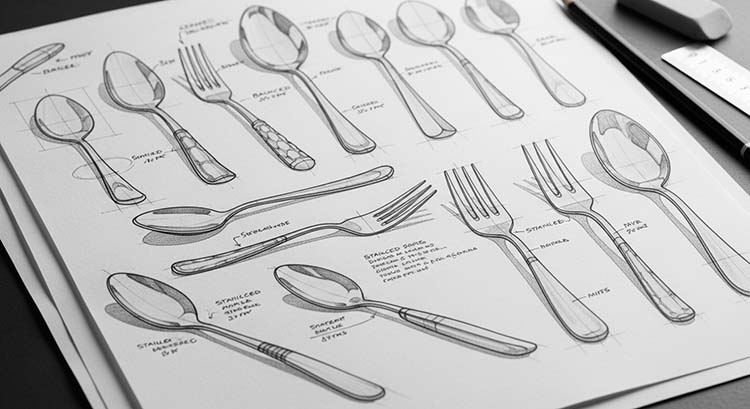
As the founder of XR Cutlery, I’ve helped clients launch hundreds of new collections. The most common mistake I see is falling in love with a design before understanding who it's for. A successful collection isn't just about a beautiful product; it's about a strategic product. It requires a clear plan that aligns the design, material, quality, and packaging with a specific market need. Let’s walk through the steps to build a collection that sells for years, not just for one season.
Why should you start with market positioning, not just design?
You found a stunning design, but after investing in a full production run, it doesn't sell. Now you're stuck with expensive inventory that doesn't fit your customers' needs or price expectations.
Starting with market positioning ensures your product fits its intended audience. By defining your target customer, price, and sales channel first, you can make strategic decisions about material, weight, and finish that align with market expectations and prevent a costly mismatch.
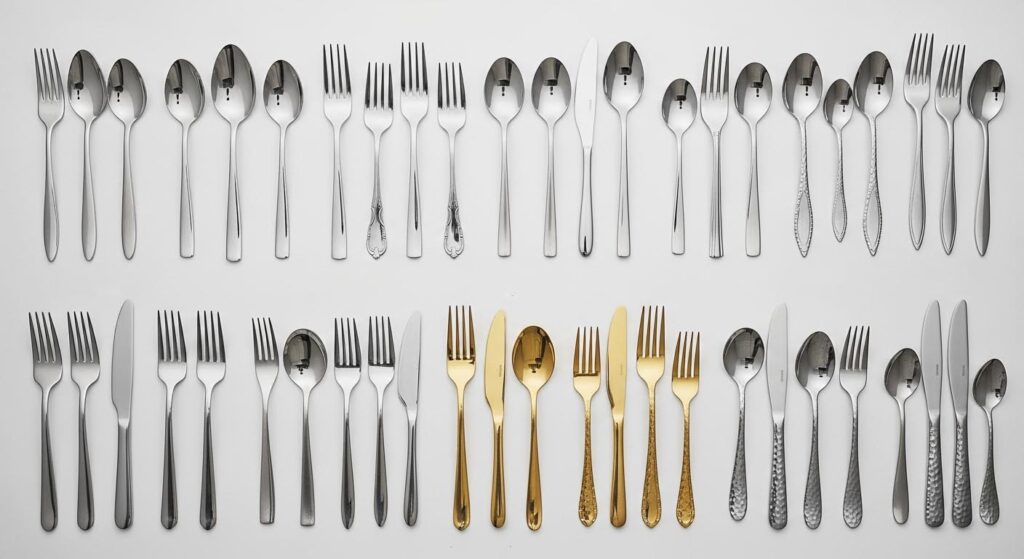
I always tell my clients that the most successful collections are not the most complex, but the most targeted. The first questions should never be "Is this design beautiful?" but rather "Who are we selling to?" and "What do they value?" The needs of a wholesale distributor supplying hotels are completely different from an e-commerce brand trying to catch a customer's eye on Instagram.
Defining this early on guides every other decision:
| Market Segment | Key Priority | Common Choice |
|---|---|---|
| Wholesale | Durability, consistency, cost-effectiveness | Heavier weight, 430/18-0 steel1, mirror polish |
| E-commerce | Strong visual impact, unique look | PVD colors (black/gold), unique finishes |
| Retail Brand | Differentiated design, brand story | Custom shapes, satin finish, quality packaging |
| Horeca2 | High durability, resistance to wear | Simple designs, 304/18-10 steel, stone wash |
By deciding whether your collection is for the premium market (heavy feel, 304 steel) or a price-conscious market (lighter weight, 430 steel) upfront, you create a clear roadmap for development and avoid creating a product that doesn't fit anywhere.
How can you ensure your design is ready for mass production?
Your prototype looks perfect, but the bulk order arrives riddled with defects. Now you're facing production delays, high reject rates, and the financial strain of a failed launch.
To ensure a design is ready for mass production, it must be evaluated for manufacturability during the concept stage. Collaborate with your factory to prototype and test for potential issues like weak points, difficult-to-polish curves, and overall structural stability.
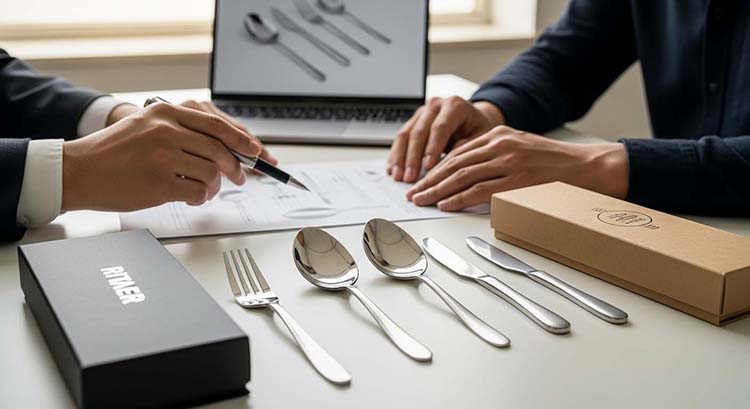
Many beautiful drawings translate into terrible products. This happens when a design isn't vetted by people who actually understand the physics of metal stamping and polishing. At XR Cutlery, our engineering team is involved from the very beginning to prevent these common mass production failures. For example, a handle that is too thin might look elegant, but it can easily bend or deform. A curve that is too sharp or intricate may create "dead zones" that polishing wheels can't reach, resulting in an inconsistent finish.
Prototype testing is more than just approving the look. It's a critical stress test. During this phase, you must confirm:
- Hand Feel and Balance: Does it feel good in the hand? Is the weight distributed comfortably?
- Durability: Does it pass basic stress tests without bending or deforming?
- Batch Reproducibility: Can the finish and shape be replicated consistently across thousands of units?
Fixing a design flaw at the sample stage costs a few hundred dollars. Fixing it after 50,000 units have been produced can cost you your entire business.
How do you build a collection for long-term success?
Your first batch sells out, but when you reorder, the new stock doesn't match. This inconsistency angers your distributors, confuses customers, and kills your brand's momentum.
Build for long-term success by planning for replenishment from day one. Develop a core SKU structure, work with a factory that standardizes all processes, and ensure they have a system for mold retention and batch consistency.
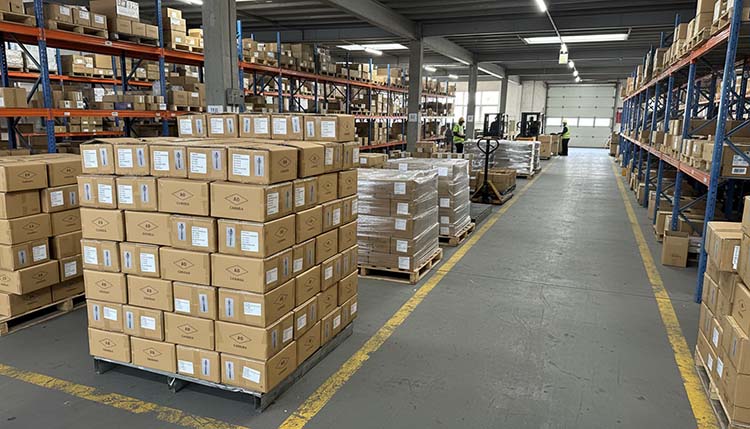
The true measure of a successful collection isn't the first order; it's the tenth. For distributors, nothing is worse than a bestseller they can't reliably restock. This is why we build our OEM/ODM process around long-term stability. With over 20 years of experience exporting to markets in Europe, the Americas, and the Middle East, we understand that consistency is king.
Here’s how we ensure your collection can scale:
- Smart SKU Structure: We help you develop a range with core models for steady sales, extension models (like serving spoons) to increase order value, and unique feature models to define your brand style.
- Standardized Production: We document every step. Your mold is retained, the polishing parameters are recorded, and the material grade is locked in. The product you order five years from now will be identical to the first batch.
- Integrated Development: With our in-house mold development capabilities, we can create custom tooling quickly and cost-effectively, whether from a drawing, a photo, or just an idea. This allows you to create truly differentiated products.
A factory should be more than just a pair of hands. A true partner helps you optimize your collection for consistent, scalable, and long-term market success.
Conclusion
A successful flatware collection is not just a beautiful product. It is a well-planned system that can be consistently manufactured, reliably replenished, and strategically scaled for long-term market dominance.
-
Research indicates that 430 stainless steel exhibits good corrosion resistance and is cost-effective for various applications, including in the wholesale market. ↩
-
Research indicates that the Horeca sector emphasizes durability and resistance to wear in its product choices due to the demanding nature of the industry. ↩