
How Are Stainless Steel Spoons and Forks Stamped and Shaped?
Have you ever wondered why some flatware feels cheap and flimsy while other sets feel balanced and substantial? The problem often isn't the material itself but a flawed manufacturing process. This can agitate brands and importers, as inconsistent quality damages reputation. The solution lies in understanding how stainless steel spoons and forks are stamped and shaped—the foundational step that defines quality.
The process of how stainless steel spoons and forks are stamped and shaped involves multiple stages. It begins with cutting a flat silhouette (a blank) from a sheet of stainless steel. This blank is then rolled to refine its thickness, trimmed to remove excess material, and stamped with any handle patterns. Finally, dedicated presses form the spoon bowl or fork tines and bend the entire piece into its final ergonomic shape.
Now that you have the quick answer, let's dive deeper. This multi-step journey from a simple steel sheet to a finished utensil is a blend of power, precision, and artistry. Understanding these stages is key to sourcing high-quality flatware that will satisfy your customers and elevate your brand.
What Are the Initial Steps in Preparing and Cutting the Steel?
Sourcing flatware that looks good in photos but feels cheap in hand is a common frustration for importers. This inconsistency can lead to customer complaints and damage your brand's credibility. The root of this issue often lies in the very first steps: a failure to properly prepare and cut the raw material.
The initial preparation involves selecting the correct grade and thickness of stainless steel coil and then using a high-tonnage press to "blank" or cut the flat outline of the spoon or fork. This stage sets the groundwork for the product's final dimensions and quality.
The Importance of Raw Material Selection
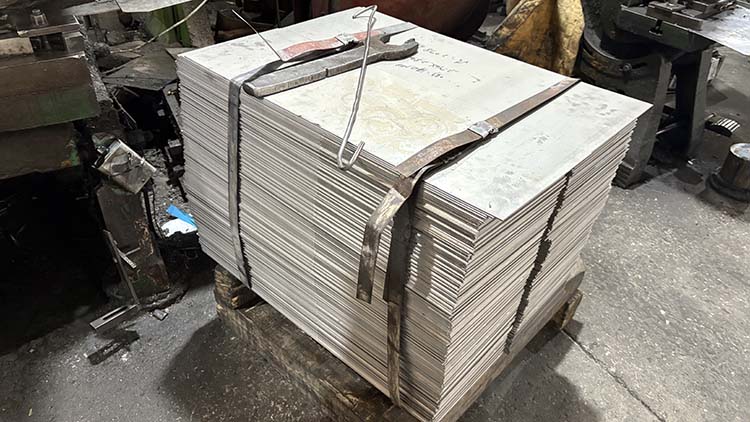
Everything begins with a roll of stainless steel. Before a single spoon is stamped, our first job is to ensure the raw material is perfect. This isn't just about grabbing any steel; it's a meticulous selection process. We work with trusted suppliers to source specific grades of stainless steel, most commonly 18/10 (304), 18/0 (430), or 18/8. The choice depends entirely on your needs—whether it's for high-end hotel use, retail, or a cost-effective wholesale line.
Our quality control team inspects every incoming coil for:
- Correct Grade: We verify the chemical composition to ensure it meets specifications like FDA and LFGB standards.
- Consistent Thickness: A variance of even a fraction of a millimeter can affect the final weight and feel of the flatware.
- Surface Defects: We check for scratches, rust, or other imperfections that could compromise the finished product.
Only after a coil passes this initial inspection is it cleared for production. This strict front-end control prevents massive headaches and inconsistencies down the line, ensuring every batch we produce for you is as good as the last.
The Blanking Process: Creating the Initial Shape
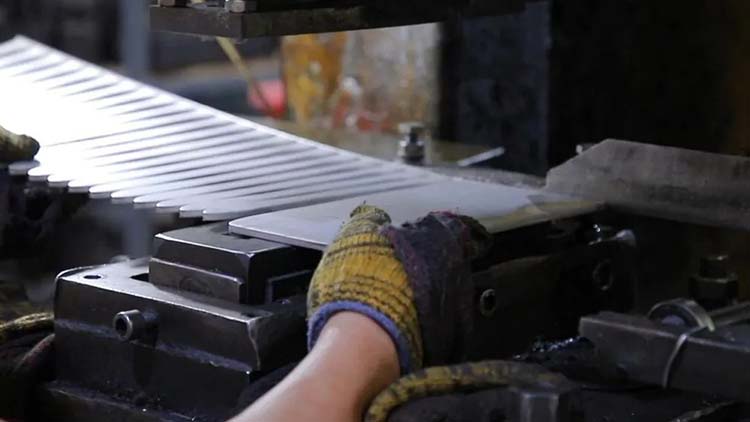
Once the steel is approved, it's fed into a massive high-tonnage press for the "blanking" operation. This is where the magic begins. A powerful press, fitted with a custom die, stamps out the flat, two-dimensional outline of the spoon or fork from the steel sheet. At this point, it looks like a simple metal silhouette of the final product.
The precision of the blanking die is critical. A well-made die ensures:
- Clean Edges: Minimizes rough edges, known as burrs, which would require extra finishing work.
- Dimensional Accuracy: The blank must be the exact right size to ensure the final product meets specifications.
- Efficient Material Use: The layout on the steel sheet is optimized to reduce scrap waste, which helps keep production costs competitive.
This first stamping step is the foundation. If the blank is cut incorrectly, no amount of polishing or finishing can fix it. That's why we invest heavily in maintaining our tooling and calibrating our presses.
How is the Flat Blank Refined Before Final Shaping?
You've got a flat metal outline of a spoon, but it's still a long way from being a finished product. If you stop here, you end up with a flimsy, cheap-feeling piece. This is where many low-cost manufacturers cut corners, resulting in flatware that lacks balance and a premium feel.
To refine the blank, it undergoes several crucial steps. It is first rolled to redistribute the material, then trimmed to perfect the outline, and finally embossed if a handle pattern is required. This sequence adds strength, smoothness, and character.
Rolling for Strength and Balance (Elongation)
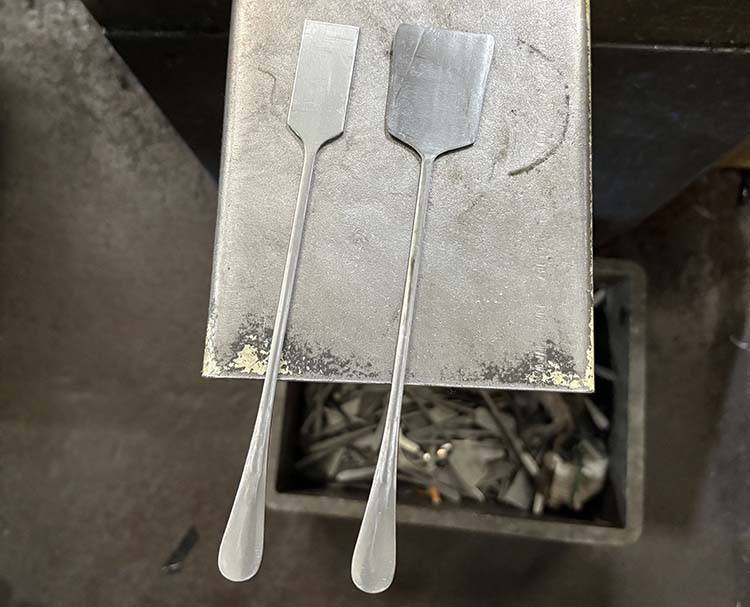
After blanking, the flat piece goes through a rolling process, sometimes called elongation. This is one of the most important steps that separates premium flatware from budget options. The blank is passed through rollers that apply pressure to specific areas, typically thinning the neck (where the handle meets the bowl or tines) while keeping the handle thicker.
This isn't about making the piece thinner overall; it's about strategic material distribution. This process achieves several things:
- Improves Strength: It work-hardens the steel in critical areas.
- Creates Balance: It allows us to control the weight distribution, ensuring the final piece feels balanced in the hand.
- Smooths Transitions: It creates a graceful, tapered transition from the functional end to the handle, which is a hallmark of quality design.
When a client wants a particularly substantial feel, we adjust the rolling process to create a thicker, more robust profile.
Trimming for a Clean Profile
The initial blanking and rolling processes can leave behind a small amount of excess material or slight roughness around the edges, called "flash" or "burrs." The trimming step cleans this up. The piece is placed in another press with a trimming die that precisely cuts away any imperfections, leaving a perfectly smooth and consistent outline.
This step is non-negotiable for safety and aesthetics. A properly trimmed piece has smooth edges that are comfortable to hold and touch. It also ensures that every single fork or spoon in a production run has the exact same profile, guaranteeing consistency for large orders.
Embossing: Adding Character and Brand Identity
If the design calls for a pattern on the handle, this is when it's added. Using another stamping press, a die with the desired pattern is pressed into the handle. This can be anything from classic floral motifs to modern geometric textures or a custom brand logo.
This is a key area for our OEM and ODM clients. For example, we worked with a North American private label brand that wanted a unique textured handle to stand out in the crowded online marketplace. During tool development, we carefully adjusted the embossing depth. The goal was to create a pattern deep enough to remain crisp and clear after polishing, but not so deep that it would create production challenges or trap food particles. This attention to detail helped the client launch a successful and differentiated product line. For minimalist designs, this step is simply skipped.
What Happens During the Final Forming and Bending Stages?
At this point, you have a well-shaped, patterned, and trimmed flat piece of metal. But it's still not a spoon or a fork. The piece feels unbalanced and is functionally useless. This is where the product's two-dimensional silhouette is finally transformed into a three-dimensional, functional utensil.
The final stage of how stainless steel spoons and forks are stamped and shaped involves two key operations: pressing the bowl or tines into their functional shape, and then bending the entire piece to create the correct ergonomic profile for balance and comfort.
Creating the Function: Spoon Bowl and Fork Tine Forming
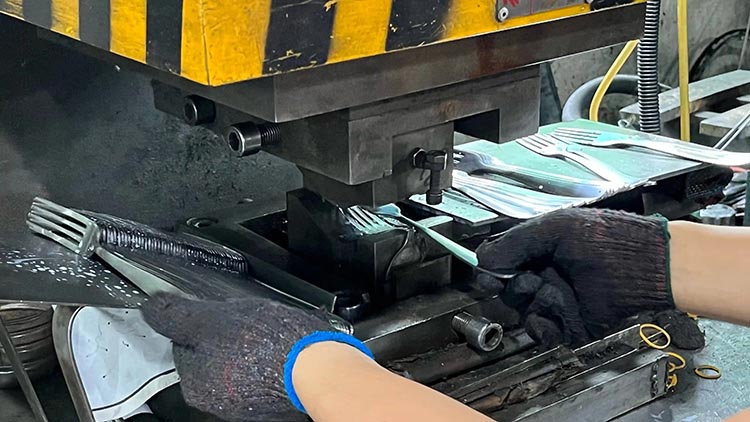
This is the moment of transformation. The flat blanks are placed into a forming press equipped with highly specific dies.
For Spoons: A die presses the flat end of the blank into a concave mold, creating the spoon's bowl. As manufacturers, we have precise control over every aspect of this process:
- Bowl Depth and Capacity: Ensuring a teaspoon holds the right amount.
- Curvature: Creating a shape that feels comfortable in the mouth.
- Symmetry: Guaranteeing the bowl is perfectly shaped without any lopsidedness.
For Forks: A similar process shapes the fork's head. The die not only forms the slight curve of the head but also ensures the tines are perfectly aligned. We control:
- Tine Spacing: To be effective for piercing food without being too wide.
- Tine Straightness: To ensure a uniform and high-quality appearance.
- Overall Symmetry: To prevent any twisting or misalignment.
The precision of these forming dies is paramount. Inaccurate forming leads to uneven spoon bowls or misaligned fork tines—defects that even the best polishing can't hide.
The Art of the Bend: Ergonomics and Aesthetics
A completely flat fork or spoon would be awkward to use. The final shaping step involves bending the piece to give it an ergonomic profile. The piece is placed in another press that creates several crucial bends:
- The Handle Curve: A gentle upward or downward curve is added to the handle so it rests comfortably in the user's palm.
- The Neck Angle: The angle between the handle and the head is adjusted. This is critical for balance and how the utensil rests on a table.
- The Shank Bend: A slight "crank" or bend is often added just before the bowl or tines, lifting them off the surface.
This is what gives flatware its "balance." When I hold a well-made fork, the weight feels evenly distributed, making it feel like a natural extension of my hand. This is no accident; it's the result of a carefully controlled bending process that we replicate thousands of times with unerring consistency.
Why is Quality Control Crucial After Stamping and Shaping Stainless Steel Spoons and Forks?
After so many powerful stamping and bending operations, it’s easy to assume the product is ready for polishing. However, rushing this step is a recipe for disaster. Minor deviations in shape or straightness can become glaring flaws after polishing, leading to high rejection rates and wasted resources.
A final, rigorous inspection after forming is the only way to guarantee a consistent, high-quality batch. This post-forming QC ensures that every piece is perfectly straight, symmetrical, and meets all dimensional tolerances before it moves to the finishing stages, where corrections become impossible.
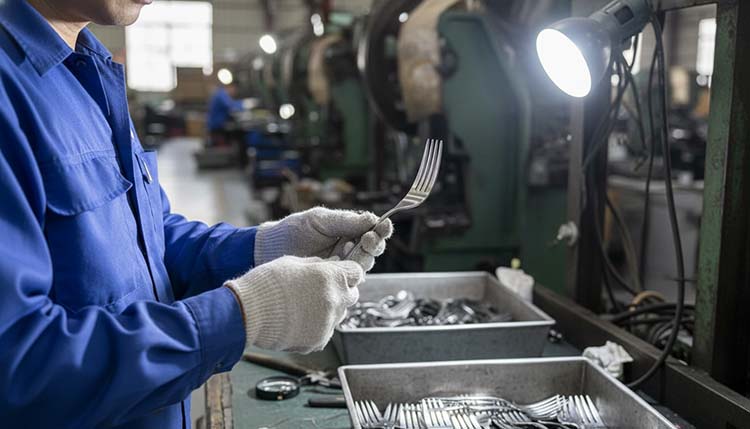
The Final Check: Straightening and Pre-Polish Inspection
Before a single piece moves to our polishing department, it must pass through another dedicated QC checkpoint. After being subjected to multiple high-tonnage presses, it's common for some pieces to have minor inconsistencies. Our inspectors check each item for:
- Straightness: Is the fork or spoon perfectly straight from end to end?
- Symmetry: Is the handle aligned with the head? Is the bowl centered?
- Tolerances: Does the piece meet the exact thickness, length, and width specified in the technical drawings?
Pieces with minor deviations are sent for fine-tuning and straightening. Any item that cannot be corrected to meet our strict standards is rejected. As a factory, we know that identifying issues at this stage is far more efficient than discovering them after hours have been spent on polishing. This early detection is key to how we maintain quality across massive production runs for our wholesale and private label clients.
How Stamping Quality Dictates Polishing Success
This is a lesson I learned early in my 20+ years in this industry: polishing can only enhance the quality of the form; it can never create it. A poorly stamped piece with uneven surfaces or inconsistent curves will still be a poorly shaped piece after it's polished—it will just be a shiny one.
I recall a situation where a European kitchenware distributor sent us samples from their previous supplier. The forks had slightly misaligned tines, and the spoon bowls were not perfectly uniform. They wanted to know if we could "fix" this with a better polish. After reviewing their samples, we explained that the root cause was in the stamping and forming dies. We recommended a new tooling setup with tighter tolerances. The resulting products were not only dimensionally consistent but also achieved a smoother, more brilliant mirror polish because the underlying surface was perfect to begin with. This helped the customer elevate the quality of their entire collection.
Frequently Asked Questions
What's the difference between stamped and forged flatware?
Stamped flatware, as described here, is cut from sheets of stainless steel. Forged flatware is made from a solid bar of steel that is heated and hammered into shape. Forging is generally more expensive and results in a heavier, thicker piece, while stamping is far more common for its efficiency and design versatility.
How does the thickness of stainless steel affect the final spoon or fork?
Thickness is a key indicator of quality. Thicker steel (e.g., 3.0mm or more) results in a heavier, more substantial, and durable piece that resists bending. Thinner steel is less expensive but can feel flimsy. We can customize the thickness based on your brand's target market and price point.
Can you create a custom handle pattern for my brand?
Absolutely. This is a core part of our OEM/ODM service. We can create a custom embossing die based on your design, whether it's a logo, a unique texture, or a specific pattern. This is an excellent way to create a proprietary product line that differentiates your brand.
Why do some forks feel more balanced than others?
Balance is a direct result of the rolling (elongation) and bending stages. A well-designed piece has its weight strategically distributed between the handle and the head. This is achieved by controlling the thickness at different points and creating the correct ergonomic bends, ensuring it feels comfortable and stable in the hand.
Conclusion
The journey of how stainless steel spoons and forks are stamped and shaped is a testament to precision engineering. It’s a multi-stage process where success at each step—from blanking and rolling to forming and bending—is critical for the final outcome. As we've seen, a high-quality finish is impossible without a perfectly formed foundation. This commitment to foundational quality is what separates premium, durable flatware from the rest. It ensures every piece is not just functional, but also balanced, consistent, and built to last.
If you are an importer, wholesaler, or brand owner looking for a manufacturing partner who understands the importance of every step, contact us at XR Cutlery. Let's work together to build a flatware collection with the consistent quality your brand deserves.