
Flatware Buying Guide for Supermarkets: What Do You Need to Know?
Struggling to build a flatware collection that flies off the shelves while protecting your margins? Many supermarket buyers face the challenge of balancing quality, price, and customer appeal, leading to slow-moving inventory and missed opportunities. This comprehensive flatware buying guide for supermarkets is designed to provide the clarity you need to select profitable products and reliable supply partners for your retail program.
A successful supermarket flatware program hinges on a strategic balance of four key elements: understanding your specific customer segments, selecting the appropriate stainless steel material for each tier, choosing market-proven designs with effective retail packaging, and sourcing everything from a reliable wholesale flatware supplier who can guarantee quality and supply stability.
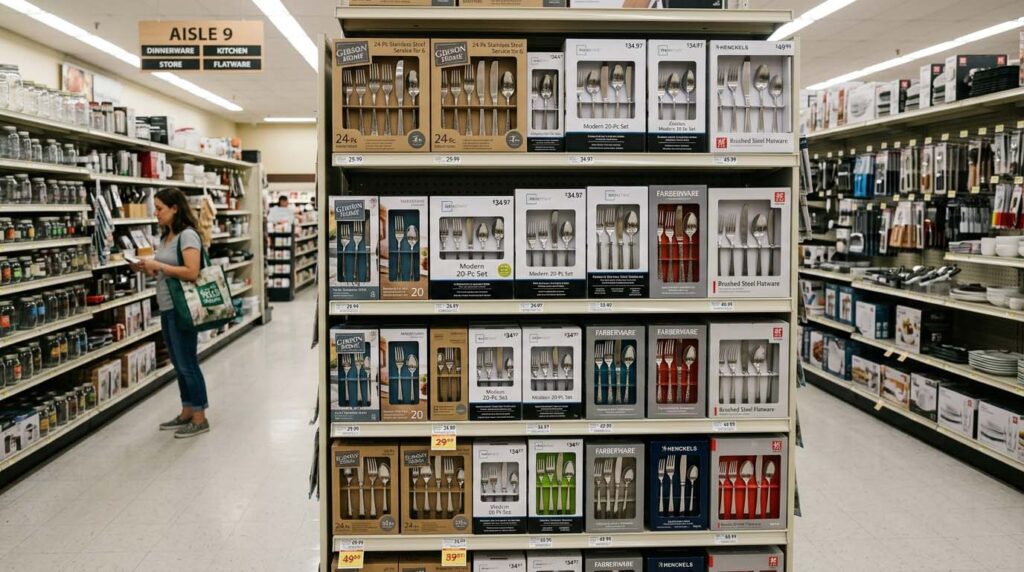
Choosing the right flatware manufacturer is the foundation of a successful tableware category. In this guide, we'll draw on our 20+ years of experience as a stainless steel cutlery manufacturer to walk you through the critical decisions that importers, distributors, and retail procurement managers must make.
How Should You Segment Customers for Supermarket Flatware?
A one-size-fits-all approach to your flatware assortment rarely works. If you only offer low-price options, you miss out on higher margins, but if you only stock premium sets, you alienate a large portion of the market. The solution is to segment your offerings to meet diverse customer needs.
Your flatware selection should be tailored to distinct customer tiers: entry-level, mid-range, and premium. Each group has different priorities regarding price, durability, and aesthetics, which should directly inform your product sourcing.
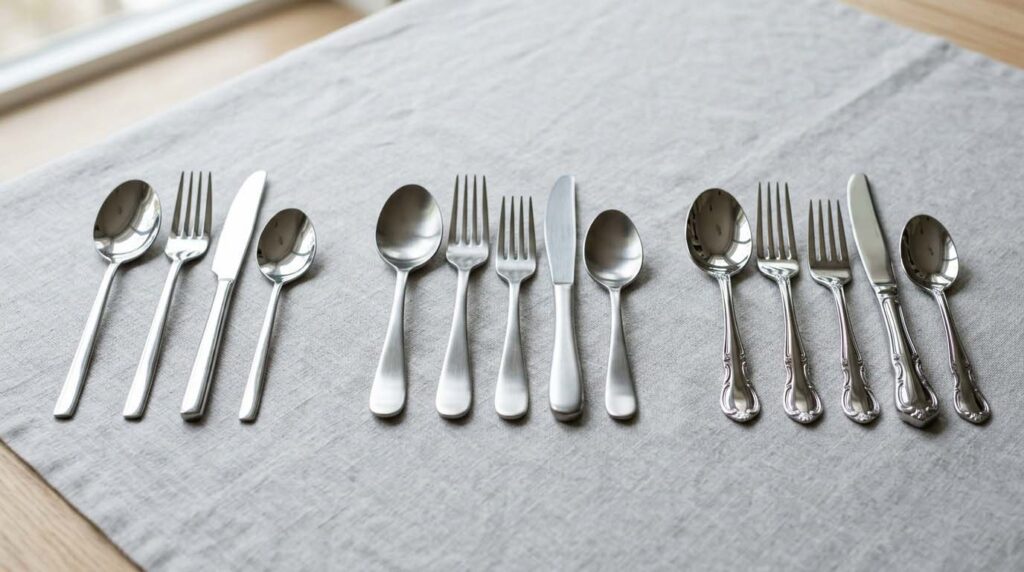
Entry-Level Customers
These consumers are highly price-sensitive and prioritize functionality and practicality above all else. They are looking for a basic, durable set for everyday use that offers maximum value. This segment represents a significant volume opportunity for supermarkets.
- Recommended Material: 18/0 stainless steel (e.g., 430 grade) offers good durability at the most competitive price point.
- Design: Simple, classic designs with a basic mirror polish have the widest appeal.
- Packaging: Standard, cost-effective packaging like a simple color box or bulk wrap is sufficient.
Mid-Range Customers
This is often the largest and most profitable segment. These customers are willing to pay a little more for better quality, improved appearance, and enhanced durability. They want a product that looks good, feels substantial, and will last for years.
- Recommended Material: 18/8 stainless steel (e.g., 304 grade) is the ideal choice, offering a great balance of corrosion resistance and value.
- Design: Modern, minimalist handle designs are very popular. This is where you can introduce more variety.
- Packaging: Upgraded packaging, such as a window box or a simple gift box, elevates the perceived value and makes the product more appealing on the shelf.
Premium Customers
While a smaller segment, premium customers offer the highest margin potential. They are interested in brand value, luxury aesthetics, and unique design features. This is an opportunity to create a "halo effect" for your entire tableware category.
- Recommended Material: 18/10 stainless steel is the gold standard, known for its superior luster and exceptional corrosion resistance.
- Design: This is the place for special finishes like hammered handles, stone wash, or PVD coatings (gold, black, rose gold).
- Packaging: Custom-designed, high-quality gift boxes are essential to communicate the product's premium nature.
| Customer Segment | Key Characteristic | Recommended Material | Popular Designs & Finishes | Packaging Focus |
|---|---|---|---|---|
| Entry-Level | Price-sensitive | 18/0 (430) Stainless Steel | Simple, classic, basic polish | Cost-effective |
| Mid-Range | Seeks value & style | 18/8 (304) Stainless Steel | Modern, minimalist, mirror polish | Retail-friendly |
| Premium | Desires luxury | 18/10 (304) Stainless Steel | Hammered, PVD, stone wash | Gift-ready |
What Stainless Steel Grade is Best for Supermarket Flatware?
The choice of stainless steel can seem confusing, with numbers like 18/10, 18/8, and 18/0 thrown around. Making the wrong choice can impact your cost, product longevity, and customer satisfaction. Let's clarify the best options for a retail environment.
For supermarket programs, the most common and effective material choices are 18/10, 18/8, and 18/0 stainless steel. The right choice depends entirely on the target customer and price point you identified in the previous step.
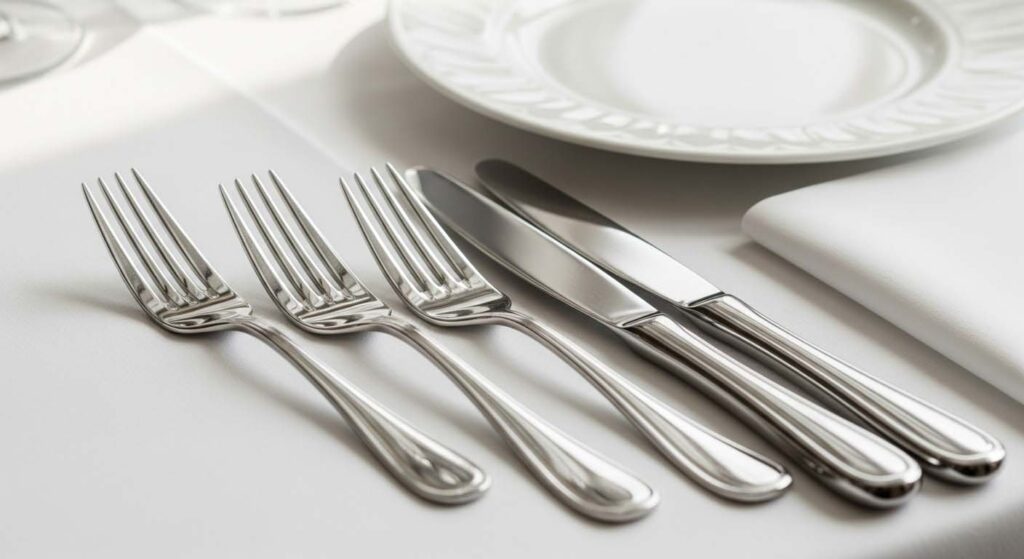
As a stainless steel flatware wholesale supplier, we produce large volumes of all three main grades for clients worldwide. Here’s a breakdown of where each one fits best.
18/10 Stainless Steel (304 Grade)
This is the highest quality material commonly used for flatware. The "18/10" refers to its composition of 18% chromium and 10% nickel. The high nickel content provides superior resistance to rust and corrosion, and gives the flatware a brilliant, silver-like shine.
- Suitable for: Premium supermarket lines, high-end retail brands, and luxury gift sets.
- Advantages: Excellent corrosion resistance, premium look and feel, long lifespan, and high perceived value.
18/8 Stainless Steel (304 Grade)
18/8 stainless steel also contains 18% chromium and a slightly lower 8% nickel. It is the most popular choice for quality, everyday household flatware. It offers excellent durability and rust resistance at a more accessible price point than 18/10.
- Suitable for: Mid-range retail collections, everyday family use, and most private label programs.
- Advantages: Great balance of performance, appearance, and cost. It's the workhorse of the retail flatware world.
18/0 Stainless Steel (430 Grade)
This grade contains 18% chromium but a negligible amount of nickel (less than 0.75%). While its corrosion resistance is lower than 18/10 or 18/8, it is perfectly adequate for most household situations, especially with proper care. It is also magnetic, which some consumers prefer.
- Suitable for: Large-volume supermarket programs, promotional items, and entry-level price points.
- Advantages: Highly competitive pricing, good durability for the cost, and ideal for mass-market distribution.
An Important Note on Other Materials
We often see buyers confused about other steel types. 316 stainless steel has even better corrosion resistance but is generally unnecessary and too costly for flatware. On the other hand, 410/420 stainless steel are primarily used for knife blades due to their hardness, which allows for a sharp serrated edge. They are not substitutes for 18/8 or 18/10 for forks and spoons.
What Flatware Designs Have the Highest Sell-Through in Supermarkets?
With an endless sea of patterns available, it's tempting to select complex or trendy designs. However, for the supermarket channel, a focused and proven assortment is far more effective. You want designs that have broad appeal and won't quickly fall out of fashion.
The most successful retail strategies focus on three core design categories: classic, modern minimalist, and luxury/decorative. These categories cover the majority of consumer preferences and are easy to merchandise.
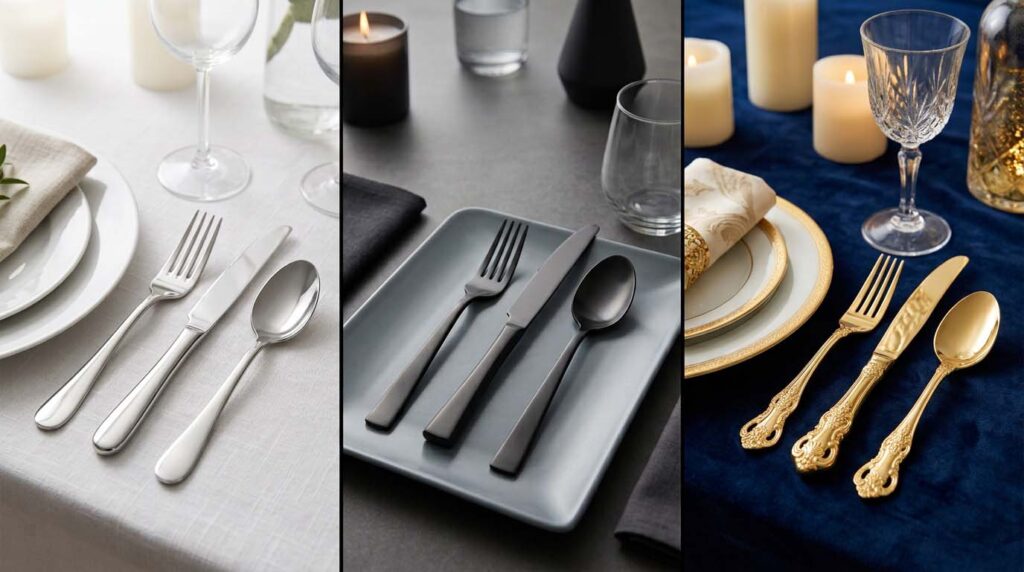
At XR Cutlery, we offer over 500 existing designs, but we find that our clients in the supermarket and retail sector achieve the best results by focusing on these proven styles.
Classic Designs
These are the timeless patterns with teardrop or rounded handles that have been popular for decades. Think of the flatware you might see in a traditional family diner or at your grandmother's house.
- Characteristics: Wide customer acceptance, easy to sell, and never goes out of style.
- Suitable for: Mass-market supermarkets and customers who prefer a traditional aesthetic. These designs are a safe bet for any core assortment.
Modern Minimalist Designs
Characterized by clean lines, flat or squared-off handles, and a lack of ornate decoration, these designs appeal to a contemporary aesthetic. They are sleek, elegant, and understated.
- Characteristics: Very popular among younger consumers, millennials, and those with modern home decor.
- Suitable for: Lifestyle retailers, home furnishing stores, and the mid-range to premium segments of a supermarket.
Luxury & Decorative Designs
This category includes any flatware with a distinct, eye-catching feature. These are statement pieces designed to stand out.
- Examples: Hammered handles that create a rustic, handcrafted feel; Gold, black, or rose gold PVD finishes for a touch of glamour; Engraved or embossed decorative patterns on the handle.
- Suitable for: Premium product lines, gift sets, and creating a high-end anchor for your tableware section.
What Are the Best Retail Flatware Set Configurations for Supermarkets?
Deciding how many pieces to include in a set is a critical commercial decision. The right configuration needs to match your target household size, hit a specific retail price point, and be easy for customers to understand.
For most supermarkets, the 16-piece and 24-piece sets are the most commercially viable options. They offer the best balance of price and practicality for the majority of consumers, making them the core of any retail flatware sets program.
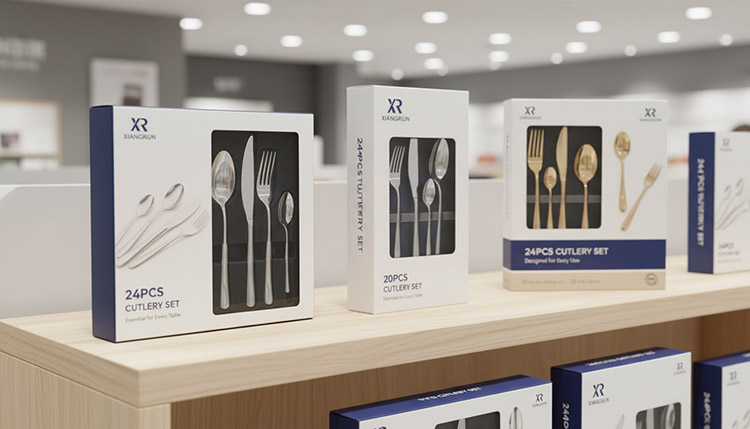
Here's a breakdown of the most common set configurations and their target audience.
16-Piece Set (Service for 4)
This is a popular entry-level option, perfect for singles, couples, or small families starting out. It's also a great way for customers to try a new design without a large investment.
- Includes: 4 dinner knives, 4 dinner forks, 4 dinner spoons, and 4 teaspoons.
- Suitable for: Small households, college students, and promotional price points.
24-Piece Set (Service for 6)
This is the most common and versatile retail option. It's a great all-rounder that fits the needs of the average family. It provides a complete setting for six people, which is ideal for both everyday meals and entertaining small groups.
- Includes: 6 dinner knives, 6 dinner forks, 6 dinner spoons, and 6 teaspoons.
- Suitable for: The majority of mid-range customers and family shoppers. This is the backbone of most supermarket flatware selections.
Larger Sets (30, 40, 48-Piece, etc.)
Larger sets are designed for bigger families or those who entertain frequently. They often include additional pieces like salad forks or soup spoons. While they have a higher price point, they offer great value on a per-piece basis.
- Suitable for: Premium collections, holiday gift programs, and warehouse club channels. These are excellent for building a high-end offering.
What Packaging Do Supermarket Flatware Programs Require?
For a retail buyer, packaging is not just a box; it's a critical part of the product. It must protect the flatware, attract the customer's eye on a crowded shelf, communicate key information, and meet logistical requirements.
Your packaging must be retail-ready, informative, and aligned with your brand. Key considerations include the box style (e.g., color box, window box), the information printed on it (material, barcode), and any private label branding requirements.
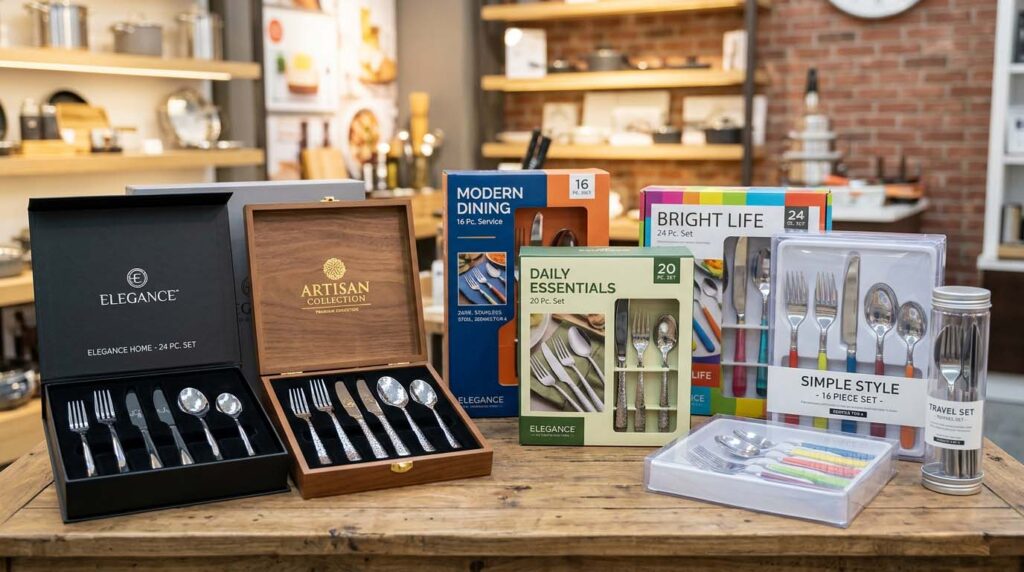
As a private label flatware manufacturer, we work closely with supermarket buyers on packaging every day. Here’s what you need to have on your checklist.
Retail Packaging Styles
- Color Box: The most common option. A fully printed cardboard box that allows for rich graphics and branding.
- Window Box: A color box with a transparent plastic window. This is highly effective as it allows customers to see the actual product design and finish, increasing purchase confidence.
- Gift Box: A more rigid, higher-quality box, often with inserts to hold each piece securely. Essential for premium and gift-oriented sets.
- PVC Box / Blister Pack: Cost-effective transparent packaging, often used for entry-level or promotional items.
Essential Information on Packaging
To be effective in a retail setting, the packaging must clearly display:
- Product Name & Description
- Material Grade (e.g., "18/10 Stainless Steel")
- Quantity / Set Configuration (e.g., "24-Piece Set / Service for 6")
- Key Product Features (e.g., "Dishwasher Safe," "Mirror Finish")
- Care Instructions
- Brand Logo
- Barcode (UPC/EAN) for scanning at checkout.
Private Label Packaging
For supermarket chains and brands developing their own lines, packaging is a key differentiator. A good supplier should support full customization, including:
- Using your brand's specific colors, fonts, and logo.
- Incorporating your own product photography.
- Adding custom inserts, thank you cards, or brand story information.
- Meeting specific logistical needs, like applying Amazon FBA labels.
What Quality Standards Are Critical in this Flatware Buying Guide for Supermarkets?
A beautiful sample means nothing if the bulk production doesn't match it. Inconsistent quality is a fast way to generate customer complaints, increase returns, and damage your store's reputation. Establishing and verifying quality standards is non-negotiable.
You must insist on a robust quality control process that covers material composition, surface quality, and functional performance. This should be verified through documentation and a multi-stage inspection process.

A professional manufacturer should have a comprehensive QC system. At XR Cutlery, our process includes checks at every stage, from raw material arrival to pre-shipment inspection. Here’s what you should be looking for.
Material Testing & Compliance
The first step is verifying the raw materials. Your supplier should be able to provide documentation confirming the stainless steel composition.
- What to check: Ask for material test reports to confirm the grade (18/10, 18/8, 18/0).
- Food Contact Compliance: Ensure the products can meet international food-grade standards like FDA (for the US) and LFGB (for the EU). We routinely provide these certifications for our clients.
Surface Quality Inspection
This is where the perceived quality is most apparent to the customer. Inspections should be done under good lighting.
- Polishing: Look for a uniform, consistent polish without dark spots or "wavy" distortions.
- Scratches & Defects: Check for deep scratches, pits, or rough edges, especially on the tines of forks and the bowl of spoons. The edges should be smooth to the touch.
- Color Consistency: For PVD-coated flatware (gold, black), check for uniform color across all pieces in a set.
Functional & Structural Testing
Flatware needs to perform its job without failing.
- Handle Strength: The joint between the handle and the head of the fork or spoon should be strong. Try to bend it with reasonable force; it shouldn't give easily.
- Weight & Balance: A well-made piece of flatware has a pleasant weight and feels balanced in the hand. It shouldn't feel flimsy or overly heavy at one end.
- Dishwasher Performance: Confirm that the flatware is rated for residential dishwashers. For PVD-coated items, ask about the coating's durability and resistance to fading.
How Do You Choose a Reliable Supermarket Flatware Supplier?
Your choice of supplier is the single most important decision in this process. A great partner brings not just a product, but also expertise, reliability, and stability to your supply chain, while a poor one can cause endless headaches.
Look for a supplier with deep manufacturing experience, proven production capability, strong customization support, and a transparent quality control system. These are the pillars of a successful long-term partnership.

As a flatware supplier China with over two decades of export experience, we know what separates a transactional order-taker from a true manufacturing partner.
Manufacturing and Export Experience
- Years in Business: Look for factories with at least 10-20 years of experience. This indicates they have navigated market changes and have stable processes.
- Export Markets: A supplier familiar with the standards and aesthetics of your target market (e.g., Europe, North America, Middle East) will be easier to work with.
- Customer Base: Ask if they work with other importers, retail chains, or brands. This demonstrates their ability to meet commercial standards.
Production Capability
Your supplier must be able to handle your volume, especially during peak seasons.
- Factory Size & Staff: A larger facility with a skilled workforce (we have over 120 staff and 8,000+㎡ of workshop space) is a good sign.
- Monthly Capacity: Ask for their monthly output. A high capacity (our factory produces over 5 million pieces per month) ensures they can scale with your business and handle large orders without compromising lead times.
- Equipment: A mix of automated machinery for consistency and manual finishing for detail work is often the ideal combination for quality flatware.
Customization Ability (OEM/ODM)
Your supplier should be more than a catalog. A strong partner can help you build your brand.
- OEM Support: They must be able to execute your requests for custom logos, packaging, colors, and finishes.
- ODM Support: The best suppliers have an R&D team that can help you develop new designs from a sketch, photo, or sample, helping you create exclusive private label flatware.
Stable Quality Control System
Ask them to walk you through their QC process. A professional factory will have multiple inspection points, including:
- Raw Material Inspection
- In-Process Inspection (after stamping, polishing, etc.)
- Finished Product Inspection
- Pre-Shipment Final Inspection
What Common Mistakes Should Supermarket Buyers Avoid?
After working with hundreds of buyers, we've seen a few common traps that can hinder the success of a flatware program. Avoiding these pitfalls is just as important as following the best practices.
The three most common and costly mistakes are focusing only on the lowest price, underestimating the importance of packaging, and over-complicating the initial product assortment.

Learning from the experience of other retail buyers can give you a significant advantage.
Choosing Only the Lowest Price
While cost is critical, making it the only factor is a recipe for failure. The lowest-priced quote often comes from factories cutting corners on material thickness, polishing quality, or QC inspections. This can lead to:
- Poor Finishes: Rough edges and inconsistent polishing that customers notice.
- Higher Complaint Rates: Increased customer service workload and returns.
- Damaged Brand Reputation: Shoppers associate the poor quality with your store brand.
A slightly higher-cost product from a reliable manufacturer often yields a much higher ROI through fewer returns and greater customer satisfaction.
Ignoring the Impact of Packaging
In a self-service retail environment, the package is your silent salesperson. Buyers sometimes focus 100% on the flatware and simply ask for the "cheapest box." This is a mistake. Customers often judge the quality of the product inside by the quality of the packaging outside. A flimsy, poorly designed box can make even a high-quality flatware set look cheap.
Selecting Too Many Designs at Once
It's tempting to want to offer a huge variety, but this can be a logistical nightmare. Launching with too many SKUs at once leads to:
- Increased Inventory Pressure: More capital tied up in stock.
- Higher Management Complexity: More barcodes, inventory locations, and sales data to track.
- Customer Choice Paralysis: Too many options can sometimes confuse shoppers.
It's a much safer and more effective strategy to start with a few proven designs in the classic and modern categories. Once you have sales data on what works for your customers, you can strategically expand your collection.
How Can Supermarkets Create a Private Label Flatware Collection?
Developing an exclusive private label collection is one of the most effective ways for a supermarket or retailer to stand out. It allows you to offer a unique product, control the branding, and achieve higher margins.
Creating a private label flatware line is a collaborative process between you and a capable OEM/ODM manufacturer. You can customize everything from handle designs and finishes to logos and packaging to create a collection that is exclusively yours.

This process is more accessible than many buyers think, especially when working with an experienced partner. Here's how we typically support our clients in building their brands.
The core of private labeling is customization. A good stainless steel cutlery manufacturer should offer a wide range of options to help you build a unique product line.
- Custom Handle Designs: While many clients start with our existing molds, we have full ODM capabilities to develop a completely new handle shape based on your drawings, samples, or ideas. This is the ultimate form of differentiation.
- Special Finishes & Colors: Go beyond the standard mirror polish. We can apply various finishes like matte/satin, vintage stone wash, or artisanal hammered textures. Furthermore, our PVD coating technology allows for durable and food-safe colors like gold, black, rose gold, and champagne.
- Logo Application: We can apply your brand logo via laser engraving for a subtle, premium mark or by stamping it into the steel during production for a more traditional, embossed feel.
- Customized Packaging: As discussed, this is crucial. We will work with you to create a box that reflects your brand's identity, using your logos, color schemes, and marketing messages to create a retail-ready product that tells your brand's story.
By combining these elements, you can move from being a reseller of generic products to the owner of a unique, branded collection that drives customer loyalty and profitability.
Frequently Asked Questions
What's the main difference between 18/10 and 18/0 stainless steel flatware?
The main difference is the nickel content. 18/10 stainless steel contains 10% nickel, offering superior rust resistance and a brighter shine, making it ideal for premium lines. 18/0 contains no nickel, making it more affordable and perfect for high-volume, entry-level programs.
What is a typical minimum order quantity (MOQ) for custom flatware?
MOQ varies by supplier and complexity. For sets using existing designs, MOQs can be relatively low. For a completely new design requiring a new mold (ODM), the MOQ will be higher to cover development costs. It's best to discuss your specific project with your bulk flatware supplier.
Can you produce flatware that meets FDA and LFGB standards?
Yes. A reputable international supplier must be able to meet these standards. At XR Cutlery, we regularly produce flatware for the US and EU markets and can provide the necessary documentation to certify that our products comply with FDA and LFGB food contact safety regulations. Always verify this with any potential supplier.
How do I get a quote for a wholesale flatware order?
To get an accurate quote, you should provide the supplier with your desired material (e.g., 18/8), the set configuration (e.g., 24-piece), the approximate order quantity, the design you are interested in, and your packaging requirements. The more details you provide, the faster and more accurate the quote will be.
Conclusion
Building a successful supermarket flatware program is a science. It requires moving beyond simple price comparisons and adopting a strategic approach. By carefully segmenting your customer base, selecting the appropriate materials and designs for each tier, and insisting on quality packaging and reliable manufacturing, you can create a profitable and sustainable tableware category. We hope this flatware buying guide for supermarkets has provided a clear roadmap for your procurement process. The key takeaway is to find a balance between all these factors and, most importantly, to choose a manufacturing partner who understands the needs of the retail market.
As a leading stainless steel cutlery manufacturer with over 20 years of experience partnering with importers, retailers, and private label brands worldwide, we specialize in this process. If you're looking for a reliable wholesale flatware supplier to help build your next collection, contact us to discuss your project.